Question: Case Problem STEELEY ASSOCIATES VERSUS CONCORD FALLS Steeley can sell the property at that point. However, the rejection of the permit will undoubtedly decrease the
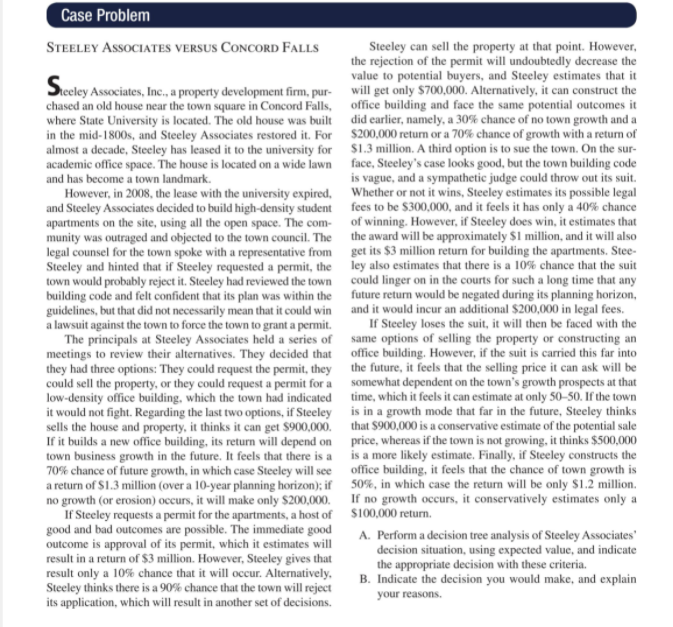
Case Problem STEELEY ASSOCIATES VERSUS CONCORD FALLS Steeley can sell the property at that point. However, the rejection of the permit will undoubtedly decrease the value to potential buyers, estimates that it Secley Associates, Ine, a property development firm, pur- will get only $700,00. Alternatively, we can construct the chased an old house near the town square in Concord Falls, office building and face the same potential outcomes it where State University is located. The old house was built did earlier, namely, a 30% chance of no town growth and a in the mid-1800s, and Steeley Associates restored it. For $200,000 return or a 70% chance of growth with a retum of almost a decade, Steeley has leased it to the university for $1.3 million. A third option is to sue the town. On the sur- academic office space. The house is located on a wide Iawn face, Steeley's case looks good, but the town building code and has become a town landmark. is vague, and a sympathetic judge could throw out its suit. However, in 2008, the lease with the university expired. Whether or not it wins, Steeley estimates its possible legal and Steeley Associates decided to build high-density student fees to be $300,000, and it feels it has only a 40% chance apartments on the site, using all the open space. The com- of winning. However, if Steeley does win, it estimates that munity was outraged and objected to the town council. The the award will be approximately $1 million, and it will also legal counsel for the town spoke with a representative from get its $3 million return for building the apartments. Stee. Steeley and hinted that if Steeley requested a permit, the ley also estimates that there is a 10% chance that the suit town would probably reject it. Steeley had reviewed the town could linger on in the courts for such a long time that any building code and felt confident that its plan was within the future return would be negated during its planning horizon, guidelines, but that did not necessarily mean that it could win and it would incur an additional $200,000 in legal fees. a lawsuit against the town to force the town to grant a permit. If Steeley loses the suit, it will then be faced with the The principals at Steeley Associates held a series of same options of selling the property or constructing an meetings to review their alternatives. They decided that office building. However, if the suit is carried this far into they had three options: They could request the permit, they the future, it feels that the selling price it can ask will be could sell the property, or they could request a permit for a somewhat dependent on the town's growth prospects at that low-density office building, which the town had indicated time, which it feels it can estimate at only 50-50. If the town it would not fight. Regarding the last two options, if Steeley is in a growth mode that far in the future, Steeley thinks sells the house and property, it thinks it can get $900,000. that $900,000 is a conservative estimate of the potential sale If it builds a new office building, its return will depend on price, whereas if the town is not growing, it thinks $500,000 town business growth in the future. It feels that there is a is a more likely estimate. Finally, if Steeley constructs the 70% chance of future growth, in which case Steeley will see office building, it feels that the chance of town growth is a return of $1.3 million (over a 10-year planning horizon); if 50%, in which case the return will be only $1.2 million no growth (or erosion) occurs, it will make only $200,000. If no growth occurs, it conservatively estimates only a If Steeley requests a permit for the apartments, a host of $100,000 return. good and bad outcomes are possible. The immediate good A. Perform a decision tree analysis of Steeley Associates outcome is approval of its permit, which it estimates will decision situation, using expected value, and indicate result in a return of $3 million. However, Steeley gives that result only a 10% chance that it will occur. Alternatively, the appropriate decision with these criteria. Steeley thinks there is a 90% chance that the town will reject B. Indicate the decision you would make, and explain its application, which will result in another set of decisions. your reasons




