



Question: case question 2,3,4,5 CASE 13.2 DONOR ADVISED FUNDS: DO DONORS KNOW BEST? The Pacific Coast Community Foundation (PCCF) had been formed in 1985 to charitably
case question 2,3,4,5 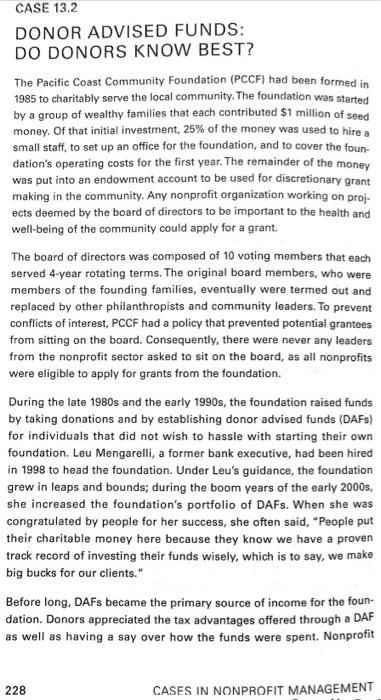
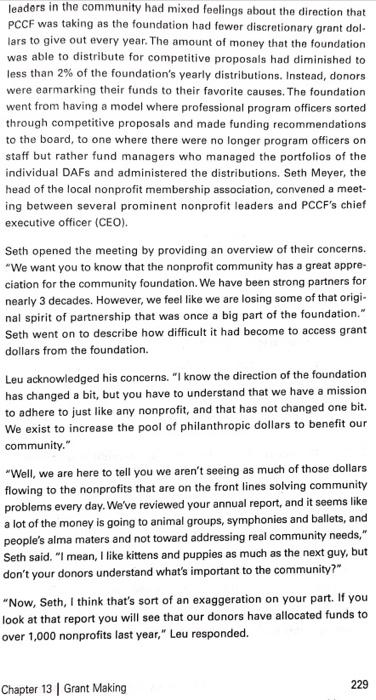
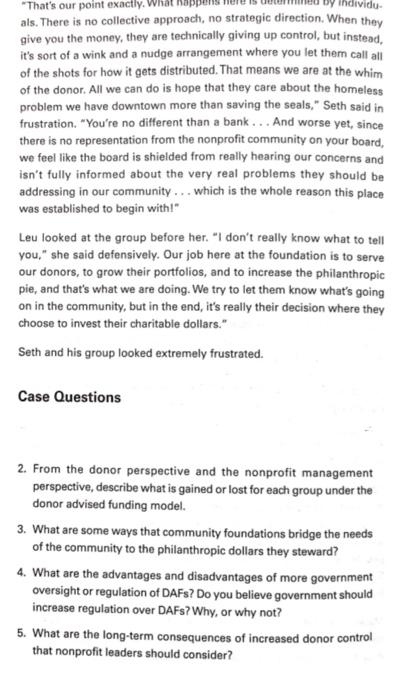
CASE 13.2 DONOR ADVISED FUNDS: DO DONORS KNOW BEST? The Pacific Coast Community Foundation (PCCF) had been formed in 1985 to charitably serve the local community. The foundation was started by a group of wealthy families that each contributed $1 million of seed money. Of that initial investment, 25% of the money was used to hire a small staff, to set up an office for the foundation, and to cover the foun- dation's operating costs for the first year. The remainder of the money was put into an endowment account to be used for discretionary grant making in the community. Any nonprofit organization working on proj- ects deemed by the board of directors to be important to the health and well-being of the community could apply for a grant. The board of directors was composed of 10 voting members that each served 4-year rotating terms. The original board members, who were members of the founding families, eventually were termed out and replaced by other philanthropists and community leaders. To prevent conflicts of interest, PCCF had a policy that prevented potential grantees from sitting on the board. Consequently, there were never any leaders from the nonprofit sector asked to sit on the board, as all nonprofits were eligible to apply for grants from the foundation. During the late 1980s and the early 1990s, the foundation raised funds by taking donations and by establishing donor advised funds (DAFs) for individuals that did not wish to hassle with starting their own foundation. Leu Mengarelli, a former bank executive, had been hired in 1998 to head the foundation. Under Leu's guidance, the foundation grew in leaps and bounds; during the boom years of the early 2000s, she increased the foundation's portfolio of DAFs. When she was congratulated by people for her success, she often said, "People put their charitable money here because they know we have a proven track record of investing their funds wisely, which is to say, we make big bucks for our clients." Before long, DAFs became the primary source of income for the foun- dation. Donors appreciated the tax advantages offered through a DAF as well as having a say over how the funds were spent. Nonprofit 228 CASES IN NONPROFIT MANAGEMENT leaders in the community had mixed feelings about the direction that PCCF was taking as the foundation had fewer discretionary grant dol- lars to give out every year. The amount of money that the foundation was able to distribute for competitive proposals had diminished to less than 2% of the foundation's yearly distributions. Instead, donors. were earmarking their funds to their favorite causes. The foundation went from having a model where professional program officers sorted through competitive proposals and made funding recommendations to the board, to one where there were no longer program officers on staff but rather fund managers who managed the portfolios of the individual DAFs and administered the distributions. Seth Meyer, the head of the local nonprofit membership association, convened a meet- ing between several prominent nonprofit leaders and PCCF's chief executive officer (CEO). Seth opened the meeting by providing an overview of their concerns. "We want you to know that the nonprofit community has a great appre- ciation for the community foundation. We have been strong partners for nearly 3 decades. However, we feel like we are losing some of that origi- nal spirit of partnership that was once a big part of the foundation." Seth went on to describe how difficult it had become to access grant dollars from the foundation. Leu acknowledged his concerns. "I know the direction of the foundation has changed a bit, but you have to understand that we have a mission to adhere to just like any nonprofit, and that has not changed one bit. We exist to increase the pool of philanthropic dollars to benefit our community." "Well, we are here to tell you we aren't seeing as much of those dollars flowing to the nonprofits that are on the front lines solving community problems every day. We've reviewed your annual report, and it seems like a lot of the money is going to animal groups, symphonies and ballets, and people's alma maters and not toward addressing real community needs," Seth said. "I mean, I like kittens and puppies as much as the next guy, but don't your donors understand what's important to the community?" "Now, Seth, I think that's sort of an exaggeration on your part. If you look at that report you will see that our donors have allocated funds to over 1,000 nonprofits last year," Leu responded. Chapter 13 | Grant Making 229 individu- "That's our point exactly. What hap als. There is no collective approach, no strategic direction. When they give you the money, they are technically giving up control, but instead, it's sort of a wink and a nudge arrangement where you let them call all of the shots for how it gets distributed. That means we are at the whim of the donor. All we can do is hope that they care about the homeless problem we have downtown more than saving the seals," Seth said in frustration. "You're no different than a bank... And worse yet, since there is no representation from the nonprofit community on your board, we feel like the board is shielded from really hearing our concerns and isn't fully informed about the very real problems they should be addressing in our community... which is the whole reason this place was established to begin with!" Leu looked at the group before her. "I don't really know what to tell you," she said defensively. Our job here at the foundation is to serve our donors, to grow their portfolios, and to increase the philanthropic pie, and that's what we are doing. We try to let them know what's going on in the community, but in the end, it's really their decision where they choose to invest their charitable dollars." Seth and his group looked extremely frustrated. Case Questions 2. From the donor perspective and the nonprofit management perspective, describe what is gained or lost for each group under the donor advised funding model. 3. What are some ways that community foundations bridge the needs of the community to the philanthropic dollars they steward? 4. What are the advantages and disadvantages of more government oversight or regulation of DAFs? Do you believe government should increase regulation over DAFs? Why, or why not? 5. What are the long-term consequences of increased donor control that nonprofit leaders should consider
Step by Step Solution
There are 3 Steps involved in it
1 Expert Approved Answer
Step: 1 Unlock

Question Has Been Solved by an Expert!
Get step-by-step solutions from verified subject matter experts
Step: 2 Unlock
Step: 3 Unlock