



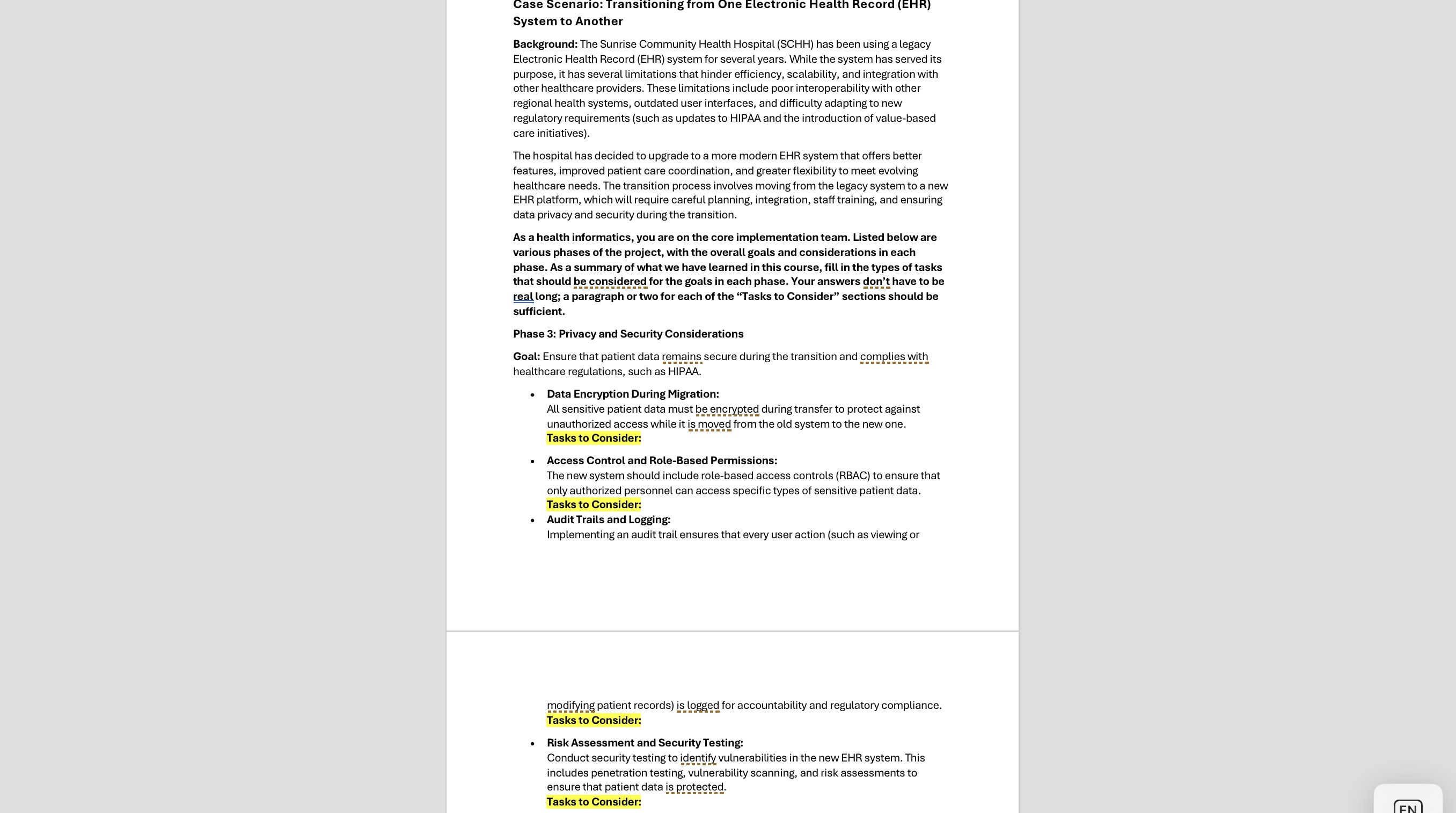
Question: Case Scenario: Transitioning from One Electronic Health Record ( EHR ) System to Another Background: The Sunrise Community Health Hospital ( SCHH ) has been
Case Scenario: Transitioning from One Electronic Health Record EHR System to Another
Background: The Sunrise Community Health Hospital SCHH has been using a legacy Electronic Health Record EHR system for several years. While the system has served its purpose, it has several limitations that hinder efficiency, scalability, and integration with other healthcare providers. These limitations include poor interoperability with other regional health systems, outdated user interfaces, and difficulty adapting to new regulatory requirements such as updates to HIPAA and the introduction of valuebased care initiatives
The hospital has decided to upgrade to a more modern EHR system that offers better features, improved patient care coordination, and greater flexibility to meet evolving healthcare needs. The transition process involves moving from the legacy system to a new EHR platform, which will require careful planning, integration, staff training, and ensuring data privacy and security during the transition.
As a health informatics, you are on the core implementation team. Listed below are various phases of the project, with the overall goals and considerations in each phase. As a summary of what we have learned in this course, fill in the types of tasks that should be considered for the goals in each phase. Your answers don't have to be real long; a paragraph or two for each of the "Tasks to Consider" sections should be sufficient.
Phase : Privacy and Security Considerations
Goal: Ensure that patient data remains secure during the transition and complies with healthcare regulations, such as HIPAA.
Data Encryption During Migration: All sensitive patient data must be encrypted during transfer to protect against unauthorized access while it is moved from the old system to the new one. Tasks to Consider:
Access Control and RoleBased Permissions: The new system should include rolebased access controls RBAC to ensure that only authorized personnel can access specific types of sensitive patient data. Tasks to Consider:
Audit Trails and Logging: Implementing an audit trail ensures that every user action such as viewing or
Risk Assessment and Security Testing:
Conduct security testing to identify vulnerabilities in the new EHR system. This includes penetration testing, vulnerability scanning, and risk assessments to ensure that patient data is protected. Tasks to Consider:
Step by Step Solution
There are 3 Steps involved in it
1 Expert Approved Answer
Step: 1 Unlock

Question Has Been Solved by an Expert!
Get step-by-step solutions from verified subject matter experts
Step: 2 Unlock
Step: 3 Unlock