Question: CASE STUDY 1: GLOBALIZATION US the Who Makes the Apple iPhone? In its carly days. Apple usually didn't look beyond its Steve Jobs demanded that
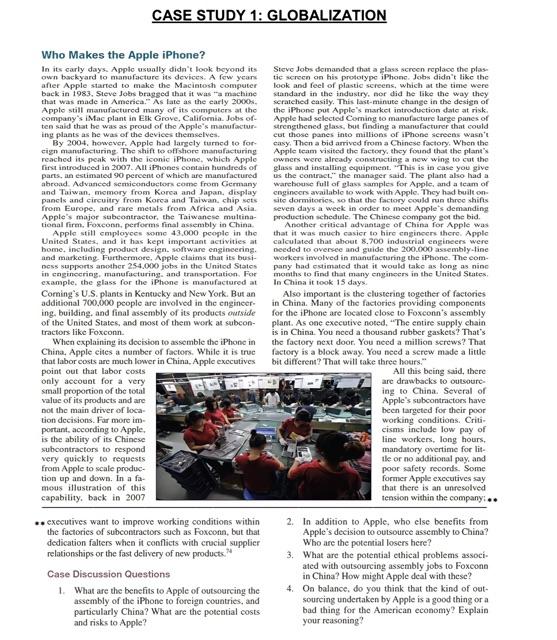
CASE STUDY 1: GLOBALIZATION US the Who Makes the Apple iPhone? In its carly days. Apple usually didn't look beyond its Steve Jobs demanded that a glass screen replace the plas own backyard to manufacture its devices. A few years tic screen on his prototype iPhone Jobs didn't like the after Apple started to make the Macintosh computer look and feel of plastic screens, which at the time were back in 1983. Steve Jobs bragged that it was a machine standard in the industry. nor did he like the way they that was made in America." As Late as the early 20% scratched easily. This last-minute change in the design of Apple still manufactured many of its computers at the the iPhone Apple Apple's market introduction date at risk. had ten said that he was as proud of the Apple's ma manufactur strengthened glass, but finding a manufacturer that could ing plants as he was of the devices themselves. cut those panes into millions of iPhone screens wasn't By 2004 however. Apple had largely turned to for easy. Then a bid arrived from a Chinese factory, When the cign manufacturing. The shift to offshore manufacturing Apple cam visited the factory, they found that the plants reached its peak with the iconic iPhone, which Apple owners were already constructing a new wing a to cut the first introduced in 2007. All iPhones contain hundreds of glass and installing equipment. This is in case you give parts, an estimated 90 percent of which are manufactured contract the manager said. The plant also had a abroad. Advanced semiconductors come from Germany warehouse full of glass samples for Apple, and a team of and Taiwan, memory from Korea and Japan, display engineers available to work with Apple. They had built on panels and circuitry from Korea and Taiwan, chip sots site dormitorios, so that the factory could run three shifts from Europe and rare metals from Africa and Asia. seven days a week in order to meet Apple's demanding Apple's major subcontractor, the Taiwanese multina production schedule The Chinese company of the bid. Lional firm. Foxconn, performs final assembly in China Another critical advantage of China for Apple was Apple still employees wome43.000 people in the that it was much casier to hire engineers there. Apple United States, and it has kept important activities at calculated that about 8.700 industrial engineers were home, including product design software engineering. needed to oversee and guide the 200.000 assembly-line and marketing. Furthermore, Apple claims that its busi- workers involved in manufacturing the iPhone. The com- ness supports another 254.000 jobs in the United States pany had estimated that it would take as long as nine in engineering, manufacturing and transportation. For months to find that many engineers in the United States example, the glass for the iPhone is manufactured at In China it took 15 days Coming's U.S. plants in Kentucky and New York. But an Also important is the clustering together of factories additional 700,000 people are involved in the engineer in China. Many of the factories providing components ing, building, and final assembly of its products outside for the iPhone are located close to Foxconn's assembly of the United States, and most of them work at subcon- plant. As one executive noted, "The entire supply chain tractors like Foxconn. is in China. You need a thousand rubber gaskets? That's When explaining its decision to assemble the iPhone in the factory next door. You need a million screws? That China, Apple cites a number of factors. While it is true factory is a block away. You need a screw made a little that labor costs are much lower in China. Apple executives bit different? That will take three hours." point out that labor costs All this being said, there only account for a very are drawbacks to outsourc small proportion of the total ing to China. Several of value of its products and are Apple's subcontractors have not the main driver of loca- been targeted for their poor tion decisions. For more im working conditions. Criti portant, according to Apple. cisms include low pay of is the ability of its Chinese line workers, long hours. subcontractors to respond mandatory overtime for lit very quickly to requests ile or no additional pay, and from Apple to scale produce poor safety records. Some tion up and down. In a fa former Apple executives say mous illustration of this that there is an unresolved capability, back in 2007 tension within the companyi.. executives want to improve working conditions within the factories of subcontractors such as Foxconn, but that dedication falters when it conflicts with crucial supplier relationships or the fast delivery of new products. Case Discussion Questions 1. What are the benefits to Apple of outsourcing the assembly of the iPhone to foreign countries, and particularly China? What are the potential costs and risks to Apple? 2. In addition to Apple, who else benefits from Apple's decision to outsource assembly to China? Who are the potential losers here? 3. What are the potential ethical problems associ ated with outsourcing assembly jobs to Foxconn in China? How might Apple deal with these? 4. On balance. do you think that the kind of out- sourcing undertaken by Apple is a good thing or a bad thing for the American economy? Explain your reasoning









 Study Help