







Question: CASE STUDY 1: Glory Finds Solution in the Clouds In 2015 management decided the firm could not achieve its strategic goals of growing the business
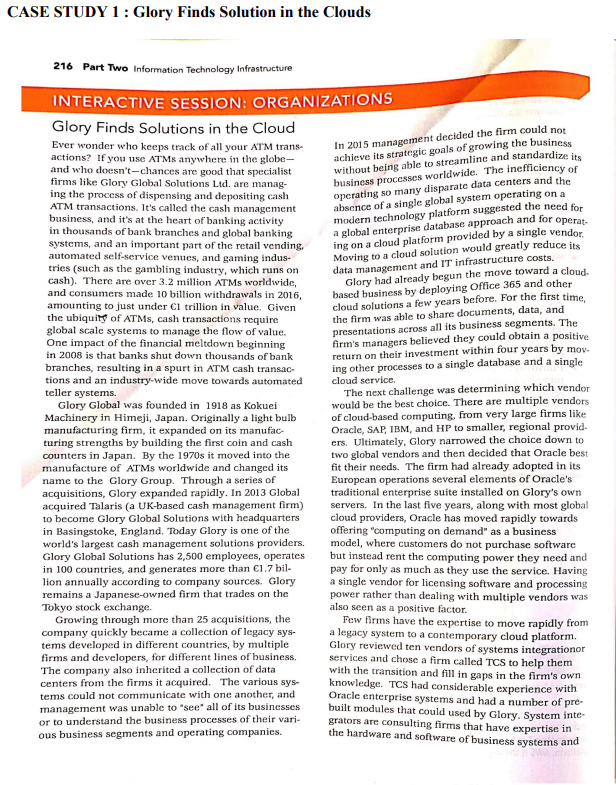
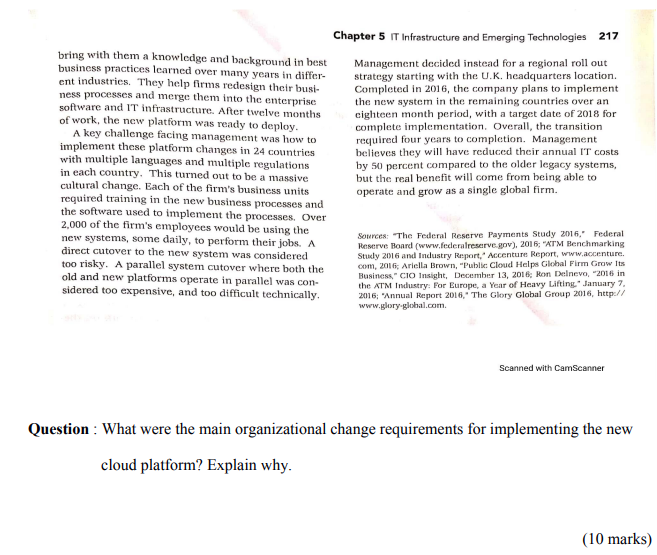
CASE STUDY 1: Glory Finds Solution in the Clouds In 2015 management decided the firm could not achieve its strategic goals of growing the business without being able to streamline and standardize its business processes worldwide. The inefficiency of operating so many disparate data centers and the absence of a single global system operating on a modern technology platform suggested the need for a global enterprise database approach and for operat ing on a cloud platform provided by a single vendor Moving to a cloud solution would greatly reduce its data management and IT infrastructure costs. Glory had already begun the move toward a cloud. based business by deploying Office 365 and other cloud solutions a few years before. For the first time, the firm was able to share documents, data, and presentations across all its business segments. The 216 Part Two Information Technology Infrastructure INTERACTIVE SESSION: ORGANIZATIONS Glory Finds Solutions in the Cloud Ever wonder who keeps track of all your ATM trans- actions? If you use ATMs anywhere in the globe- and who doesn't-chances are good that specialist firms like Glory Global Solutions Ltd. are manag- ing the process of dispensing and depositing cash ATM transactions. It's called the cash management business, and it's at the heart of banking activity in thousands of bank branches and global banking systems, and an important part of the retail vending, automated self-service venues, and gaming indus- tries (such as the gambling industry, which runs on cash). There are over 3.2 million ATMs worldwide, and consumers made 10 billion withdrawals in 2016, amounting to just under Ci trillion in value. Given the ubiquits of ATMs, cash transactions require global scale systems to manage the flow of value. One impact of the financial meltdown beginning firm's managers believed they could obtain a positive in 2008 is that banks shut down thousands of bank return on their investment within four years by mov. branches, resulting in a spurt in ATM cash transac ing other processes to a single database and a single tions and an industry-wide move towards automated cloud service. teller systems. The next challenge was determining which vendor Glory Global was founded in 1918 as Kokuei would be the best choice. There are multiple vendors Machinery in Himeji, Japan. Originally a light bulb of cloud-based computing, from very large firms like manufacturing firm, it expanded on its manufac- Oracle, SAP, IBM, and HP to smaller, regional provid. turing strengths by building the first coin and cash ers, Ultimately, Glory narrowed the choice down to counters in Japan. By the 1970s it moved into the two global vendors and then decided that Oracle best manufacture of ATMs worldwide and changed its fit their needs. The firm had already adopted in its name to the Glory Group. Through a series of European operations several elements of Oracle's acquisitions, Glory expanded rapidly. In 2013 Global traditional enterprise suite installed on Glory's own acquired Talaris (a UK-based cash management firm) servers. In the last five years, along with most global to become Glory Global Solutions with headquarters cloud providers, Oracle has moved rapidly towards in Basingstoke, England. Today Glory is one of the offering "computing on demand" as a business world's largest cash management solutions providers. model, where customers do not purchase software Glory Global Solutions has 2,500 employees, operates but instead rent the computing power they need and in 100 countries, and generates more than 1.7 bil- pay for only as much as they use the service. Having lion annually according to company sources. Glory a single vendor for licensing software and processing remains a Japanese-owned firm that trades on the power rather than dealing with multiple vendors was Tokyo stock exchange. also seen as a positive factor. Growing through more than 25 acquisitions, the Few firms have the expertise to move rapidly from company quickly became a collection of legacy sys- a legacy system to a contemporary cloud platform. tems developed in different countries, by multiple Glory reviewed ten vendors of systems integrationor firms and developers, for different lines of business. services and chose a firm called TCS to help them The company also inherited a collection of data with the transition and fill in gaps in the firm's own centers from the firms it acquired. The various sys- knowledge. TCS had considerable experience with tems could not communicate with one another, and Oracle enterprise systems and had a number of pre- management was unable to see all of its businesses built modules that could used by Glory. System inte- or to understand the business processes of their vari- grators are consulting firms that have expertise in ous business segments and operating companies. the hardware and software of business systems and bring with them a knowledge and background in best business practices learned over many years in differ- ent industries. They help firms redesign their busi- ness processes and merge them into the enterprise software and IT infrastructure. After twelve months of work, the new platform was ready to deploy. A key challenge facing management was how to implement these platform changes in 24 countries with multiple languages and multiple regulations in each country. This turned out to be a massive cultural change. Each of the firm's business units required training in the new business processes and the software used to implement the processes. Over 2,000 of the firm's employees would be using the new systems, some daily, to perform their jobs. A direct cutover to the new system was considered too risky. A parallel system cutover where both the old and new platforms operate in parallel was con sidered too expensive, and too difficult technically. Chapter 5 IT Infrastructure and Emerging Technologies 217 Management decided instead for a regional roll out strategy starting with the U.K. headquarters location. Completed in 2016, the company plans to implement the new system in the remaining countries over an cighteen month period, with a target date of 2018 for complete implementation. Overall, the transition required four years to completion Management believes they will have reduced their annual IT costs by 50 percent compared to the older legacy systems, but the real benefit will come from being able to operate and grow as a single global firm. Sources: "The Federal Reserve Payments Study 2016," Federal Reserve Board (www.federalreserve gov), 2016, "ATM Benchmarking Study 2016 and Industry Report, Accenture Report, www.accenture. com, 2016, Ariella Brown, "Public Cloud Helps Global Firm Grow Its Business," CIO Insight, December 13, 2016: Ron Delnevo, 2016 in the ATM Industry For Europe, a Year of Heavy Lifting January 7. 2016; Annual Report 2016, The Glory Global Group 2016, http:// www.glory-global.com Scanned with CamScanner Question : What were the main organizational change requirements for implementing the new cloud platform? Explain why. (10 marks)
Step by Step Solution
There are 3 Steps involved in it

Get step-by-step solutions from verified subject matter experts
 Study Help