







Question: Case Study 1 It is believed that children can throw a ball further after lunch than before lunch. A researcher decided to investigate this hypothesis
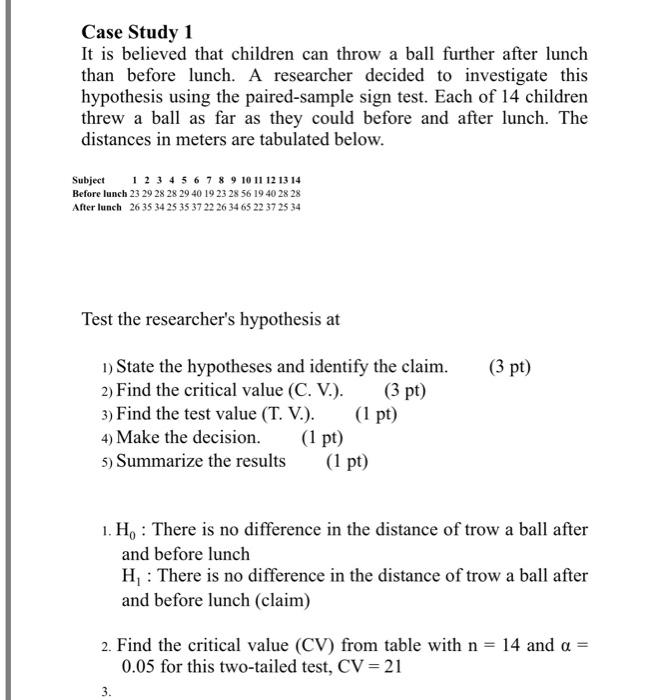
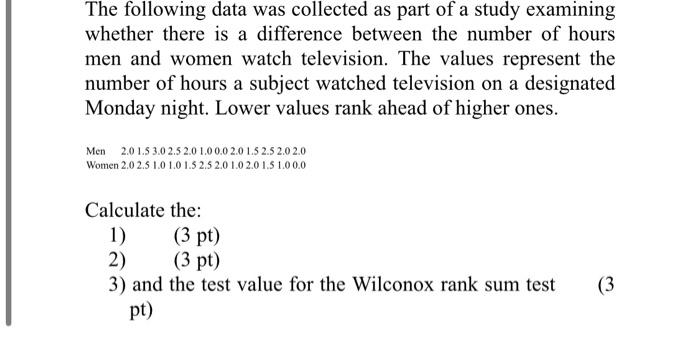
Case Study 1 It is believed that children can throw a ball further after lunch than before lunch. A researcher decided to investigate this hypothesis using the paired-sample sign test. Each of 14 children threw a ball as far as they could before and after lunch. The distances in meters are tabulated below. Subject 1 2 3 4 5 6 7 8 9 10 11 12 13 14 Before lunch 23 29 28 28 29 40 19 23 28 56 19 40 28 28 After lunch 26 35 34 25 35 37 22 26 34 65 22 37 25 34 Test the researcher's hypothesis at (3 pt) (3 pt) 1) State the hypotheses and identify the claim. 2) Find the critical value (C. V.). 3) Find the test value (T. V.). (1 pt) 4) Make the decision. (1 pt) 5) Summarize the results (1 pt) 1. H,: There is no difference in the distance of trow a ball after and before lunch H,: There is no difference in the distance of trow a ball after and before lunch (claim) 2. Find the critical value (CV) from table with n = 14 and a = 0.05 for this two-tailed test, CV = 21 3. The following data was collected as part of a study examining whether there is a difference between the number of hours men and women watch television. The values represent the number of hours a subject watched television on a designated Monday night. Lower values rank ahead of higher ones. Men 2.0 1.5 3.0 2.5 2.0 1.0 0.0 2.0 1.5 2.5 2.0 2.0 Women 2.0 2.5 1.0 1.0 1.5 2.5 2.0 1.0 2.0 1.5 1.00.0 Calculate the: 1) (3 pt) 2) (3 pt) 3) and the test value for the Wilconox rank sum test pt) (3
Step by Step Solution
There are 3 Steps involved in it

Get step-by-step solutions from verified subject matter experts
 Study Help