







Question: CASE STUDY 1 Knowledge Management and Collaboration at Tata Consulting Services Tata Consultancy Services (TCS) is an IT-services, business solutions, and outsourcing organization that offers
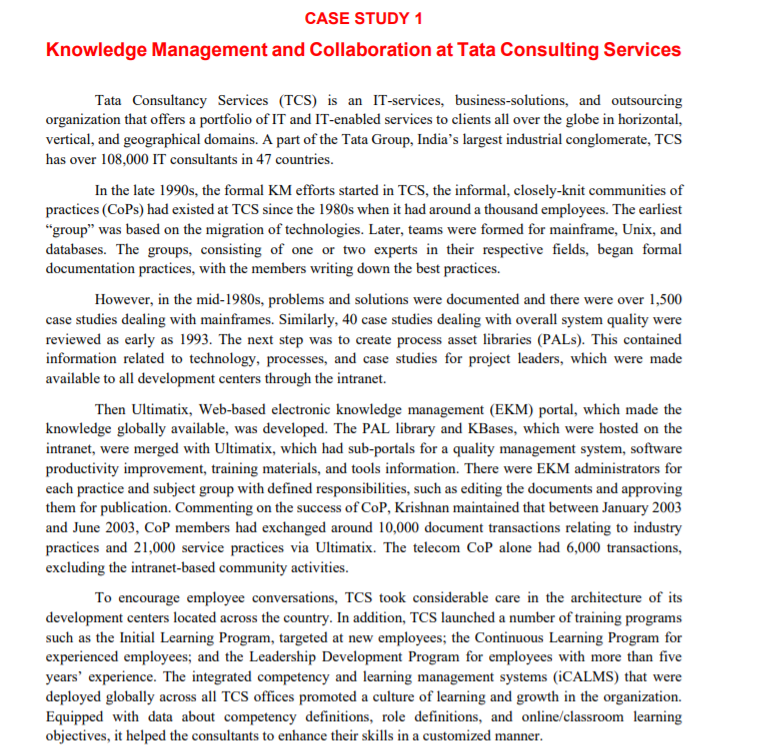
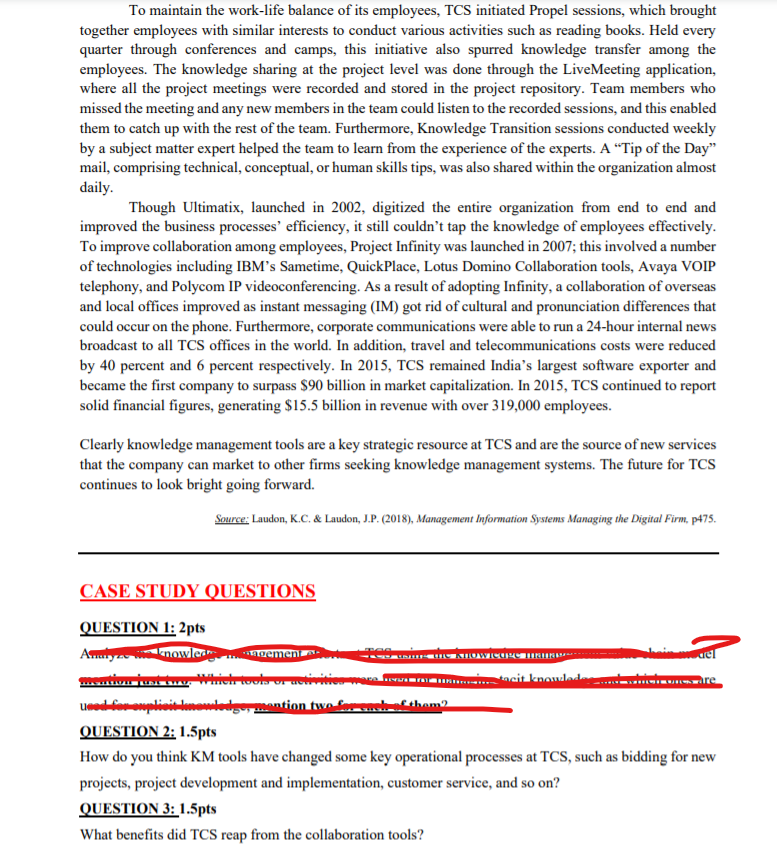
CASE STUDY 1 Knowledge Management and Collaboration at Tata Consulting Services Tata Consultancy Services (TCS) is an IT-services, business solutions, and outsourcing organization that offers a portfolio of IT and IT-enabled services to clients all over the globe in horizontal, vertical, and geographical domains. A part of the Tata Group, India's largest industrial conglomerate, TCS has over 108,000 IT consultants in 47 countries. In the late 1990s, the formal KM efforts started in TCS, the informal, closely-knit communities of practices (COPs) had existed at TCS since the 1980s when it had around a thousand employees. The earliest "group" was based on the migration of technologies. Later, teams were formed for mainframe, Unix, and databases. The groups, consisting of one or two experts in their respective fields, began formal documentation practices, with the members writing down the best practices. However, in the mid-1980s, problems and solutions were documented and there were over 1,500 case studies dealing with mainframes. Similarly, 40 case studies dealing with overall system quality were reviewed as early as 1993. The next step was to create process asset libraries (PALs). This contained information related to technology, processes, and case studies for project leaders, which were made available to all development centers through the intranet. Then Ultimatix, Web-based electronic knowledge management (EKM) portal, which made the knowledge globally available, was developed. The PAL library and KBases, which were hosted on the intranet, were merged with Ultimatix, which had sub-portals for a quality management system, software productivity improvement, training materials, and tools information. There were EKM administrators for each practice and subject group with defined responsibilities, such as editing the documents and approving them for publication. Commenting on the success of Cop, Krishnan maintained that between January 2003 and June 2003, CoP members had exchanged around 10,000 document transactions relating to industry practices and 21,000 service practices via Ultimatix. The telecom CoP alone had 6,000 transactions, excluding the intranet-based community activities. To encourage employee conversations, TCS took considerable care in the architecture of its development centers located across the country. In addition, TCS launched a number of training programs such as the Initial Learning Program, targeted at new employees; the Continuous Learning Program for experienced employees; and the Leadership Development Program for employees with more than five years' experience. The integrated competency and learning management systems (CALMS) that were deployed globally across all TCS offices promoted a culture of learning and growth in the organization. Equipped with data about competency definitions, role definitions, and online/classroom learning objectives, it helped the consultants to enhance their skills in a customized manner. To maintain the work-life balance of its employees, TCS initiated Propel sessions, which brought together employees with similar interests to conduct various activities such as reading books. Held every quarter through conferences and camps, this initiative also spurred knowledge transfer among the employees. The knowledge sharing at the project level was done through the LiveMeeting application, where all the project meetings were recorded and stored in the project repository. Team members who missed the meeting and any new members in the team could listen to the recorded sessions, and this enabled them to catch up with the rest of the team. Furthermore, Knowledge Transition sessions conducted weekly by a subject matter expert helped the team to learn from the experience of the experts. A "Tip of the Day" mail, comprising technical, conceptual, or human skills tips, was also shared within the organization almost daily. Though Ultimatix, launched in 2002, digitized the entire organization from end to end and improved the business processes' efficiency, it still couldn't tap the knowledge of employees effectively. To improve collaboration among employees, Project Infinity was launched in 2007; this involved a number of technologies including IBM's Sametime, QuickPlace, Lotus Domino Collaboration tools, Avaya VOIP telephony, and Polycom IP videoconferencing. As a result of adopting Infinity, a collaboration of overseas and local offices improved as instant messaging (IM) got rid of cultural and pronunciation differences that could occur on the phone. Furthermore, corporate communications were able to run a 24-hour internal news broadcast to all TCS offices in the world. In addition, travel and telecommunications costs were reduced by 40 percent and 6 percent respectively. In 2015, TCS remained India's largest software exporter and became the first company to surpass $90 billion in market capitalization. In 2015, TCS continued to report solid financial figures, generating $15.5 billion in revenue with over 319,000 employees. Clearly knowledge management tools are a key strategic resource at TCS and are the source of new services that the company can market to other firms seeking knowledge management systems. The future for TCS continues to look bright going forward. Source: Laudon, K.C. & Laudon, J.P. (2018), Management Information Systems Managing the Digital Firm, p475. algement WOOD re CASE STUDY QUESTIONS QUESTION 1: 2 pts Annowleri CALEFETISHLAWIUNE tacit knowled unedfeenpliitunew mention two QUESTION 2: 1.5pts How do you think KM tools have changed some key operational processes at TCS, such as bidding for new projects, project development and implementation, customer service, and so on? QUESTION 3: 1.5pts What benefits did TCS reap from the collaboration tools
Step by Step Solution
There are 3 Steps involved in it
1 Expert Approved Answer
Step: 1 Unlock

Question Has Been Solved by an Expert!
Get step-by-step solutions from verified subject matter experts
Step: 2 Unlock
Step: 3 Unlock
 Study Help