







Question: Case Study 1 : Learning the Lessons of Apollo 13 Ron Howard's epic movie Apollo 23 recounts the ill-fated Apollo 13 mission to the moon,
Case Study 1 : Learning the Lessons of Apollo 13
Ron Howard's epic movie Apollo 23 recounts the ill-fated Apollo 13 mission to the moon, a mission that came close to causing the first loss of life in space for a United States astronaut. The astronauts were only a third of the way into the mission when one of the oxygen tanks in the command ship Odyssey exploded, crippling the spacecraft, and endangering the lives
of the crew. The story of Apollo 13 is one of hope, inspiration, and perseverance, and
one that holds many useful parallels for those in the field of information system
(IS) project management. What are these parallels? Consider the factors that contributed to the success of the Apollo program. Have a clear objective. More than anything else, having a clear objective helps to ensure a successful project. With the Apollo program, that objective
was to land a man on the moon and return him safely to earth, a goal that was achieved just seven short years after President Kennedy first issued the challenge to the nation and the world.
To be successful, IS projects must also have clear goals and objectives. A complete statement of a project's objectives, milestones, and requirements, embodied in a statement of work or similar contractual document, helps to ensure that everyone agrees on the purpose and deliverables of the project. This also keeps everyone focused on the business reason for doing the project
in the first place. Pick the best people. The Apollo astronauts were the best of the best. Selected from the top test and military pilots, they were the most highly qualified and capable people available. That level of excellence showed when it came to overcoming obstacles and achieving the impossible, as was often required to complete the Apollo missions. To achieve success in IS projects, we must also seek to employ the best people available, especially for the project manager and lead technical staff. We should seek to hire industry specialists with broad experience drawn from diverse assignments-people who can overcome the unexpected problems that occur in even the best planned project. By hiring the best, you acquire people who have already been tempered by the fires of adversity and have overcome them. Support them with the best team. No matter how good the astronauts were, they would never have been successful without the team that supported them and their mission. From the scientists and engineers who built the rockets, to the programmers who wrote the navigation programs, to the
seamstress who sewed the spacesuits, the success of the Apollo missions resulted from thousands of people pulling together to achieve something that once seemed impossible
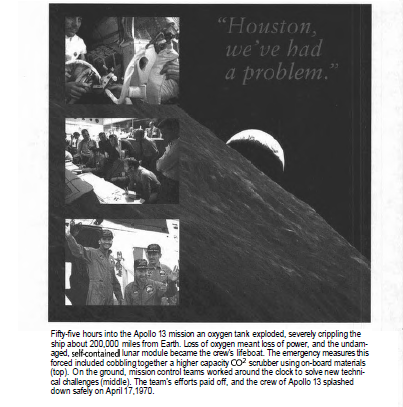
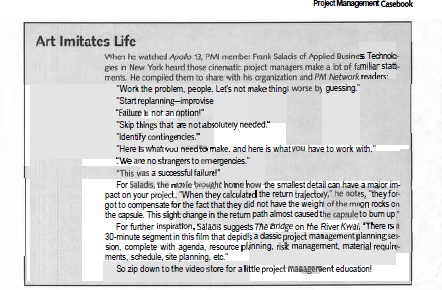
Houston, we've had a problem. Fifty-five hours into the Apollo 13 mission an oxygen tank exploded, severely crippling the ship about 200,000 miles from Earth. Loss of oxygen meant loss of power, and the undam- aged, self-contained lunar module became the crew's lifeboat. The emergency measures this forced induded cobbling together a higher capacity CO scrubber using on-board materials (top). On the ground, mission control teams worked around the clock to solve new techni- cal challenges (middle). The team's efforts paid off, and the crew of Apollo 13 splashed down safely on April 17,1970.ProjectManagement Casebock Art Imitates Life When he watched Apolo , PA member Frank Salads of Applied Busines Technolo gies in New York heard those cinematic project managers make a lot of familiar stan ments. He compiled them to share with his organization and PM Network readers: "Work the problem, people. Let's not make things worse by guessing." "Start replanning-improvise "Failure is not an option!" "Skip things that are notabsolutely needed." "Identify contingencies!" "Here Is what you need to make. and here is whatyou have to work with." "We are no strangers to emergencies." "This was a successful failure!" For Saladis, the movie brought home how the smallest detail can have a major im- pact on your project. "When they calculated the return trajectory," he notes, "they for got to compensate for the fact that they did not have the weight of the moon rocks on the capsule. This sight change in the return path almost caused the capsule to bum up," For further inspiration, Saladis suggests The oldge on the River Kwan "There is a 30-minute segment in this film that depidis a classic project management planning ses son, complete with agenda, resource planning, risk management, material require- ments, schedule, site planning, etc." So zip down to the video store for a little project managersent education!\f
Step by Step Solution
There are 3 Steps involved in it

Get step-by-step solutions from verified subject matter experts
 Study Help