



Question: Case Study 1: Nestl's approach to working with small farmers exemplifies the symbiotic relationship between social progress and competitive advantage. Ironically, while the company's reputation
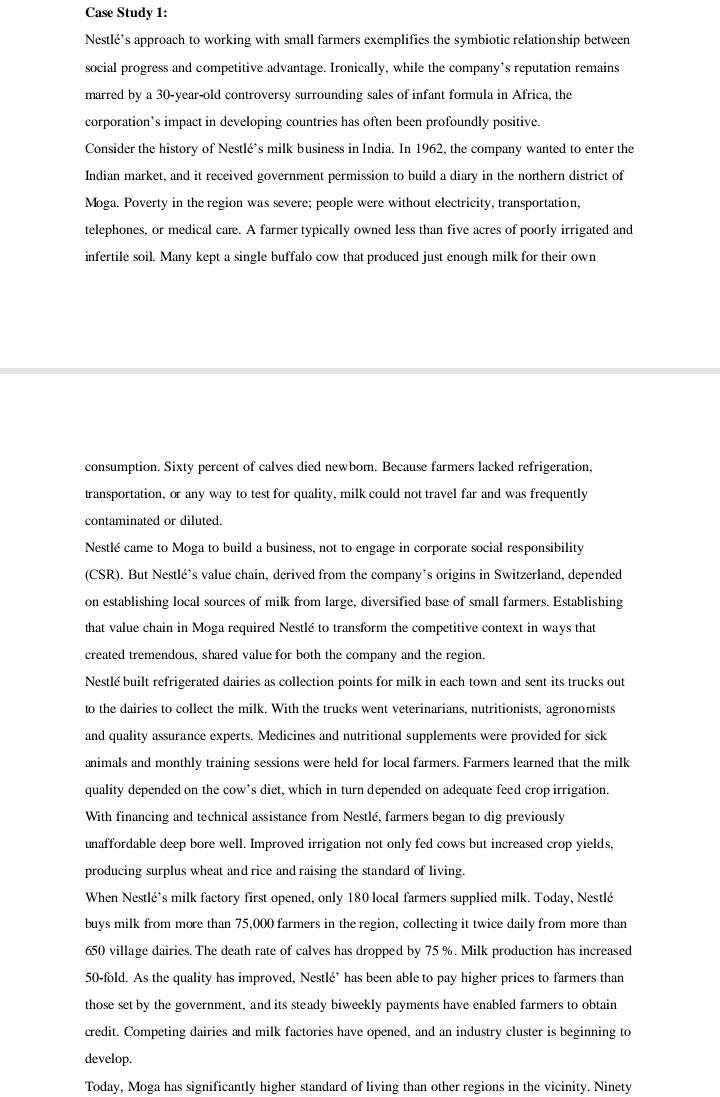
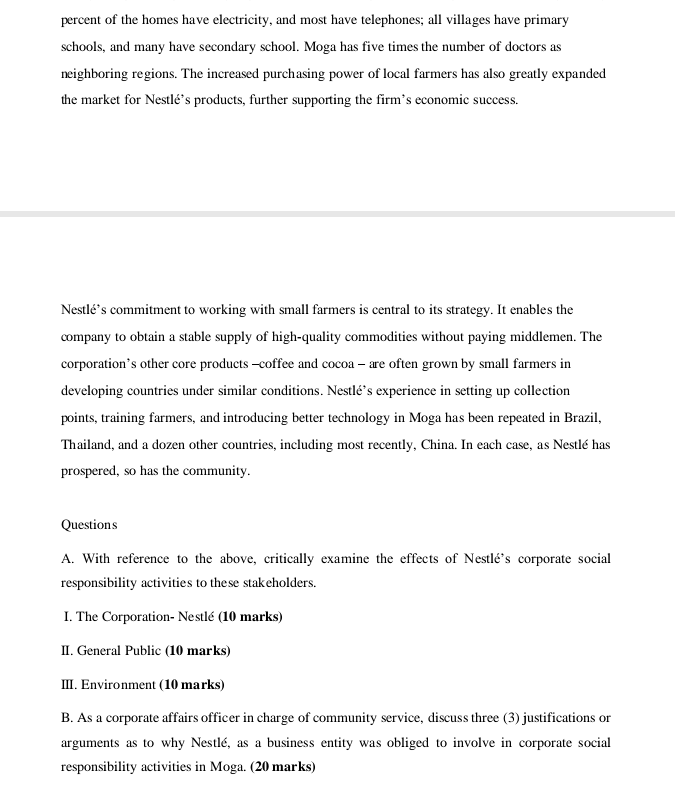
Case Study 1: Nestl's approach to working with small farmers exemplifies the symbiotic relationship between social progress and competitive advantage. Ironically, while the company's reputation remains marred by a 30-year-old controversy surrounding sales of infant formula in Africa, the corporation's impact in developing countries has often been profoundly positive. Consider the history of Nestl's milk business in India. In 1962, the company wanted to enter the Indian market, and it received government permission to build a diary in the northern district of Moga. Poverty in the region was severe; people were without electricity, transportation, telephones, or medical care. A farmer typically owned less than five acres of poorly irrigated and infertile soil. Many kept a single buffalo cow that produced just enough milk for their own consumption. Sixty percent of calves died newbom. Because farmers lacked refrigeration, transportation, or any way to test for quality, milk could not travel far and was frequently contaminated or diluted. Nestl came to Moga to build a business, not to engage in corporate social responsibility (CSR). But Nestle's value chain, derived from the company's origins in Switzerland, depended on establishing local sources of milk from large, diversified base of small farmers. Establishing that value chain in Moga required Nestl to transform the competitive context in ways that created tremendous, shared value for both the company and the region. Nestl built refrigerated dairies as collection points for milk in each town and sent its trucks out to the dairies to collect the milk. With the trucks went veterinarians, nutritionists, agronomists and quality assurance experts. Medicines and nutritional supplements were provided for sick animals and monthly training sessions were held for local farmers. Farmers learned that the milk quality depended on the cow's diet, which in turn depended on adequate feed crop irrigation. With financing and technical assistance from Nestl, farmers began to dig previously unaffordable deep bore well. Improved irrigation not only fed cows but increased crop yields, producing surplus wheat and rice and raising the standard of living. When Nestl's milk factory first opened, only 180 local farmers supplied milk. Today, Nestl buys milk from more than 75,000 farmers in the region, collecting it twice daily from more than 650 village dairies. The death rate of calves has dropped by 75 %. Milk production has increased 50-fold. As the quality has improved, Nestle has been able to pay higher prices to farmers than those set by the government, and its steady biweekly payments have enabled farmers to obtain credit. Competing dairies and milk factories have opened, and an industry cluster is beginning to develop Today, Moga has significantly higher standard of living than other regions in the vicinity. Ninety percent of the homes have electricity, and most have telephones; all villages have primary schools, and many have secondary school. Moga has five times the number of doctors as neighboring regions. The increased purchasing power of local farmers has also greatly expanded the market for Nestl's products, further supporting the firm's economic success. Nestl's commitment to working with small farmers is central to its strategy. It enables the company to obtain a stable supply of high-quality commodities without paying middlemen. The corporation's other core products -coffee and cocoa - are often grown by small farmers in developing countries under similar conditions. Nestl's experience in setting up collection points, training farmers, and introducing better technology in Moga has been repeated in Brazil, Thailand, and a dozen other countries, including most recently, China. In each case, as Nestl has prospered, so has the community. Questions A. With reference to the above, critically examine the effects of Nestl's corporate social responsibility activities to these stakeholders. I. The Corporation- Nestl (10 marks) II. General Public (10 marks) III. Environment (10 marks) B. As a corporate affairs officer in charge of community service, discuss three (3) justifications or arguments as to why Nestl, as a business entity was obliged to involve in corporate social responsibility activities in Moga. (20 marks)
Step by Step Solution
There are 3 Steps involved in it
1 Expert Approved Answer
Step: 1 Unlock

Question Has Been Solved by an Expert!
Get step-by-step solutions from verified subject matter experts
Step: 2 Unlock
Step: 3 Unlock