Question: Case Study #1: Project Scheduling *I've called this meeting to resolve a major problem with our management cost and control system (MCCS). remarked Wilfred Livingston,
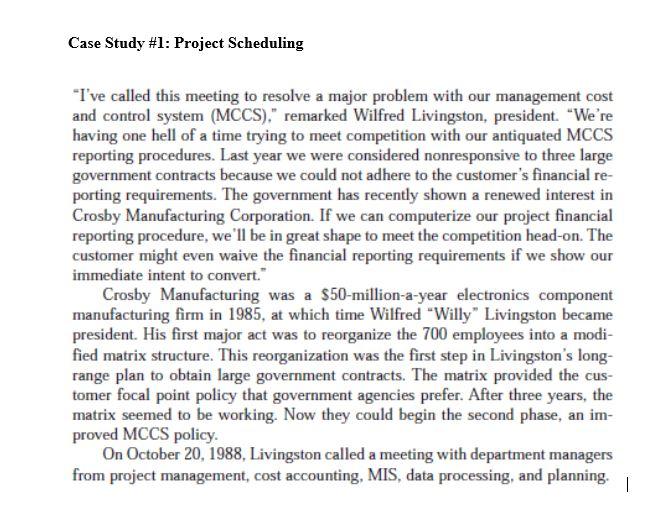
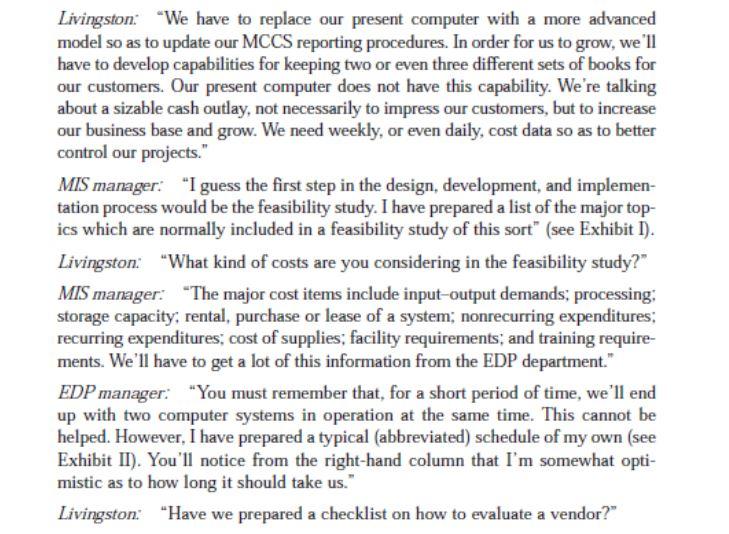
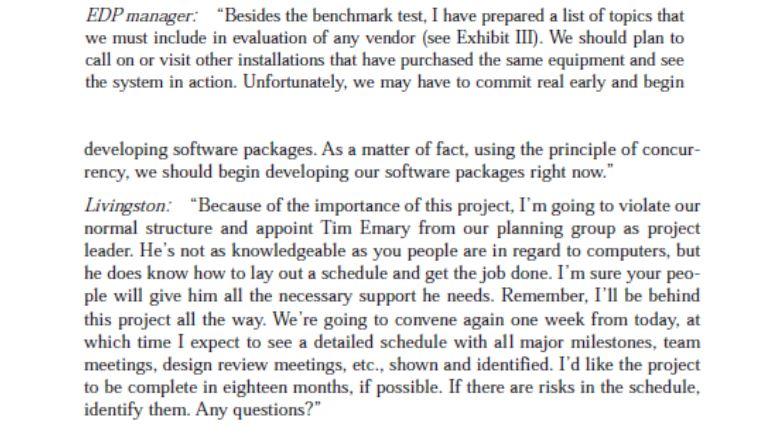
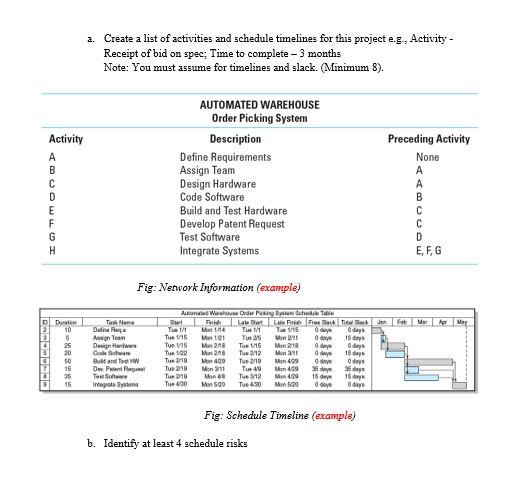
Case Study #1: Project Scheduling *I've called this meeting to resolve a major problem with our management cost and control system (MCCS)." remarked Wilfred Livingston, president. "We're having one hell of a time trying to meet competition with our antiquated MCCS reporting procedures. Last year we were considered nonresponsive to three large government contracts because we could not adhere to the customer's financial re- porting requirements. The government has recently shown a renewed interest in Crosby Manufacturing Corporation. If we can computerize our project financial reporting procedure, we'll be in great shape to meet the competition head-on. The customer might even waive the financial reporting requirements if we show our immediate intent to convert." Crosby Manufacturing was a $50-million-a-year electronics component manufacturing firm in 1985, at which time Wilfred "Willy" Livingston became president. His first major act was to reorganize the 700 employees into a modi- fied matrix structure. This reorganization was the first step in Livingston's long- range plan to obtain large government contracts. The matrix provided the cus- tomer focal point policy that government agencies prefer. After three years, the matrix seemed to be working. Now they could begin the second phase, an im- proved MCCS policy. On October 20, 1988, Livingston called a meeting with department managers from project management, cost accounting, MIS, data processing, and planning. | Livingston: "We have to replace our present computer with a more advanced model so as to update our MCCS reporting procedures. In order for us to grow, we'll have to develop capabilities for keeping two or even three different sets of books for our customers. Our present computer does not have this capability. We're talking about a sizable cash outlay, not necessarily to impress our customers, but to increase our business base and grow. We need weekly, or even daily, cost data so as to better control our projects." MIS manager: "I guess the first step in the design, development, and implemen- tation process would be the feasibility study. I have prepared a list of the major top- ics which are normally included in a feasibility study of this sort" (see Exhibit I). Livingston: "What kind of costs are you considering in the feasibility study?" MIS manager: "The major cost items include input-output demands; processing, storage capacity, rental, purchase or lease of a system, nonrecurring expenditures: recurring expenditures; cost of supplies, facility requirements, and training require- ments. We'll have to get a lot of this information from the EDP department." EDP manager: "You must remember that, for a short period of time, we'll end up with two computer systems in operation at the same time. This cannot be helped. However, I have prepared a typical (abbreviated) schedule of my own (see Exhibit II). You'll notice from the right-hand column that I'm somewhat opti- mistic as to how long it should take us." Livingston: "Have we prepared a checklist on how to evaluate a vendor?" EDP manager: "Besides the benchmark test, I have prepared a list of topics that we must include in evaluation of any vendor (see Exhibit III). We should plan to call on or visit other installations that have purchased the same equipment and see the system in action. Unfortunately, we may have to commit real early and begin developing software packages. As a matter of fact, using the principle of concur- rency, we should begin developing our software packages right now." Livingston: "Because of the importance of this project, I'm going to violate our normal structure and appoint Tim Emary from our planning group as project leader. He's not as knowledgeable as you people are in regard to computers, but he does know how to lay out a schedule and get the job done. I'm sure your peo- ple will give him all the necessary support he needs. Remember, I'll be behind this project all the way. We're going to convene again one week from today, at which time I expect to see a detailed schedule with all major milestones, team meetings, design review meetings, etc., shown and identified. I'd like the project to be complete in eighteen months, if possible. If there are risks in the schedule, identify them. Any questions?" a. Create a list of activities and schedule timelines for this project es, Activity - Receipt of bid on spec; Time to complete - 3 months Note: You must assume for timelines and slack. (Minimum 8). Activity A B C D E F G H AUTOMATED WAREHOUSE Order Picking System Description Define Requirements Assign Team Design Hardware Code Software Build and Test Hardware Develop Patent Request Test Software Integrate Systems In mo Preceding Activity None A A B C D E,F,G Fig: Network Information (Example) D 10 6 25 20 Afondled Whouse Order Paling System Schedule Table w Pich tar ut la Firen Free Back To Set Tul Man 14 Tue 11 Toins Ody Oy More! Tue 26 Mon 2011 deye 15 Tue 1/15 Men 2018 Tue 102 day M20 Tue 212 Men duy 15 de Tue 2/10 Mon 400 Tue 2/10 Min 42 daye Oy Tue 19 Mon 11 Tue 09 Man 15 days 25days Tue 210 Une Tue 112 Men 409 15 de 15 Tue 600 Mon 500 Tue 620 Men daye Oy Tuss Tue 16 Tane Duna in Tan Design Hard Code Satan Bus and Dw Patienten Tewww Integrate Med & 21 15 36 15 Fig: Schedule Timeline (example) b. Identify at least 4 schedule risks Case Study #1: Project Scheduling *I've called this meeting to resolve a major problem with our management cost and control system (MCCS)." remarked Wilfred Livingston, president. "We're having one hell of a time trying to meet competition with our antiquated MCCS reporting procedures. Last year we were considered nonresponsive to three large government contracts because we could not adhere to the customer's financial re- porting requirements. The government has recently shown a renewed interest in Crosby Manufacturing Corporation. If we can computerize our project financial reporting procedure, we'll be in great shape to meet the competition head-on. The customer might even waive the financial reporting requirements if we show our immediate intent to convert." Crosby Manufacturing was a $50-million-a-year electronics component manufacturing firm in 1985, at which time Wilfred "Willy" Livingston became president. His first major act was to reorganize the 700 employees into a modi- fied matrix structure. This reorganization was the first step in Livingston's long- range plan to obtain large government contracts. The matrix provided the cus- tomer focal point policy that government agencies prefer. After three years, the matrix seemed to be working. Now they could begin the second phase, an im- proved MCCS policy. On October 20, 1988, Livingston called a meeting with department managers from project management, cost accounting, MIS, data processing, and planning. | Livingston: "We have to replace our present computer with a more advanced model so as to update our MCCS reporting procedures. In order for us to grow, we'll have to develop capabilities for keeping two or even three different sets of books for our customers. Our present computer does not have this capability. We're talking about a sizable cash outlay, not necessarily to impress our customers, but to increase our business base and grow. We need weekly, or even daily, cost data so as to better control our projects." MIS manager: "I guess the first step in the design, development, and implemen- tation process would be the feasibility study. I have prepared a list of the major top- ics which are normally included in a feasibility study of this sort" (see Exhibit I). Livingston: "What kind of costs are you considering in the feasibility study?" MIS manager: "The major cost items include input-output demands; processing, storage capacity, rental, purchase or lease of a system, nonrecurring expenditures: recurring expenditures; cost of supplies, facility requirements, and training require- ments. We'll have to get a lot of this information from the EDP department." EDP manager: "You must remember that, for a short period of time, we'll end up with two computer systems in operation at the same time. This cannot be helped. However, I have prepared a typical (abbreviated) schedule of my own (see Exhibit II). You'll notice from the right-hand column that I'm somewhat opti- mistic as to how long it should take us." Livingston: "Have we prepared a checklist on how to evaluate a vendor?" EDP manager: "Besides the benchmark test, I have prepared a list of topics that we must include in evaluation of any vendor (see Exhibit III). We should plan to call on or visit other installations that have purchased the same equipment and see the system in action. Unfortunately, we may have to commit real early and begin developing software packages. As a matter of fact, using the principle of concur- rency, we should begin developing our software packages right now." Livingston: "Because of the importance of this project, I'm going to violate our normal structure and appoint Tim Emary from our planning group as project leader. He's not as knowledgeable as you people are in regard to computers, but he does know how to lay out a schedule and get the job done. I'm sure your peo- ple will give him all the necessary support he needs. Remember, I'll be behind this project all the way. We're going to convene again one week from today, at which time I expect to see a detailed schedule with all major milestones, team meetings, design review meetings, etc., shown and identified. I'd like the project to be complete in eighteen months, if possible. If there are risks in the schedule, identify them. Any questions?" a. Create a list of activities and schedule timelines for this project es, Activity - Receipt of bid on spec; Time to complete - 3 months Note: You must assume for timelines and slack. (Minimum 8). Activity A B C D E F G H AUTOMATED WAREHOUSE Order Picking System Description Define Requirements Assign Team Design Hardware Code Software Build and Test Hardware Develop Patent Request Test Software Integrate Systems In mo Preceding Activity None A A B C D E,F,G Fig: Network Information (Example) D 10 6 25 20 Afondled Whouse Order Paling System Schedule Table w Pich tar ut la Firen Free Back To Set Tul Man 14 Tue 11 Toins Ody Oy More! Tue 26 Mon 2011 deye 15 Tue 1/15 Men 2018 Tue 102 day M20 Tue 212 Men duy 15 de Tue 2/10 Mon 400 Tue 2/10 Min 42 daye Oy Tue 19 Mon 11 Tue 09 Man 15 days 25days Tue 210 Une Tue 112 Men 409 15 de 15 Tue 600 Mon 500 Tue 620 Men daye Oy Tuss Tue 16 Tane Duna in Tan Design Hard Code Satan Bus and Dw Patienten Tewww Integrate Med & 21 15 36 15 Fig: Schedule Timeline (example) b. Identify at least 4 schedule risks









 Study Help