







Question: Case study 1.2 The case study highlights that the risk appetite of equity investors contrast with those of rating agencies. By referring to pertinent sources,
Case study
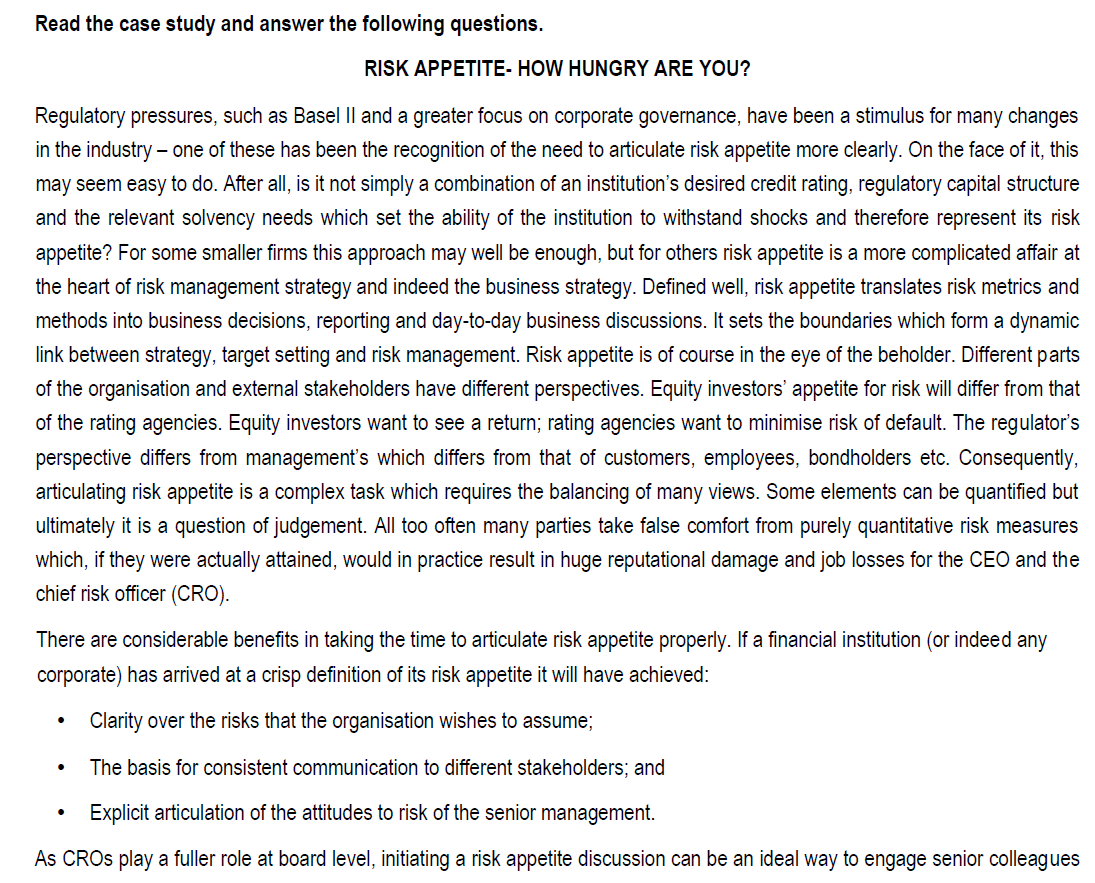
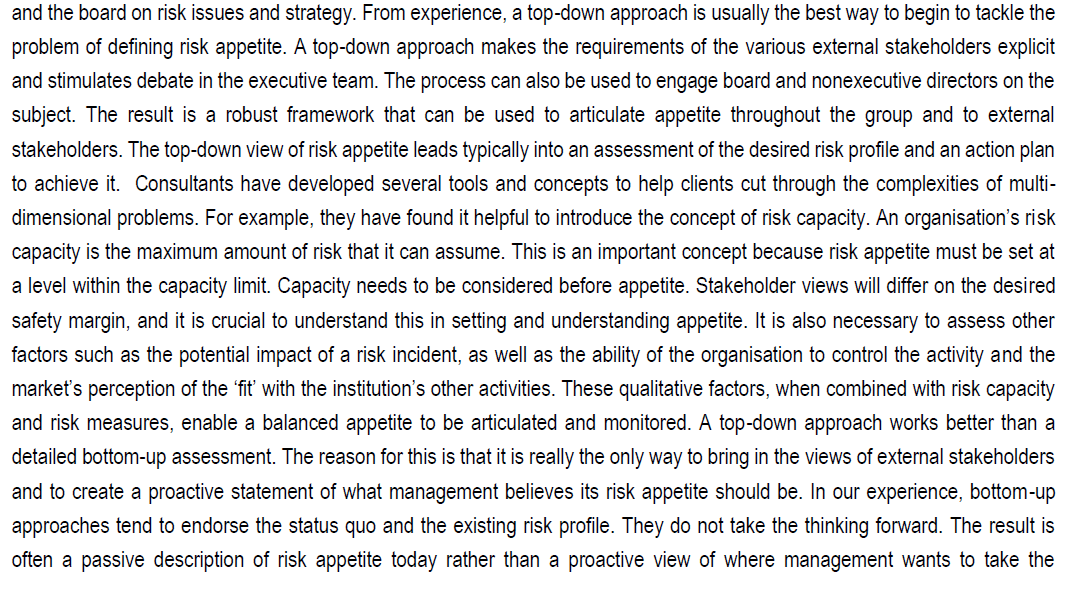
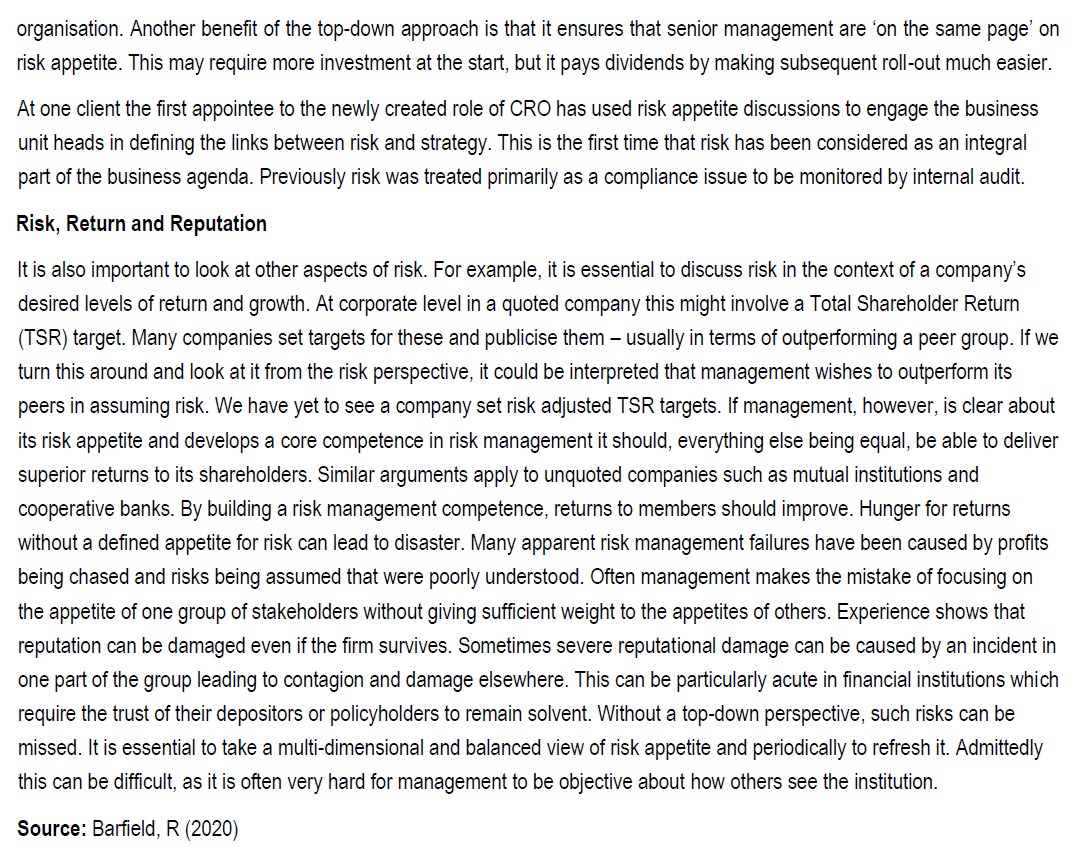


1.2 The case study highlights that the risk appetite of equity investors contrast with those of rating agencies. By referring to pertinent sources, examine the reasons for the differing risk appetites of TWO organizations of your choice. Support your analysis with appropriate examples. (20 Marks 1.4 Using any organisation of your choice, critically discuss the links between risk and strategy and why organisations should prioritise the creation of a CRO. (20 Marks) 1.5 In reference to the organisation used in question 1.4 above, provide a risk matrix in which you articulate on what a risk threshold implies. Relevant diagrams should be used in your response. (20 Marks) organisation. Another benefit of the top-down approach is that it ensures that senior management are 'on the same page' on risk appetite. This may require more investment at the start, but it pays dividends by making subsequent roll-out much easier. At one client the first appointee to the newly created role of CRO has used risk appetite discussions to engage the business unit heads in defining the links between risk and strategy. This is the first time that risk has been considered as an integral part of the business agenda. Previously risk was treated primarily as a compliance issue to be monitored by internal audit. Risk, Return and Reputation It is also important to look at other aspects of risk. For example, it is essential to discuss risk in the context of a company's desired levels of return and growth. At corporate level in a quoted company this might involve a Total Shareholder Return (TSR) target. Many companies set targets for these and publicise them - usually in terms of outperforming a peer group. If we turn this around and look at it from the risk perspective, it could be interpreted that management wishes to outperform its peers in assuming risk. We have yet to see a company set risk adjusted TSR targets. If management, however, is clear about its risk appetite and develops a core competence in risk management it should, everything else being equal, be able to deliver superior returns to its shareholders. Similar arguments apply to unquoted companies such as mutual institutions and cooperative banks. By building a risk management competence, returns to members should improve. Hunger for returns without a defined appetite for risk can lead to disaster. Many apparent risk management failures have been caused by profits being chased and risks being assumed that were poorly understood. Often management makes the mistake of focusing on the appetite of one group of stakeholders without giving sufficient weight to the appetites of others. Experience shows that reputation can be damaged even if the firm survives. Sometimes severe reputational damage can be caused by an incident in one part of the group leading to contagion and damage elsewhere. This can be particularly acute in financial institutions which require the trust of their depositors or policyholders to remain solvent. Without a top-down perspective, such risks can be missed. It is essential to take a multi-dimensional and balanced view of risk appetite and periodically to refresh it. Admittedly this can be difficult, as it is often very hard for management to be objective about how others see the institution. RISK APPETITE- HOW HUNGRY ARE YOU? Regulatory pressures, such as Basel II and a greater focus on corporate governance, have been a stimulus for many changes in the industry - one of these has been the recognition of the need to articulate risk appetite more clearly. On the face of it, this may seem easy to do. After all, is it not simply a combination of an institution's desired credit rating, regulatory capital structure and the relevant solvency needs which set the ability of the institution to withstand shocks and therefore represent its risk appetite? For some smaller firms this approach may well be enough, but for others risk appetite is a more complicated affair at the heart of risk management strategy and indeed the business strategy. Defined well, risk appetite translates risk metrics and methods into business decisions, reporting and day-to-day business discussions. It sets the boundaries which form a dynamic link between strategy, target setting and risk management. Risk appetite is of course in the eye of the beholder. Different parts of the organisation and external stakeholders have different perspectives. Equity investors' appetite for risk will differ from that of the rating agencies. Equity investors want to see a return; rating agencies want to minimise risk of default. The regulator's perspective differs from management's which differs from that of customers, employees, bondholders etc. Consequently, articulating risk appetite is a complex task which requires the balancing of many views. Some elements can be quantified but ultimately it is a question of judgement. All too often many parties take false comfort from purely quantitative risk measures which, if they were actually attained, would in practice result in huge reputational damage and job losses for the CEO and the chief risk officer (CRO). There are considerable benefits in taking the time to articulate risk appetite properly. If a financial institution (or indeed any corporate) has arrived at a crisp definition of its risk appetite it will have achieved: - Clarity over the risks that the organisation wishes to assume; - The basis for consistent communication to different stakeholders; and - Explicit articulation of the attitudes to risk of the senior management. As CROs play a fuller role at board level, initiating a risk appetite discussion can be an ideal way to engage senior colleagues and the board on risk issues and strategy. From experience, a top-down approach is usually the best way to begin to tackle the problem of defining risk appetite. A top-down approach makes the requirements of the various external stakeholders explicit and stimulates debate in the executive team. The process can also be used to engage board and nonexecutive directors on the subject. The result is a robust framework that can be used to articulate appetite throughout the group and to external stakeholders. The top-down view of risk appetite leads typically into an assessment of the desired risk profile and an action plan to achieve it. Consultants have developed several tools and concepts to help clients cut through the complexities of multidimensional problems. For example, they have found it helpful to introduce the concept of risk capacity. An organisation's risk capacity is the maximum amount of risk that it can assume. This is an important concept because risk appetite must be set at a level within the capacity limit. Capacity needs to be considered before appetite. Stakeholder views will differ on the desired safety margin, and it is crucial to understand this in setting and understanding appetite. It is also necessary to assess other factors such as the potential impact of a risk incident, as well as the ability of the organisation to control the activity and the market's perception of the 'fit' with the institution's other activities. These qualitative factors, when combined with risk capacity and risk measures, enable a balanced appetite to be articulated and monitored. A top-down approach works better than a detailed bottom-up assessment. The reason for this is that it is really the only way to bring in the views of external stakeholders and to create a proactive statement of what management believes its risk appetite should be. In our experience, bottom-up approaches tend to endorse the status quo and the existing risk profile. They do not take the thinking forward. The result is often a passive description of risk appetite today rather than a proactive view of where management wants to take the
Step by Step Solution
There are 3 Steps involved in it

Get step-by-step solutions from verified subject matter experts
 Study Help