







Question: CASE STUDY 14.1 Prescriptive and emergent strategies: profits from the sun, wind and sea? Even from nuclear energy? With the drive towards renewable energy, companies
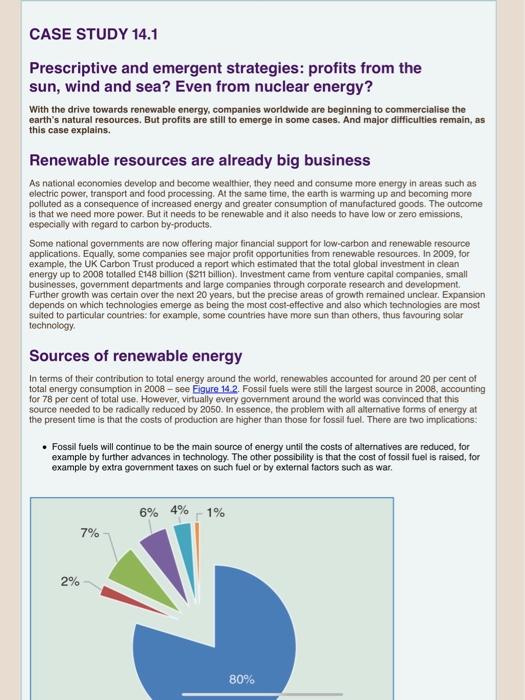
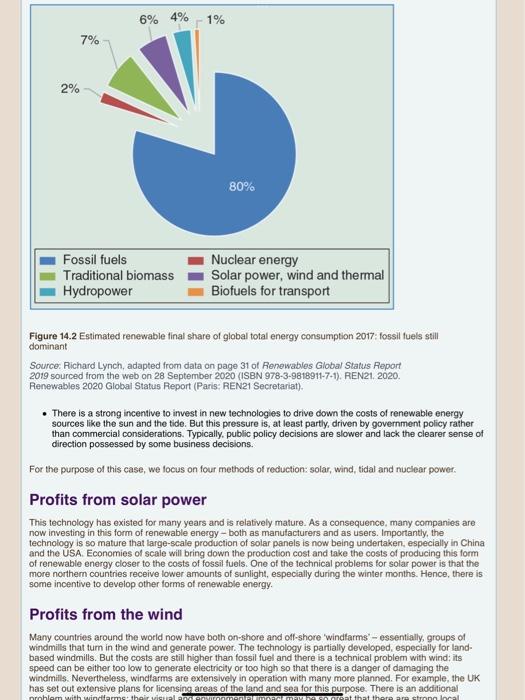
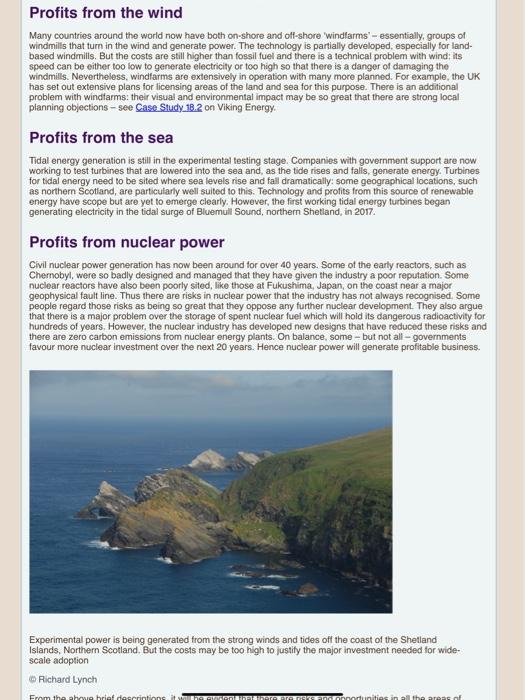
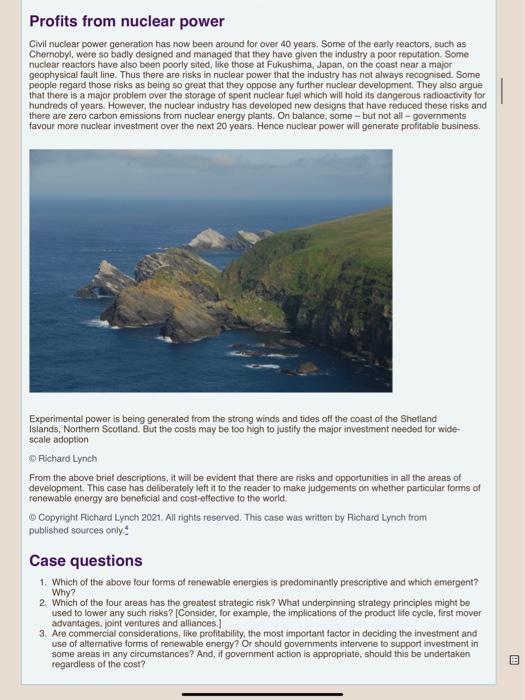
CASE STUDY 14.1 Prescriptive and emergent strategies: profits from the sun, wind and sea? Even from nuclear energy? With the drive towards renewable energy, companies worldwide are beginning to commercialise the earth's natural resources. But profits are still to emerge in some cases. And major difficulties remain, as this case explains. Renewable resources are already big business As national economies develop and become wealthier, they need and consume more energy in areas such as electric power, transport and food processing. At the same time, the earth is warming up and becoming more polluted as a consequence of increased energy and greater consumption of manufactured goods. The outcome is that we need more power. But it needs to be renewable and it also needs to have low or zero emissions, especially with regard to carbon by-products. Some national governments are now offering major financial support for low-carbon and renewable resource applications. Equally. some companies see major profit opportunities from renewable resources. In 2009 , for example, the UK Carbon Trust produced a report which estimated that the total global investment in clean energy up to 2008 totalled 2148 billion ( $211 billion). Investment came from venture capital companies, small businesses, govemment departments and large companies through corporate research and development. Further growth was certain over the next 20 years, but the precise areas of growth remained unclear. Expansion depends on which technologies emerge as being the most cost-effective and also which technologies are most suited to particular countries: for example, some countries have more sun than others, thus tavouring solar technology. Sources of renewable energy In terms of their contribution to total energy around the world, renewables accounted for around 20 per cent of total energy consumption in 2008 - see Eigure 14. 2. Fossil fuels were still the largest source in 2008 , accounting for 78 per cent of total use. However, virtually every government around the worid was comvinced that this source needed to be radically reduced by 2050 . In essence, the problem with all allemative forms of energy at the present time is that the costs of production are higher than those for fossil fuel. There are two implications: - Fossil fuels will continue to be the main source of energy until the costs of alternatives are reduced, for example by further advances in technology. The other possibility is that the cost of fossil fuel is raised, for example by extra government taxes on such fuel or by external factors such as war. Figure 14.2 Estimated renewable final share of global total energy consumption 2017: fossil fuels still dominant Source: Richard Lynch, adapted from data on page 31 of Renewables Global Status Report 2019 sourced from the web on 28 September 2020 (ISBN 978-3-9818911-7-1). REN21. 2020. Renewables 2020 Global Status Report (Paris: REN21 Secretariat). - There is a strong incentive to invest in new technologies to drive down the costs of renewable energy sources like the sun and the tide. But this pressure is, at least partly, driven by government policy rather than commercial considerations. Typically. public policy decisions are slower and lack the clearer sense of direction possessed by some business decisions. For the purpose of this case, we focus on four methods of reduction: solar, wind, tidal and nuclear power. Profits from solar power This technology has existed for many years and is relatively mature. As a consequence, many companies are now investing in this form of renewable energy - both as manufacturers and as users. Importantly, the technology is so mature that large-scale production of solar panels is now being undertaken, especially in China and the USA. Economies of scale will bring down the production cost and take the costs of producing this form of renewable energy closer to the costs of fossil fuels. One of the lechnical problems for solar power is that the more northem countries receive lower amounts of sunlight, especially during the winter months. Hence, there is some incentive to develop other forms of renewable energy. Profits from the wind Many countries around the worid now have both on-shore and off-shore 'windtarms' - essentially, groups of windmills that tum in the wind and generate power. The technology is partially developed, especially for landbased windmills. But the costs are still higher than fossil fuel and there is a technical problem with wind; its speed can be either too low to generate electricity or too high so that there is a danger of damaging the windmills. Nevertheless, windlarms are extensively in operation with many more planned. For example, the UK. has set out extensive plans for licensing areas of the land and sea for this purpose. There is an additional Profits from the wind Many countries around the world now have both on-shore and off-shore 'windtarms' - essentially, groups of windmills that turn in the wind and generate power. The technology is partially developed, especially for landbased windmills. But the costs are still higher than fossil fuel and there is a lechnical problem with wind; its speed can be either too low to generate electricity or too high so that there is a danger of damaging the windmills. Nevertheless, windfarms are extensively in operation with many more planned. For example, the UK has set out extensive plans for licensing areas of the land and sea for this purpose. There is an additional problem with windiarms: their visual and environmental impact may be so great that there are strong local planning objections - see Case Study 18.2 on Viking Energy. Profits from the sea Tidal energy generation is still in the experimental testing stage. Companies with government support are now working to test turbines that are lowered into the sea and, as the tide rises and falls, generate energy. Turbines for tidal energy need to be sited where sea levels rise and fall dramatically: some geographical locations, such as northem Scotland, are particularly well suited to this. Technology and profits from this source of renewable energy have scope but are yet to emerge clearly. However, the first working tidal energy turbines began generating electricity in the tidal surge of Bluemull Sound, northem Shetland, in 2017. Profits from nuclear power Civil nuclear power generation has now been around for over 40 years. Some of the early reactors, such as Chernobyl, were so badly designed and managed that they have given the industry a poor reputation. Some nuclear reactors have also been poorly sited, like those at Fukushima, Japan, on the coast near a major geophysical fault line. Thus there are risks in nuclear power that the industry has not always recognised. Some people regard those risks as being so great that they oppose any further nuclear development. They also argue that there is a major problem over the storage of spent nuclear fuel which will hoid its dangerous radioactivity for hundreds of years, However, the nuclear industry has developed new designs that have reduced these risks and there are zero carbon emissions from nuclear energy plants. On balance, some - but not all - governments favour more nuclear investment over the next 20 years. Hence nuclear power will generate profitable business. Experimental power is being generated from the strong winds and tides oft the coast of the Shetland Islands, Northern Scotland. But the costs may be too high to justify the major investment needed for widescale adoption Fichard Lynch Profits from nuclear power Civil nuclear power generation has now been around tor over 40 years. Some of the earty reactors, such as Chernobyl, were so badly designed and managed that they have given the industry a poor reputation. Some nuclear reactors have also been poorly sited, like those at Fukushima, Japan, on the coast near a major geophysical fault line. Thus there are risks in nuclear power that the industry has not always recognised. Some people regard those risks as being so great that they oppose any further nuclear development. They also argue that there is a major probiem over the storage of spent nuclear fuel which will hoid its dangerous radioactivity for hundreds of years. However, the nuclear industry has developed new designs that have reduced these risks and there are zero carbon emissions from nuclear energy plants. On balance, some - but not all - governments favour more nuclear investment over the next 20 years. Hence nuclear power will generate profitable business. Experimental power is being generated from the strong winds and tides off the coast of the Shetland Islands, Northern Scotland. But the costs may be too high to justify the major investment needed for widescale adoption Fichard Lynch From the above briet descriptions, it will be evident that there are risks and opportunities in all the areas of development. This case has deliberately left it to the reader to make judgements on whether particular forms of renewable energy are beneficial and cost-eflective to the world. (5) Copyright Fichard Lynch 2021. All rights reserved. This case was writen by Fichard Lynch from published sources only. Case questions 1. Which of the above four forms of renewable energies is predominantly prescriptive and which emergent? Why? 2. Which of the four areas has the greatest strategic risk? What underpinning strategy principles might be used to lower any such risks? [Consider, for example, the implications of the product lfe cycle, first mover advantages, joint ventures and alliances.] 3. Are commercial considerations, like prolitability, the most important factor in deciding the investment and use of altemative forms of renewable energy? Or should governments intervene to support investment in some areas in any circumstances? And, if government action is appropriate, should this be undertaken regardless of the cost
Step by Step Solution
There are 3 Steps involved in it

Get step-by-step solutions from verified subject matter experts
 Study Help