







Question: Case Study # 2 - Common Sources and Forms of Financing ( Chapter 7 ) Terence Breezeway, the CEO of Prairie Home Stores, wondered what
Case Study # Common Sources and Forms of Financing Chapter
Terence Breezeway, the CEO of Prairie Home Stores, wondered what retirement would be like. It was almost years to the day since his uncle Jacob Breezeway, Prairie Home's founder, had asked him to take responsibility for managing the company. Now it was time to spend more time riding and fishing on the old Lazy Beta Ranch.
Under Mr Breezeway's leadership Prairie Home had grown slowly but steadily and was solidly profitable. Table shows earnings, dividends, and book asset values for the past years. Most of the company's supermarkets had been modernized and its brand name was well known.
Financial data for Prairie Home Stores, $ millions
tableBook value, start of year,$$$$$
But if Prairie Home did go public, what should its shares sell for? Mr Breezeway worried that shares would be sold, either
by Breezeway family members or by the company itself, at too low a price. One relative was about to accept a private
offer for $ the current book value per share, but Mr Breezeway had intervened and convinced the wouldbe seller to
wait.
Prairie Home's value did not just depend on its current book value or earnings, but on its future prospects, which were
good. One financial projection shown in the top panel of Table called for growth in earnings of over by
Unfortunately this plan would require reinvestment of all Prairie Home's earnings from to After that the
company could resume its normal dividend payout and growth rate. Mr Breezeway believed this plan was feasible.
Page
Financial projections for Prairie Home Stores, $ millions
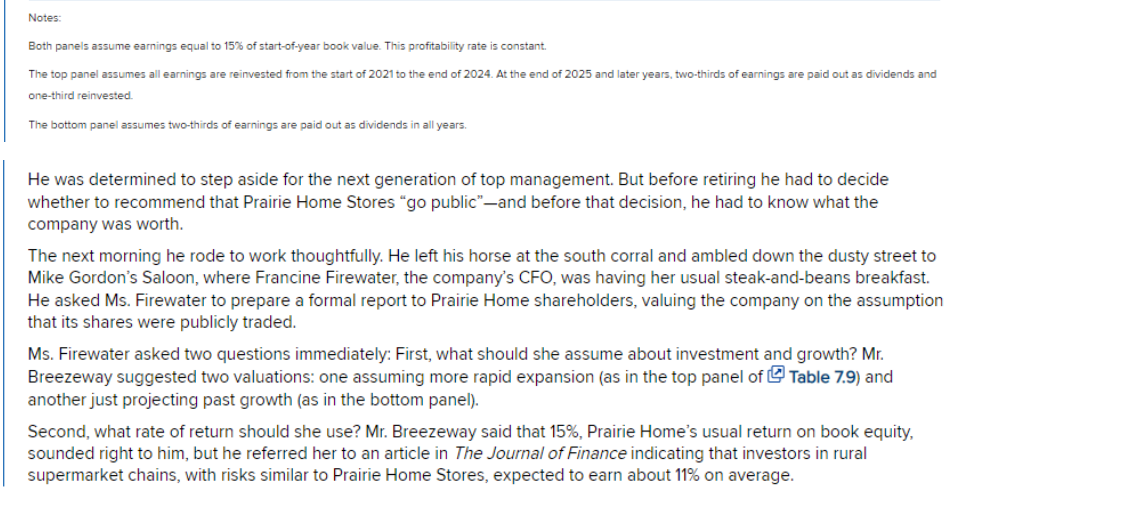
Notes:
Notes:
Both panels assume earnings equal to of startofyear book value. This profitability rate is constant.
The top panel assumes all earnings are reinvested from the start of to the end of At the end of and later years, twothirds of earnings are paid out as dividends and
onethird reinvested.
The bottom panel assumes twothirds of earnings are paid out as dividends in all years.
He was determined to step aside for the next generation of top management. But before retiring he had to decide
whether to recommend that Prairie Home Stores go public"and before that decision, he had to know what the
company was worth.
The next morning he rode to work thoughtfully. He left his horse at the south corral and ambled down the dusty street to
Mike Gordon's Saloon, where Francine Firewater, the company's CFO, was having her usual steakandbeans breakfast.
He asked Ms Firewater to prepare a formal report to Prairie Home shareholders, valuing the company on the assumption
that its shares were publicly traded.
Ms Firewater asked two questions immediately: First, what should she assume about investment and growth? Mr
Breezeway suggested two valuations: one assuming more rapid expansion as in the top panel of Table and
another just projecting past growth as in the bottom panel
Second, what rate of return should she use? Mr Breezeway said that Prairie Home's usual return on book equity,
sounded right to him, but he referred her to an article in The Journal of Finance indicating that investors in rural
supermarket chains, with risks similar to Prairie Home Stores, expected to earn about on average.
Step by Step Solution
There are 3 Steps involved in it
1 Expert Approved Answer
Step: 1 Unlock

Question Has Been Solved by an Expert!
Get step-by-step solutions from verified subject matter experts
Step: 2 Unlock
Step: 3 Unlock
 Study Help