Question: Case Study 2 - Project Human Resourcing - Team Building Phil Jones is a project leader at Engineering Co and leader of a team operating
Case Study 2 - Project Human Resourcing - Team
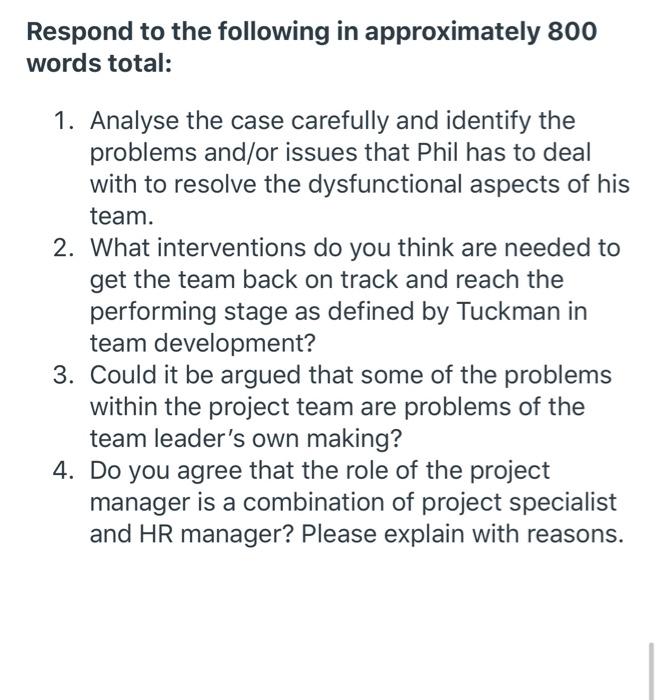
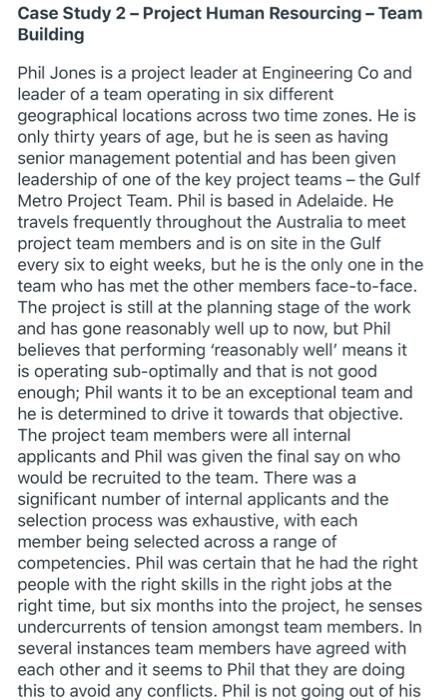
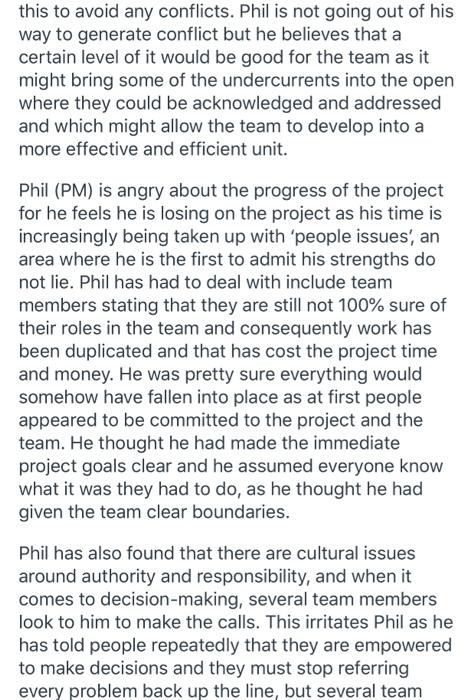
Case Study 2 - Project Human Resourcing - Team Building Phil Jones is a project leader at Engineering Co and leader of a team operating in six different geographical locations across two time zones. He is only thirty years of age, but he is seen as having senior management potential and has been given leadership of one of the key project teams - the Gulf Metro Project Team. Phil is based in Adelaide. He travels frequently throughout the Australia to meet project team members and is on site in the Gulf every six to eight weeks, but he is the only one in the team who has met the other members face-to-face. The project is still at the planning stage of the work and has gone reasonably well up to now, but Phil believes that performing 'reasonably well' means it is operating sub-optimally and that is not good enough; Phil wants it to be an exceptional team and he is determined to drive it towards that objective. The project team members were all internal applicants and Phil was given the final say on who would be recruited to the team. There was a significant number of internal applicants and the selection process was exhaustive, with each member being selected across a range of competencies. Phil was certain that he had the right people with the right skills in the right jobs at the right time, but six months into the project, he senses undercurrents of tension amongst team members. In several instances team members have agreed with each other and it seems to Phil that they are doing this to avoid any conflicts. Phil is not going out of his this to avoid any conflicts. Phil is not going out of his way to generate conflict but he believes that a certain level of it would be good for the team as it might bring some of the undercurrents into the open where they could be acknowledged and addressed and which might allow the team to develop into a more effective and efficient unit. Phil (PM) is angry about the progress of the project for he feels he is losing on the project as his time is increasingly being taken up with 'people issues, an area where he is the first to admit his strengths do not lie. Phil has had to deal with include team members stating that they are still not 100% sure of their roles in the team and consequently work has been duplicated and that has cost the project time and money. He was pretty sure everything would somehow have fallen into place as at first people appeared to be committed to the project and the team. He thought he had made the immediate project goals clear and he assumed everyone know what it was they had to do, as he thought he had given the team clear boundaries. Phil has also found that there are cultural issues around authority and responsibility, and when it comes to decision-making, several team members look to him to make the calls. This irritates Phil as he has told people repeatedly that they are empowered to make decisions and they must stop referring every problem back up the line, but several team Phil has also found that there are cultural issues around authority and responsibility, and when it comes to decision-making, several team members look to him to make the calls. This irritates Phil as he has told people repeatedly that they are empowered to make decisions and they must stop referring every problem back up the line, but several team members countered that they are unsure of what they can make decisions on and that Phil is inconsistent, telling people to be pro-active and then overruling them later. Phil is a problem-solver and he decided that something has to be done to put the team back on track. He read Bruce Tuckman's stage of team development with interest and he is now convinced that the team is stuck at the storming stage and he is unsure of what has to be done to get it to the performing stage. He is desperate for the team to succeed, not only for his own career. Phil wants all of the team members to be able to look back on their time on the project team as a positive experience and he wants people to be proud on their time on the project they were part of the Gulf Metro Project Team. Respond to the following in approximately 800 words total: 1. Analyse the case carefully and identify the problems and/or issues that Phil has to deal with to resolve the dysfunctional aspects of his team. 2. What interventions do you think are needed to get the team back on track and reach the performing stage as defined by Tuckman in team development? 3. Could it be argued that some of the problems within the project team are problems of the team leader's own making? 4. Do you agree that the role of the project manager is a combination of project specialist and HR manager? Please explain with reasons
Step by Step Solution

There are 3 Steps involved in it

1 Expert Approved Answer
Step: 1 Unlock blur-text-image

Question Has Been Solved by an Expert!

Get step-by-step solutions from verified subject matter experts

Step: 2 Unlock
Step: 3 Unlock

Students Have Also Explored These Related General Management Questions!