







Question: Case Study 3 - 2 Resolving Impasse by Binding Arbitration The Employer is a government agency which seeks to enhance health, lengthen life, and reduce
Case Study Resolving Impasse by Binding Arbitration
The Employer is a government agency which seeks to enhance health, lengthen life, and reduce the burdens of illness and disability. The Union represents approximately police officers whose job is to ensure the safety and security of the Employer's facilities, employees, and visitors. While negotiating a renewal of their Collective Bargaining Agreement, the Parties disagree over whether bargaining unit employees should be prohibited from using tobacco products on the Employer's premises. Executive Order issued by President Clinton on August prohibits "the smoking of tobacco products in all interior space owned, rented, or leased by the executive branch of the Federal Government, and in any outdoor areas under executive branch control in front of air intake ducts," with certain exceptions that are not relevant to the issue in this case.
The Employer proposed to the Union a Memorandum of Agreement that prohibited tobacco use of any kind, in any of the Employer's owned or leased buildings, on all outside property or grounds, including parking areas and in government vehicles. Employees who failed to comply with the policy would be subject to discipline. The Union's proposal was to prohibit smoking in government buildings and vehicles, within feet of building entrances, and feet of Hospital entrances, and near building air intakes. Members will still be able to smoke in their privately owned vehicles while on government property and still be able to use smokeless tobacco products. The Parties agree they are at an impasse over the tobacco issue and have asked for binding arbitration by the Federal Service Impasses Panel. The Panel asked both sides to submit their final offers and single written statements of position on the tobacco ban policy.
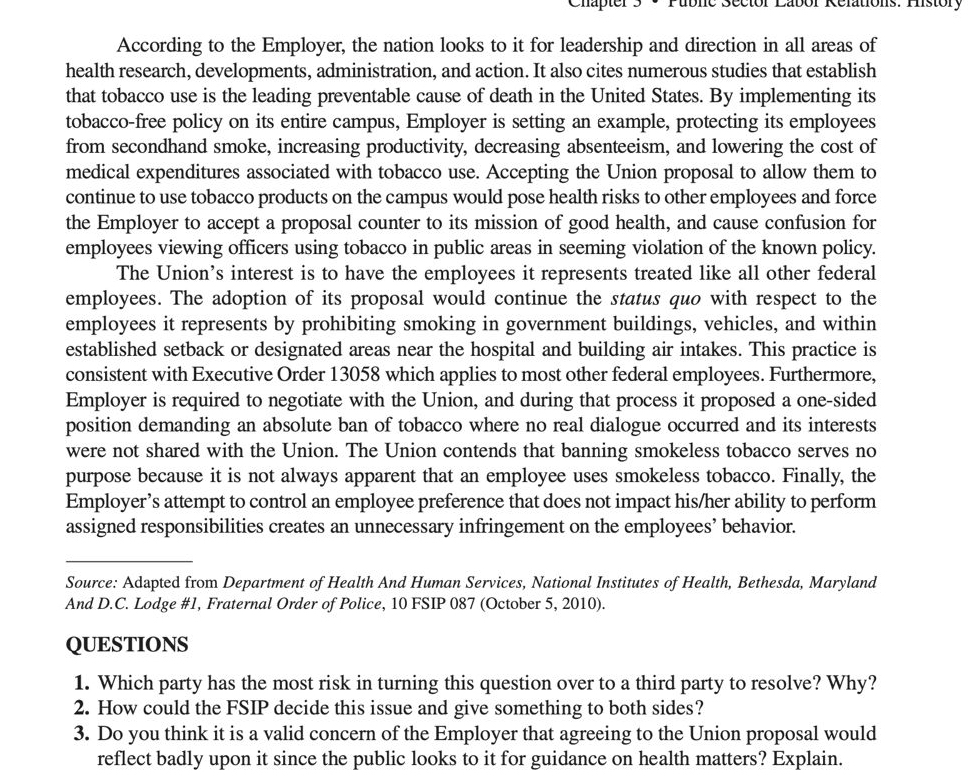
According to the Employer, the nation looks to it for leadership and direction in all areas of health research, developments, administration, and action. It also cites numerous studies that establish that tobacco use is the leading preventable cause of death in the United States. By implementing its tobaccofree policy on its entire campus, Employer is setting an example, protecting its employees from secondhand smoke, increasing productivity, decreasing absenteeism and lowering the cost of medical expenditures associated with tobacco use. Accepting the Union proposal to allow them to continue to use tobacco products on the campus would pose health risks to other employees and force the Employer to accept a proposal counter to its mission of good health, and cause confusion for employees viewing officers using tobacco in public areas in seeming violation of the known policy.
The Union's interest is to have the employees it represents treated like all other federal employees. The adoption of its proposal would continue the status quo with respect to the employees it represents by prohibiting smoking in government buildings, vehicles, and within established setback or designated areas near the hospital and building air intakes. This practice is consistent with Executive Order which applies to most other federal employees. Furthermore, Employer is required to negotiate with the Union, and during that process it proposed a onesided position demanding an absolute ban of tobacco where no real dialogue occurred and its interests were not shared with the Union. The Union contends that banning smokeless tobacco serves no purpose because it is not always apparent that an employee uses smokeless tobacco. Finally, the Employer's attempt to control an employee preference that does not impact hisher ability to perform assigned responsibilities creates an unnecessary infringement on the employees' behavior.
Source: Adapted from Department of Health And Human Services, National Institutes of Health, Bethesda, Maryland And DC Lodge # Fraternal Order of Police, FSIP October
QUESTIONS
Which party has the most risk in turning this question over to a third party to resolve? Why?
How could the FSIP decide this issue and give something to both sides?
Do you think it is a valid concern of the Employer that agreeing to the Union proposal would reflect badly upon it since the public looks to it for guidance on health matters? Explain.
Step by Step Solution
There are 3 Steps involved in it
1 Expert Approved Answer
Step: 1 Unlock

Question Has Been Solved by an Expert!
Get step-by-step solutions from verified subject matter experts
Step: 2 Unlock
Step: 3 Unlock
 Study Help