Question: Case Study 3 Outsourcing the helpdesk operation This is a true story. The names have been changed to protect the innocent. Telecommunications Management Software (TeMaSo)
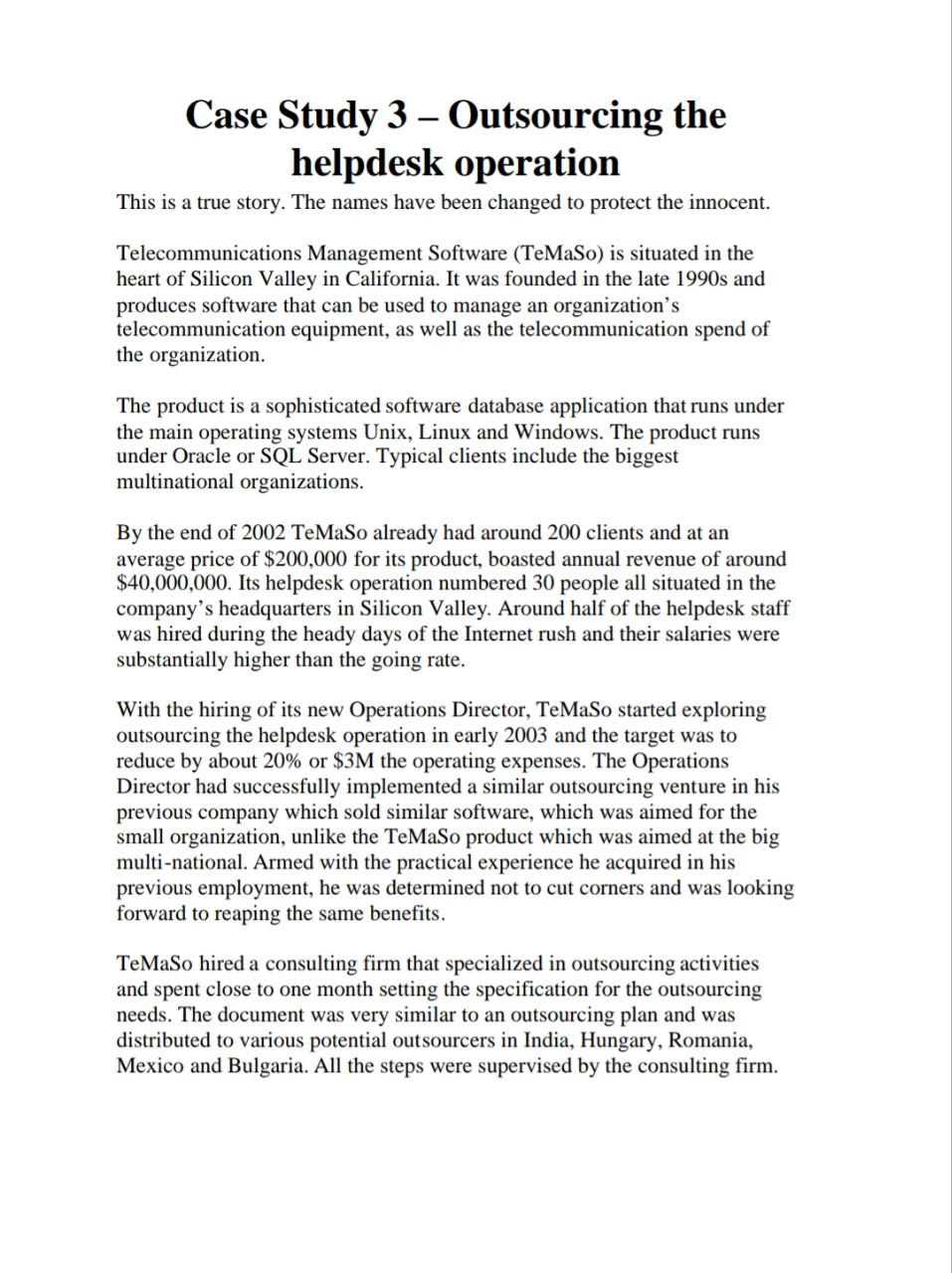
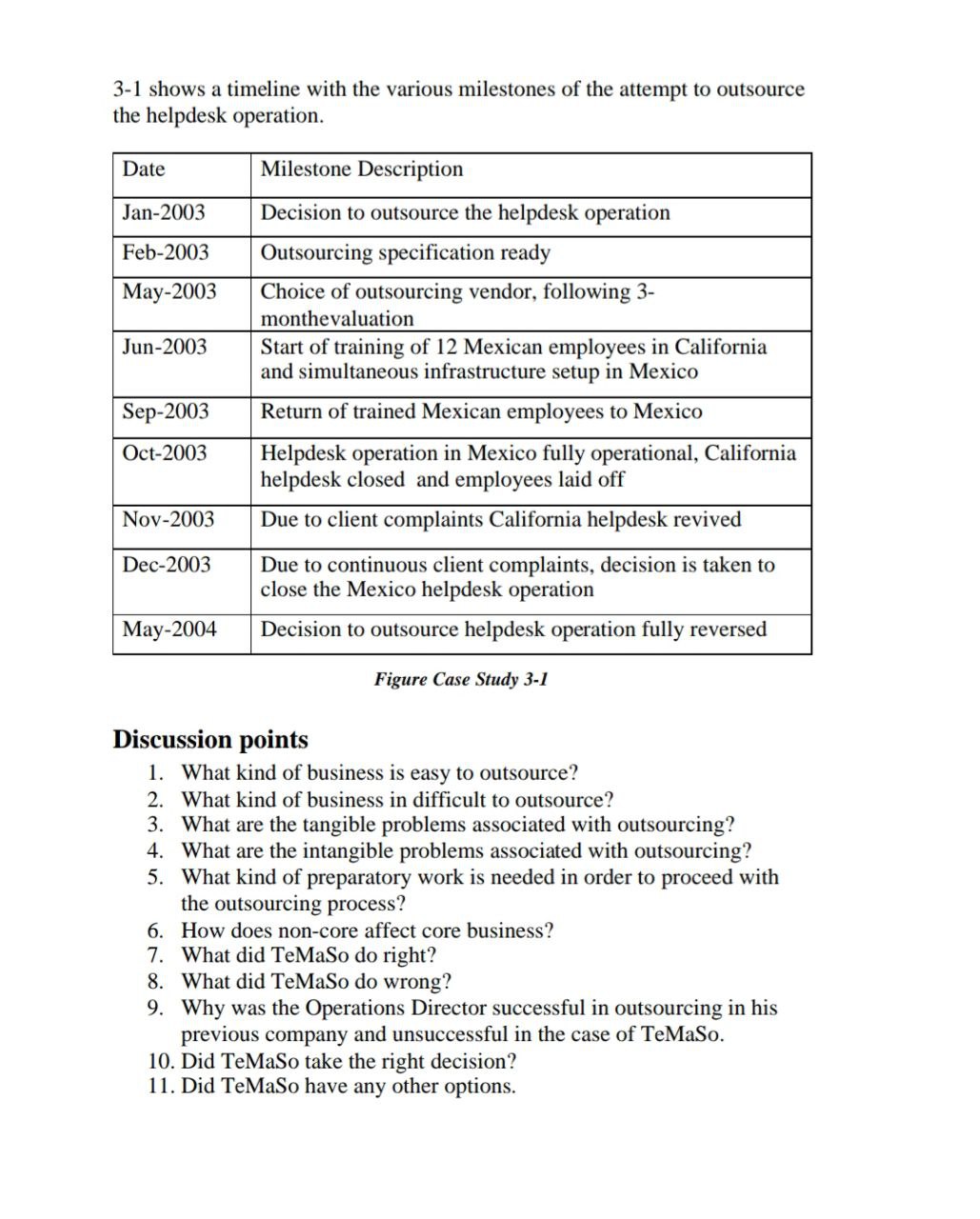
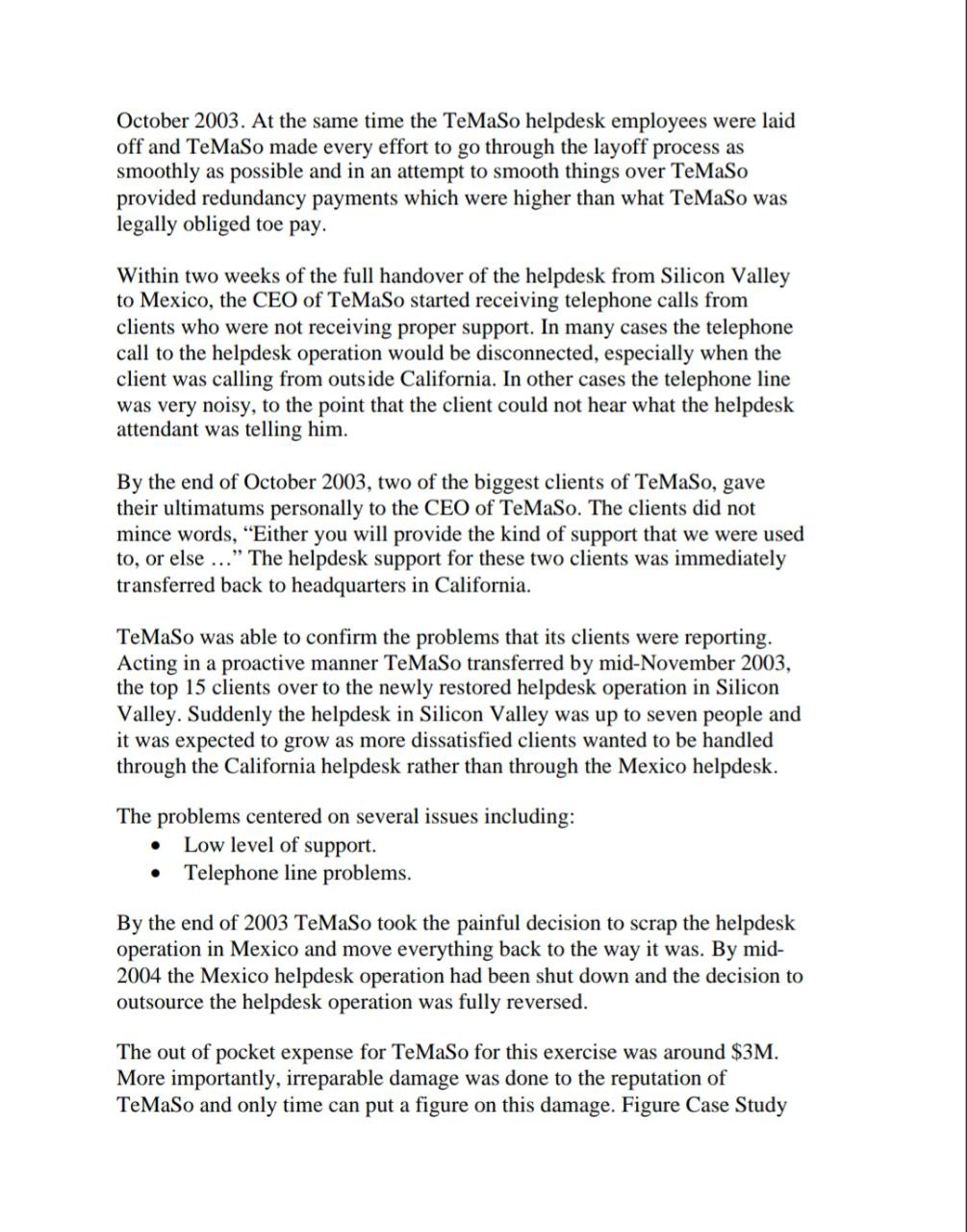
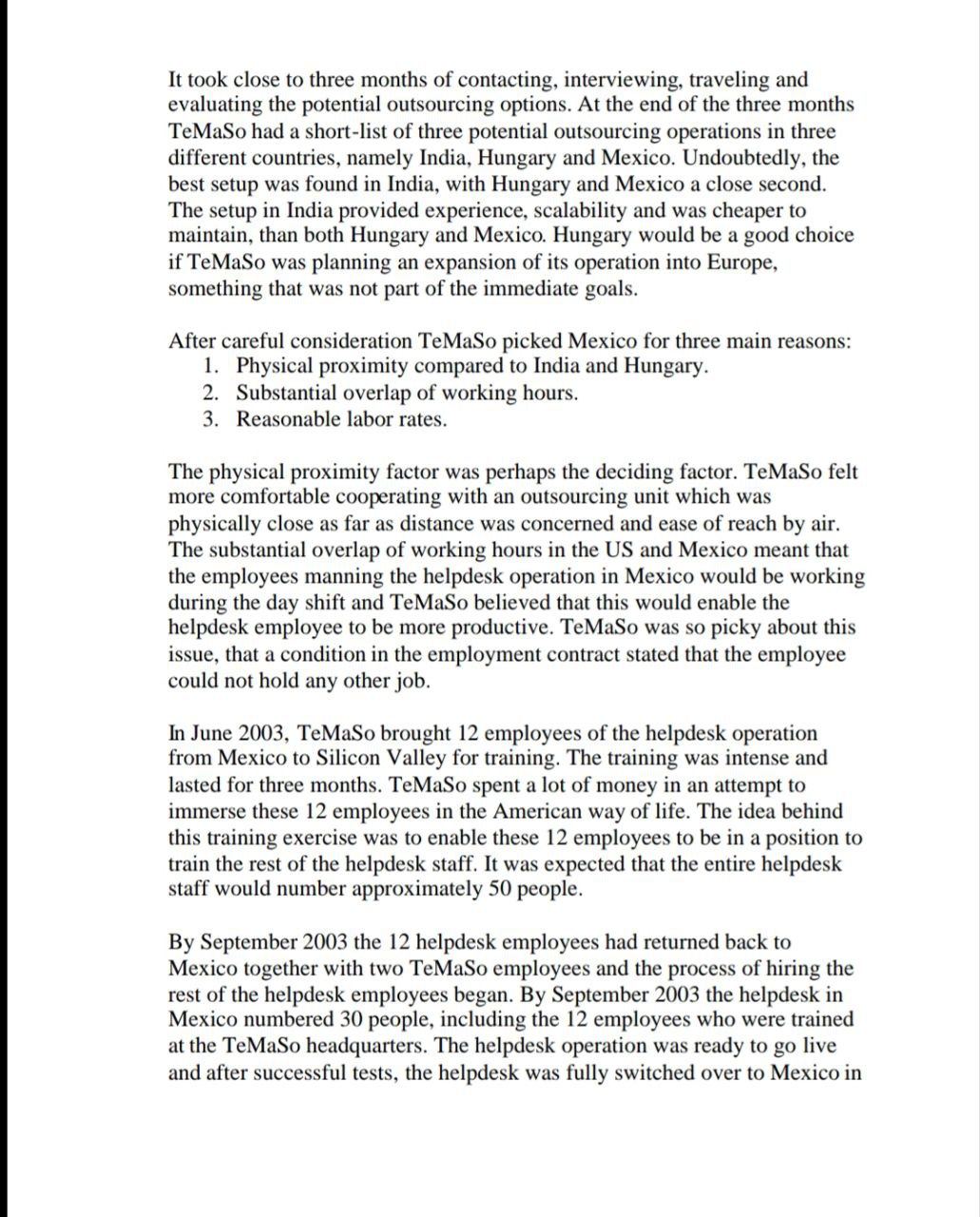
Case Study 3 Outsourcing the helpdesk operation This is a true story. The names have been changed to protect the innocent. Telecommunications Management Software (TeMaSo) is situated in the heart of Silicon Valle}r in California. It was founded in the late 19908 and produces software that can be used to manage an organization's telecommunication equipment, as well as the telecommunication spend of the organization. The product is a sophisticated software database application that runs under the main operating systems Unix, Linux and Windows. The product runs under Oracle or SQL Server. Typical clients include the biggest multinational organizations. By the end of 2002 TeMaSo already had around 200 clients and at an average price of $200,000 for its product. boasted annual revenue of around $40,000,000. Its helpdesk operation numbered 30 people all situated in the company's headquarters in Silicon Valley. Around half of the helpdesk staff was hired during the heady days of the Internet rush and their salaries were substantially higher than the going rate. With the hiring of its new Operations Director. TeMaSo started exploring outsourcing the helpdesk operation in early 2003 and the target was to reduce by about 20% or $3M the operating expenses. The Operations Director had successfully implemented a similar outsourcing venture in his previous company which sold similar software. which was aimed for the small organization. unlike the TeMaSo product which was aimed at the big multi-national. Armed with the practical experience he acquired in his previous employment. he was determined not to cut corners and was looking forward to reaping the same benefits. TeMaSo hired a consulting firm that specialized in outsourcing activities and spent close to one month setting the specication for the outsourcing needs. The document was very similar to an outsourcing plan and was distributed to various potential outsourcers in India, Hungary. Romania. Mexico and Bulgaria. All the steps were supervised by the consulting rm. 3-1 shows a timeline with the various milestones of the attempt to outsource the helpdesk operation. Date Milestone Description Jan-2003 Decision to outsource the helpdesk operation Feb-2003 Outsourcing specification ready May-2003 Choice of outsourcing vendor, following 3- monthevaluation Jun-2003 Start of training of 12 Mexican employees in California and simultaneous infrastructure setup in Mexico Sep-2003 Return of trained Mexican employees to Mexico Oct-2003 Helpdesk operation in Mexico fully operational, California helpdesk closed and employees laid off Nov-2003 Due to client complaints California helpdesk revived Dec-2003 Due to continuous client complaints, decision is taken to close the Mexico helpdesk operation May-2004 Decision to outsource helpdesk operation fully reversed Figure Case Study 3-1 Discussion points 1. What kind of business is easy to outsource? 2. What kind of business in difficult to outsource? 3. What are the tangible problems associated with outsourcing? . What are the intangible problems associated with outsourcing? 5. What kind of preparatory work is needed in order to proceed with the outsourcing process? 6. How does non-core affect core business? 7. What did TeMaSo do right? 8. What did TeMaSo do wrong? 9. Why was the Operations Director successful in outsourcing in his previous company and unsuccessful in the case of TeMaSo. 10. Did TeMaSo take the right decision? 11. Did TeMaSo have any other options.October 2003. At the same time the TeMaSo helpdesk employees were laid off and TeMaSo made every effort to go through the layoff process as smoothly as possible and in an attempt to smooth things over TeMaSo provided redundancy payments which were higher than what TeMaSo was legally obliged toe pay. Within two weeks of the full handover of the helpdesk from Silicon Valley to Mexico. the lCEO of TeMaSo started receiving telephone calls from clients who were not receiving proper support. In many cases the telephone call to the helpdesk operation would be disconnected. especially when the client was calling from outside California. In other cases the telephone line was very noisy, to the point that the client could not hear what the helpdeslt attendant was telling him. By the end of October 2003., two of the biggest clients of TeMaSo. gave their ultimatums personally to the CEO of TeMaSo. The clients did not mince words, \"Either you will provide the kind of support that we were used to. or else The helpdesk support for these two clients was immediately transferred back to headquarters in California. TeMaSo was able to conrm the problems that its clients were reporting. Acting in a proactive manner TeMaSo transferred by mid-November 2003. the top 15 clients over to the newly restored helpdesk operation in Silicon Valley. Suddenly the helpdesk in Silicon Valley was up to seven people and it was expected to grow as more dissatised clients wanted to be handled through the California helpdesk rather than through the Mexico helpdesk. The problems centered on several issues including: 0 Low level of support. 0 Telephone line problems. By the end of 2003 TeMaSo took the painful decision to scrap the helpdesk operation in Mexico and move everything back to the way it was. By mid- 2004 the Mexico helpdeslt operation had been shut down and the decision to outsource the helpdesk operation was fully reversed. The out of pocket expense for TeMaSo for this exercise was around $3M. More importantly. irreparable damage was done to the reputation of TeMaSo and only time can put a gure on this damage. Figure Case Study It took close to three months of contacting, interviewing, traveling and evaluating the potential outsourcing options. At the end of the three months TeMaSo had a short-list of three potential outsourcing operations in three different countries, namely India, Hungary and Mexico. Undoubtedly, the best setup was found in India, with Hungary and Mexico a close second. The setup in India provided experience, scalability and was cheaper to maintain, than both Hungary and Mexico. Hungary would be a good choice if TeMaSo was planning an expansion of its operation into Europe, something that was not part of the immediate goals. After careful consideration TeMaSo picked Mexico for three main reasons: 1. Physical proximity compared to India and Hungary. 2. Substantial overlap of working hours. 3. Reasonable labor rates. The physical proximity factor was perhaps the deciding factor. TeMaSo felt more comfortable cooperating with an outsourcing unit which was physically close as far as distance was concerned and ease of reach by air. The substantial overlap of working hours in the US and Mexico meant that the employees manning the helpdesk operation in Mexico would be working during the day shift and TeMaSo believed that this would enable the helpdesk employee to be more productive. TeMaSo was so picky about this issue, that a condition in the employment contract stated that the employee could not hold any other job. In June 2003, TeMaSo brought 12 employees of the helpdesk operation from Mexico to Silicon Valley for training. The training was intense and lasted for three months. TeMaSo spent a lot of money in an attempt to immerse these 12 employees in the American way of life. The idea behind this training exercise was to enable these 12 employees to be in a position to train the rest of the helpdesk staff. It was expected that the entire helpdesk staff would number approximately 50 people. By September 2003 the 12 helpdesk employees had returned back to Mexico together with two TeMaSo employees and the process of hiring the rest of the helpdesk employees began. By September 2003 the helpdesk in Mexico numbered 30 people, including the 12 employees who were trained at the TeMaSo headquarters. The helpdesk operation was ready to go live and after successful tests, the helpdesk was fully switched over to Mexico in
Step by Step Solution
There are 3 Steps involved in it
1 Expert Approved Answer
Step: 1 Unlock
Question Has Been Solved by an Expert!
Get step-by-step solutions from verified subject matter experts
Step: 2 Unlock
Step: 3 Unlock
Students Have Also Explored These Related General Management Questions!









 Study Help