Question: Case Study - 3.1: How The Internet is Impacting the Buying Decision Process As marketers, we know that the Internet has dramatically affected the buying
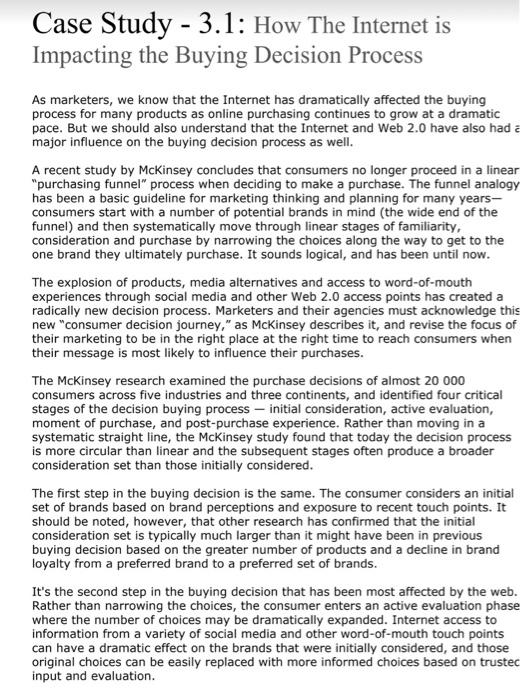
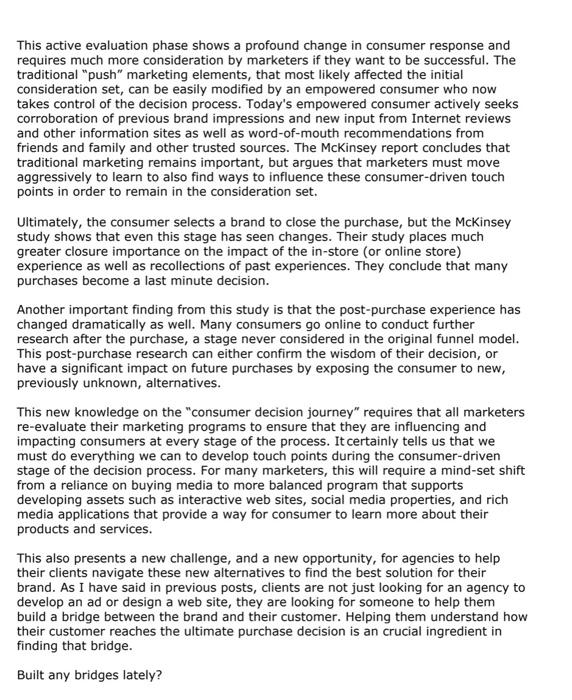
Case Study - 3.1: How The Internet is Impacting the Buying Decision Process As marketers, we know that the Internet has dramatically affected the buying process for many products as online purchasing continues to grow at a dramatic pace. But we should also understand that the Internet and Web 2.0 have also had a major influence on the buying decision process as well. A recent study by McKinsey concludes that consumers no longer proceed in a linear "purchasing funnel" process when deciding to make a purchase. The funnel analogy has been a basic guideline for marketing thinking and planning for many yearsconsumers start with a number of potential brands in mind (the wide end of the funnel) and then systematically move through linear stages of familiarity, consideration and purchase by narrowing the choices along the way to get to the one brand they ultimately purchase. It sounds logical, and has been until now. The explosion of products, media alternatives and access to word-of-mouth experiences through social media and other Web 2.0 access points has created a radically new decision process. Marketers and their agencies must acknowledge this new "consumer decision journey," as McKinsey describes it, and revise the focus of their marketing to be in the right place at the right time to reach consumers when their message is most likely to influence their purchases. The McKinsey research examined the purchase decisions of almost 20000 consumers across five industries and three continents, and identified four critical stages of the decision buying process - initial consideration, active evaluation, moment of purchase, and post-purchase experience. Rather than moving in a systematic straight line, the McKinsey study found that today the decision process is more circular than linear and the subsequent stages often produce a broader consideration set than those initially considered. The first step in the buying decision is the same. The consumer considers an initial set of brands based on brand perceptions and exposure to recent touch points. It should be noted, however, that other research has confirmed that the initial consideration set is typically much larger than it might have been in previous buying decision based on the greater number of products and a decline in brand loyalty from a preferred brand to a preferred set of brands. It's the second step in the buying decision that has been most affected by the web. Rather than narrowing the choices, the consumer enters an active evaluation phase where the number of choices may be dramatically expanded. Internet access to information from a variety of social media and other word-of-mouth touch points can have a dramatic effect on the brands that were initially considered, and those original choices can be easily replaced with more informed choices based on trustec input and evaluation. This active evaluation phase shows a profound change in consumer response and requires much more consideration by marketers if they want to be successful. The traditional "push" marketing elements, that most likely affected the initial consideration set, can be easily modified by an empowered consumer who now takes control of the decision process. Today's empowered consumer actively seeks corroboration of previous brand impressions and new input from Internet reviews and other information sites as well as word-of-mouth recommendations from friends and family and other trusted sources. The McKinsey report concludes that traditional marketing remains important, but argues that marketers must move aggressively to learn to also find ways to influence these consumer-driven touch points in order to remain in the consideration set. Ultimately, the consumer selects a brand to close the purchase, but the McKinsey study shows that even this stage has seen changes. Their study places much greater closure importance on the impact of the in-store (or online store) experience as well as recollections of past experiences. They conclude that many purchases become a last minute decision. Another important finding from this study is that the post-purchase experience has changed dramatically as well. Many consumers go online to conduct further research after the purchase, a stage never considered in the original funnel model. This post-purchase research can either confirm the wisdom of their decision, or have a significant impact on future purchases by exposing the consumer to new, previously unknown, alternatives. This new knowledge on the "consumer decision journey" requires that all marketers re-evaluate their marketing programs to ensure that they are influencing and impacting consumers at every stage of the process. It certainly tells us that we must do everything we can to develop touch points during the consumer-driven stage of the decision process. For many marketers, this will require a mind-set shift from a reliance on buying media to more balanced program that supports developing assets such as interactive web sites, social media properties, and rich media applications that provide a way for consumer to learn more about their products and services. This also presents a new challenge, and a new opportunity, for agencies to help their clients navigate these new alternatives to find the best solution for their brand. As I have said in previous posts, clients are not just looking for an agency to develop an ad or design a web site, they are looking for someone to help them build a bridge between the brand and their customer. Helping them understand how their customer reaches the ultimate purchase decision is an crucial ingredient in finding that bridge. Built any bridges lately? 4. The Mckinsey research examined how many consumers in how many industries, and in how many continents. 5. What were the four critical stages of the decision buying process? 6. McKinsey study found that the decision process is more circular than linear. What does this mean? 7. Describe the first step in the buying decision. 8. How web has affected the second step in the buying decision? 9. Explain how internet has made the consumer empowered than before in decision process. 10. Describe how McKinsey report advises today's marketers to influence the customers decision making. 11. For making a purchase, the consumer selects a brand to close. What the McKinsey study conclude about this step in decision making process? 12. What is the finding of McKinsey report about the post-purchase experience? 13. How this study can be helpful for all marketers in influencing consumers? 14. What general shift, many marketers think, should exist in order to develop touch points during the consumer-driven stage of the decision process? 15. Describe what is a new challenge, and a new opportunity, for advertising agencies to help their clients









 Study Help