







Question: Case Study | 311 4.8 CASE STUDY The Mobile Payment Marketplace: Goat Rodeo early every day, it seems, a new mobile payment system is announced
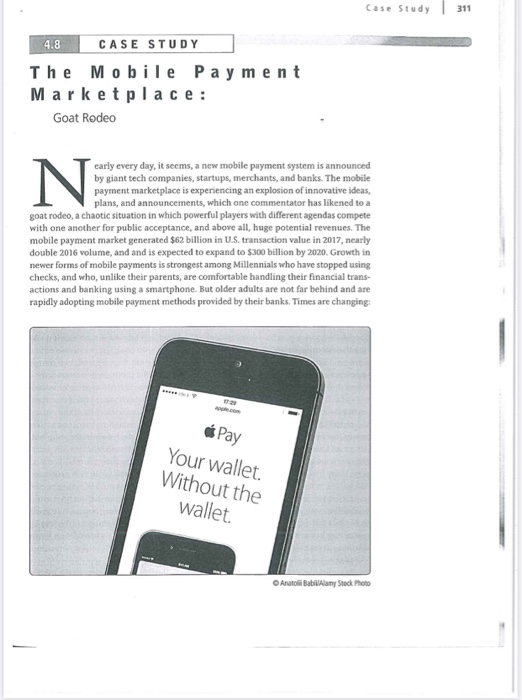
Case Study | 311 4.8 CASE STUDY The Mobile Payment Marketplace: Goat Rodeo early every day, it seems, a new mobile payment system is announced by giant tech companies, startups, merchants, and banks. The mobile payment marketplace is experiencing an explosion of innovative ideas, plans, and announcements, which one commentator has likened to a goat rodeo, a chaotic situation in which powerful players with different agendas compete with one another for public acceptance, and above all, huge potential revenues. The mobile payment market generated $62 billion in U.S. transaction value in 2017, nearly double 2016 volume, and and is expected to expand to $300 billion by 2020. Growth in newer forms of mobile payments is strongest among Millennials who have stopped using checks, and who, unlike their parents are comfortable handling their financial trans- actions and banking using a smartphone. But older adults are not far behind and are rapidly adopting mobile payment methods provided by their banks. Times are changing: Pay Your wallet. Without the wallet. Anatoli BabiAlamy Stock Photo 312 CHAPTER 4 E Commerce Security and Payment Systems for the first time, more people are using mobile banking on their phones and laptops than going to a bank branch American consumers spent over $5.7 trillion on credit and debit card transactions in 2016, and mobile payments are still just a tiny percentage of the existing credit and debit card system. But even if a small percentage of the $5.7 trillion credit card trans- actions move from plastic to mobile, the potential revenue is very large. On the other hand, moving consumers away from over 300 million credit and debit cards, which can be swiped at millions of merchants and used online with ease and safety, is proving to be a difficult task. The rosy future of mobile payments painted by tech companies may be a long time coming The mobile payment market is a battle among the titans of online payment and retailing: PayPal, credit card companies like Visa and MasterCard, Google, Apple, Samsung, and startup tech companies like Venmo and Square. The startups are backed by millions in venture capital. Even large retailers like Walmart, Best Buy, and Target are getting into the game by developing their own mobile payment apps. Major banks are in the line of fire who needs a checking account when you can pay with a mobile phone? Rising to this challenge, the banks are building their own mobile payment systems, and investing in startups to lead the charge. There are, by one count, about 2,000 startups in the global mobile payment market. The most recent startups focus on peer-to-peer mobile payments. Venmo is a good example, Venmo is a social mobile payment app that lets users transfer money to one another. It can also be used to pay at a small number of participating merchants Founded in 2010 by two college students who wanted to send cash to one another for sharing restaurant tabs and paying small debts without the hassle of cash or writing checks, Venmo was purchased by PayPal in 2013. Users sign up for a Venmo account and link their account to a bank account, a debit card, or credit card. Users can also create a pre-paid Venmo balance by sending money to their Venmo account, and then charge payments against that balance. There is no charge for the service when users have a Venmo balance or use a debit card, and a 3% charge for using a credit card as the source of funds. There is a social aspect of Venmo that allows users to share their purchase events (but with amount paid stripped from the notification). Users have the option to keep all transactions private as well. When they want to make a payment to another person, they enter the person's e-mail and the funds are transferred when the recipient, who must also have a Venmo account, accepts the payment. Venmo relies on NFC tech- nology to make in-person payments to individuals by tapping their phones. Venmo's popularity has skyrocketed, especially among Millennials, and in 2016 it processed $18 billion in transactions, a 135% increase over the previous year and was expected to process $28 billion in 2017. The company does not release information on its sub- scriber base, and because it is largely a free service, it does not contribute significantly to PayPal's gross revenues. PayPal has begun to monetize its investment in Venmo by expanding beyond peer-to-peer small payments, and extending its use to merchants who accept PayPal payments, a much larger user base, which includes large retailers like Home Depot, Target, Sears, and Office Max. Startups like Venmo are small fry compared to the three other giants in the mobile payment market. First in terms of subscribers are the technology companies like Apple, Case Study | 313 Google, Samsung, PayPal, and Square, all of which have major hardware and software mobile payment initiatives. Apple, Google, and Samsung own and license the hardware and software platform of the ubiquitous smartphone, while PayPal and Square operate large-scale payment processing platforms and apps that can be used on all smartphones Second, the large national merchants are developing their own mobile payment systems in an effort, in part, to sidestep the credit card companies (Visa, MasterCard, Discover, and American Express), which charge them a 3% transaction fee that gets passed along to the consumer as 3% higher prices, and in part to maintain control over the point of sale consumer moment at the cash register. These firms have tens of millions of loyal customers. Banks like JPMorgan Chase, Wells Fargo, Citi, and other money center banks, and of course, the credit card companies Visa, Master Card, and others, are the third major player. These firms have the advantage of owning and operating the global banking and credit card systems, with hundreds of millions of trusting and loyal banking and credit card customers, and the expertise to provide security and financial stability for their products. They are, however, late to the game, and are just now entering the mobile payment marketplace. Let's take a look at the technology companies first, all of whom offer variations on contactless payments, often referred to as digital or mobile wallets. Apple Pay is an app that comes with iPhone 6 phones and later. It uses built-in NFC technology. Users set up an account, and enter their banking credentials, using either their credit/debit card account information, or their checking or savings account, as the source of funds. When customers want to make a payment, they press the iPhone Touch ID button, which reads the customer's fingerprint and ensures the phone does indeed belong to the person. On the Apple Watch, there's a special button just for Apple Pay transactions Next, the consumer swipes the device near a merchant's NFC point-of-sale terminal, which begins the transaction process. The iPhone 6 and later comes with a hardware defined secure area on a chip that contains a unique device number and the ability to generate a one-time 16-digit code. Together they form a digital token. The token infor mation is encrypted and sent to Apple servers to verify the authenticity of the device and the person. Apple sends the payment request to the credit card issuer. Credit card issuers verify the account owner and available credit. In about one second, the transac tion is approved or denied. Credit Card Information is not shared with the merchant and not transmitted from the iPhone. The 800 million credit cards stored on Apple's iTunes servers are also encrypted. If hackers intercept the NFC communication at the point-of-sale, or intercept the stream of data moving over the cellular network, it would be useless, and incapable of supporting additional transactions because the message is encrypted, and involves a one-time-only digital token. Apple Pay is free to consumers, and the credit card companies charge their usual fee of 3% for each transaction. Apple collects. 15% from the credit companies and banks, and in return, guarantees the transaction is valid. Apple Pay does not store any user funds and is solely a technology-based intermediary between consumers and banks, and, unlike Venmo is not subject to federal banking regulations. Merchants' point-of- sale terminals need to be NFC-enabled, and merchants need to install Apple software to accept payments. Apple Pay can be used by any consumer that has a credit card from a major issuer bank 314 CHAPTER 4 E-commerce Security and Payment Systems Apple has developed relationships with many of the key players in the payment ecosystem, including credit giants Visa, MasterCard, American Express, and Discover, as well as 11 large bank credit card issuers including JPMorgan Chase, Bank of America, Citigroup, and Wells Fargo, which together account for 83% of U.S. credit card payment volume. Apple has also signed up national merchants such as Walgreens, Duane Reade, McDonald's, Disney, Macy's, Bloomingdale's, Staples, and Whole Foods Groupon and Uber have integrated Apple Payjnto their systems Android Pay is a Google app that provides an NFC-based payment system much like Apple Pay Android is the most widely used smartphone operating system in the world Launched in 2015, Android Pay replaces Google Wallet, which has been repurposed as a peer-to-peer payment service that allows users to pay friends using only their e-mail address, similar to PayPal and Venmo. Users sign up for an Android Pay account by entering their existing bank credit or debit card account information, or by deposit ing a prepaid balance of funds in their Android Pay account. Google is for some users a prepaid digital card where users transfer funds to their Android Pay account, and there fore is subject to federal regulations. To use Android Pay, customers hold their phone near the merchant's NFC terminal at checkout. Users are asked to enter their PIN and then choose to pay with either the credit or debit card on file with Android Pay or with their cash balance. If the user chooses to pay with a bank card, the app creates a unique digital token and sends this as an encrypted message to Android servers, which then communicate with the issuing bank, for approval. Approval messages are sent to the merchant's point-of-sale terminal. No card information is transmitted from the point of purchase. Android Pay is free for subscribers except when they use their credit card, which entails a 3% credit card transaction fee charged by the credit card companies. However, Google may offer consumers rewards, and in the future, display ads. Because Android Pay can store user funds, it is subject to federal banking regulations. Samsung Pay was introduced by Samsung in the United States in September 2015, after an earlier roll-out in Samsung's home country, South Korea Samsung smartphones are the most widely used smartphones in the world. As with Apple Pay and Android Pay, users create an account, and submit their bank credit or debit card information Samsung Pay prioritizes the use of NFC technology when merchants have the appropri ate terminal, but when that is not available, switches to a technology called Magnetic Secure Transmission that sends the card data stored on the user's device to traditional magnetic stripe terminals. This means that Samsung Pay can be used by the millions of existing point-of-sale card swiping terminals without upgrading to NFC terminals or installing any apps. Samsung Pay also stores coupons and reward cards, but does not store user funds and is not a prepaid card. Therefore, it most likely will not be subject to U.S.federal regulations. Like the other mobile wallets, it is essentially a place where users can store all their credit cards Currently, the most popular mobile payment systems are offered by PayPal and Square, some of which do not use NFC. While claiming to be financial services firms, both PayPal and Square are financial service software platform firms, technology companies in disguise. PayPal was late to the mobile payment market, beaten to the punch by Square Square started in 2009 with Square Reader, a square plastic device that Case Study | 315 plugged into an iPhone or iPad, and allowed users to easily set up a merchant license to accept credit cards, and then swipe the cards locally on the Square Reader device. Using the Square app, it allows merchants to easily accept credit card payments from custom- ers on the go. Square also developed Square Register (now called Point of Sale), which is a software app that turns a tablet into a point-of-sale terminal and cash register Square has morphed into a small business services company, serving coffee shops, newsstands small retailers, and farmers' market merchants, as well as piano teachers, baby sitters, and taxi drivers, allowing them to easily accept credit card payments Square generated $50 billion in transactions in 2016, up 40% from the previous year, but showed a loss of $15 million on revenue of $452 million PayPal is currently the most successful and profitable non-traditional online payment system, used mostly on desktops and tablets, but rapidly becoming a mobile payment force. PayPal is currently the largest alternative (non-credit card) online payment service, processing $354 billion in transactions in 2016, and has 197 million subscribers. PayPal processed $99 billion in mobile payments in 2016, up from 566 billion in 2015. PayPal is growing payment volume at around 25% annually. PayPal currently enables mobile payments in three ways. First, PayPal sells a device that allows merchants (mostly small businesses) to swipe credit cards using a smart- phone or tablet, just like the Square device. Second, the most common PayPal mobile payment occurs when customers use their mobile device browser on a tablet or smart- phone to make a purchase or payment at a website. This is not very helpful for mer chants like Starbucks, Macy's, or local restaurants, who would like customers to be able to purchase goods in their stores and outlets on the fly without keying in information to a smartphone. A third method is PayPal's updated app for iOS and Android devices On entering a merchant's store that accepts PayPal app payments, the app establishes a link using Bluetooth with the merchant's app that is also running on an iOS or Android device. This step authenticates the user's PayPal account. On checkout, the customer tells the merchant he or she will pay with PayPal. The merchant app charges the cus- tomer's PayPal account. After the payment is authorized, a message is sent to the customer's phone. No credit card information is being transmitted or shared with the merchant. Users do not have to enter a pincode or swipe their phone at a special merchant device, so merchants are not required to purchase an expensive NFC point- of-sale device, but they must have the PayPal merchant app stored on a desktop or mobile app, which is really acting like a digital cash register. In 2012, PayPal launched PayPal Here, a device that will both read credit cards equipped with computer chips, as well as accept payments from Android Pay and Apple Pay. The service includes a card reader that plugs into a tablet or smartphone, and a stand-alone contactless device that can accept NFC payments, as well as swipe credit cards. In 2015, PayPal launched the PayPal.me app, a peer-to-peer payment service that allows users to make and receive payments from friends. Users share their PayPal.me link with friends and can trans- fer money to their PayPal accounts. The service is free and is a direct competitor with Venmo and other P2P payment services. Venmo, which PayPal also owns, only works with U.S. banks, credit and debit cards, while PayPal.me is targeted at PayPal's global user base. In 2016 PayPal launched NFC payments for locations that accept Visa's con- 316 CHAPTER 4 E-commerce Security and Payment Systems tactless payments, and in 2017 added Citibank and Discover cards to its credit card banking relationships While mobile payment systems developed by technology companies are experienc ing rapid growth, mobile wallets developed by large national merchants have sputtered Large national merchants have had a contentious relationship with credit card firms because of the 3% fees charged by credit card companies, which raise prices to consum ers by the same amount Merchants would much prefer customers pay with store credit cards that are linked to the customer's bank account, or debit accounts, where banks do not charge a fee, or customer supplied prepayment funds. Some merchants also offer their own store credit cards and have developed their own transaction processing systems, circumventing the bank credit card system entirely. Merchants also want to control the point-of-sale moment, where they can offer coupons, loyalty rewards, and special discounts, rather than rely on mobile wallets provided by the technology com panies, which do not offer these capabilities. Despite their huge customer base and financial resources, the large retailers have not succeeded in by passing the credit card companies. In 2012, a joint venture of the 15 largest merchants announced the Merchant Customer Exchange (MCX). MCX was backed by Walmart, Target, Sears, 7-Eleven, Sunoco, and 10 other national pharmacies, supermarkets, and restaurant chains. The backers of this effort have annual sales of more than $1 trillion dollars. That was enough to make everyone involved in mobile payments stand up and listen, even Google and Apple. Their initial effort was coined CurrentC, and was piloted in 2014. CurrentC was an app that allowed customers to pay using their bank accounts, bank debit cards, or store-issued credit cards, but not tradi tional bank credit cards. The idea was to circumvent the bank credit system entirely, and avoid paying the credit companies their typical 3% fee. Current was withdrawn in 2016, and the MCX joint venture has ended due to squabbles among the partners, and an excessively long development time for the app. In 2016, Walmart introduced its own Walmart Pay app for both iOS and Android phones. Using OR recognition technology, not NFC, Walmart Pay now accepts all bank credit and debit cards, but the majority of customers use the in-house Walmart store credit card. It can also read coupons and offer rewards to loyal customers. Walmart Pay can only be used at Walmart stores, but given that Walmart has 146 million customers a week at 4,600 retail stores in the United States, that's not a terrible disadvantage. In 2017, 24 million customers were using the Walmart Pay app every month. The advantage to Walmart is that it owns the customer transaction, and information, without the intervention of the tech giants The third entrant to the mobile payment market is composed of the large national banks and credit card companies. Banks and credit card firms have been very slow moving into the mobile payment space, in part because the existing credit system works so well and their cards are widely accepted by consumers and merchants. Mobile payment systems from tech companies and merchants are competitors for the loyalty of bank customers who deposit billions of dollars in bank checking, savings, and debit cards, where banks can charge fees, and use the deposits essentially free of cost, given the low or non-existent interest rates on these accounts. JP Morgan Chase has launched Retail Checkout, a card reader that accepts tap card and mobile wallet NFC payments Case Study | 317 and the Chase Mobile app for smartphones and tablets, which allows bank customers to perform a wide variety of banking functions like peer-to-peer payments by e-mail (QuickPay) pay bills, deposit checks, check balances, and even apply for mortgages. Citi has launched Citi Mobile with similar functionality. Banks so far have not introduced apps for making NFC payments for consumer purchases, but these will surely be intro duced shortly. The large banks are investing heavily in payment startups to acquire these capabilities. In 2017, the large banks introduced a major joint effort to compete with PayPal and Venmo in the P2P marketspace with the introduction of Zelle, a mobile instant payment app. The goal is to bring mobile instant payments to over 86 million existing mobile banking customers. Unlike PayPal and Venmo, where it can take some time for transfers to occur, with Zelle the payments land nearly instantly in recipient accounts. In the first 6 months of operation, Zelle processed over $33 billion in mobile payments, compared to PayPal's $17 billion in mobile payments for the entire year of 2016! By the end of the year, Zelle will likely be processing four times as many mobile transactions as PayPal. The future for smartphone mobile wallets is assured given the size of the players involved, the potential rewards for successful players, and the demands of consumers for a payment system that does not involve swiping plastic cards, dealing with slips of paper receipts, and digging for cash in their pockets and purses Confused by all these mobile payment options? You're in good company: so are many consumers. The transition to mobile payments is going much slower than pundits initially thought, with millions of consumers trying the new methods once, and then not using them again because not enough merchants accept them, lack of familiarity, and concerns about security and privacy. The actual use of NFC-based integrated mobile wallets from Apple, Samsung, and Android Pay varies from 2% to 5% of those who even have the app, and growth is flat. In 2017, 38 million consumers used their phones to pay at the point of sale at least once in the preceding six months, about 20% of smartphone users. The P2P payment market has shown spectacular growth, especially among Mil- lennials, but utilization growth has slowed, and in the scheme of things, this is a small market that is vulnerable to P2P products offered by major banks, which already have over 100 million online banking customers. Most consumers are still happy to swipe their cards. It is unlikely that all the mobile payment systems described above will survive, and also quite likely that consumers will remain confused by all their payment options for some time to come. A full transition to mobile payments will be a long time coming Case Study Questions 1. Who are the three major players in the mobile payment market? 2. Why is Venmo considered a social-mobile payment system? 3. How does Apple Pay differ from Android Pay and Samsung Pay? 4. How does PayPal enable mobile payments
Step by Step Solution
There are 3 Steps involved in it

Get step-by-step solutions from verified subject matter experts
 Study Help