Question: Case study 7 Simplifying business processes to secure competitive advantage for Car Care Plan BACKGROUND AND HISTORY Car Care Plan (CCP) is one of the
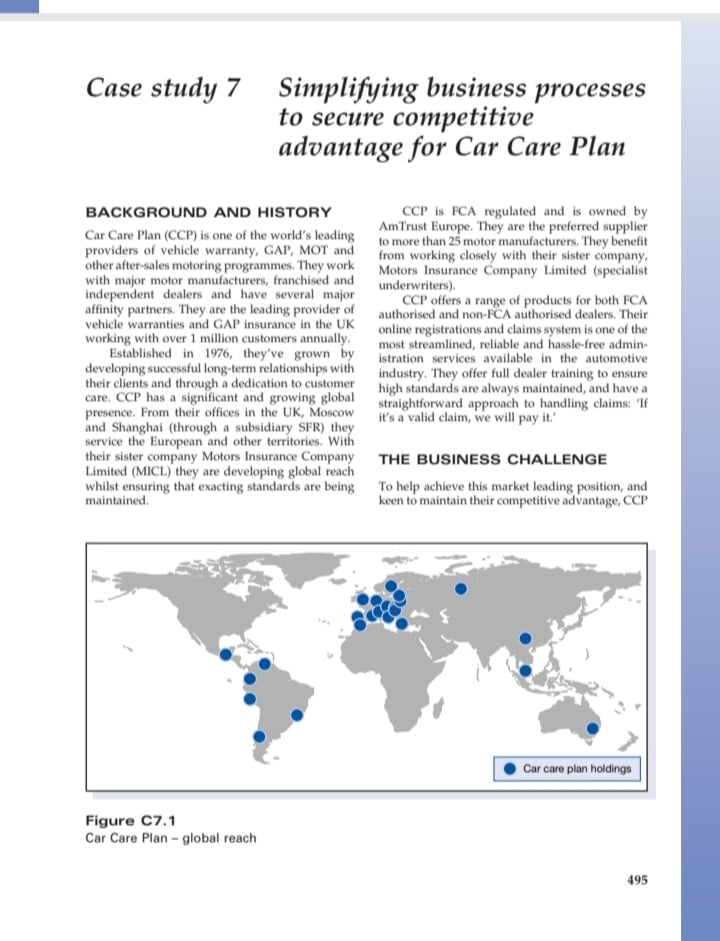
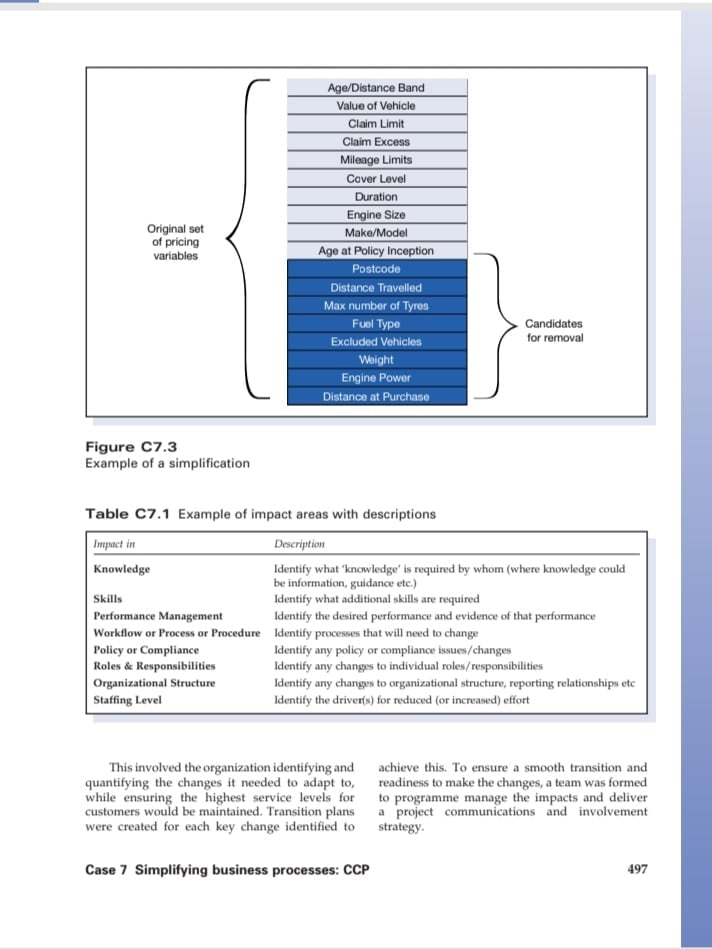
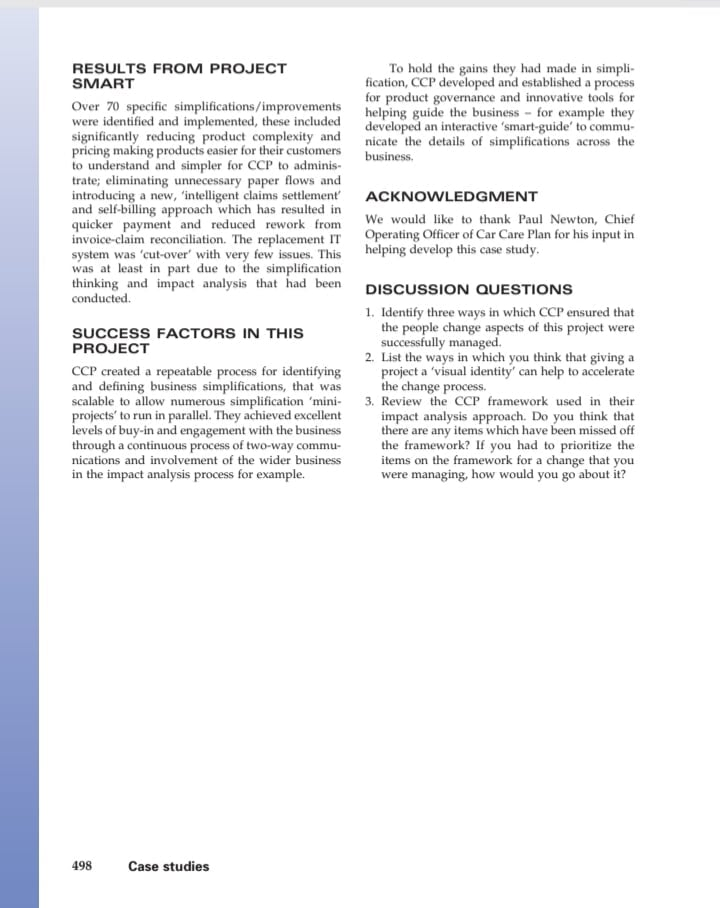
Case study 7 Simplifying business processes to secure competitive advantage for Car Care Plan BACKGROUND AND HISTORY Car Care Plan (CCP) is one of the world's leading providers of vehicle warranty, GAP, MOT and other after-sales motoring programmes. They work with major motor manufacturers, franchised and independent dealers and have several major affinity partners. They are the leading provider of vehicle warranties and GAP insurance in the UK working with over 1 million customers annually. Established in 1976, they've grown by developing successful long-term relationships with their clients and through a dedication to customer care. CCP has a significant and growing global presence. From their offices in the UK, Moscow and Shanghai (through a subsidiary SFR) they service the European and other territories. With their sister company Motors Insurance Company Limited (MICL) they are developing global reach whilst ensuring that exacting standards are being maintained CCP is FCA regulated and is owned by Am Trust Europe. They are the preferred supplier to more than 25 motor manufacturers. They benefit from working closely with their sister company, Motors Insurance Company Limited (specialist underwriters). CCP offers a range of products for both FCA authorised and non-FCA authorised dealers. Their online registrations and claims system is one of the most streamlined, reliable and hassle-free admin istration services available in the automotive industry. They offer full dealer training to ensure high standards are always maintained, and have a straightforward approach to handling claims: 'If it's a valid claim, we will pay it' THE BUSINESS CHALLENGE To help achieve this market leading position, and keen to maintain their competitive advantage, CCP Car care plan holdings Figure C7.1 Car Care Plan - global reach 495 project smart examined using simple Pareto Analyses which pricing variables were actively used in their policy pricing decisions. This allowed them to identify candidates for removal from their pricing algorithms - a simplification. simply better Figure C7.2 Project Smart decided to replace and future proof their legacy IT systems used for policy and claims administra- tion. They recognised that this was an excellent opportunity to drive simplification into their business processes, in order to maximize the benefits of the IT replacement and to achieve significant improvements in customer service and efficiency. They branded the project to give it an identity and logo that could be used for project documentation and to help in consistent communi- cations. The project was titled Project Smart and the 'strapline' was 'Simply Better'. OVERVIEW OF THEIR APPROACH TO SIMPLIFYING THEIR BUSINESS They adopted a phased approach to Project Smart in order to achieve business simplification: First they identified the key changes - simplifications - required to simplify a wide range of business processes and secured senior commitment to change. The second phase designed these changes and tested their feasibility, with the next layer of management owning the changes The third phase was to implement a set of improvements that were not reliant on the future IT system and assess the impact of the change. The fourth phase was to implement the new IT system and processes. MORE ABOUT HOW CCP APPROACHED THE PROJECT PHASES Phase 1: Using continuous improvement techni- ques (and broadly following a Plan-Do-Check-Act cycle) a team of business analysts and subject matter experts examined problems and improve ment opportunities, to identify potential simplifica- tions throughout the business (in Operations, Sales and Marketing, Finance, Underwriting, Actuarial and Compliance). The key activities in this phase were to assess the issues the business was experiencing, gather and summarise supporting data and to develop recommendations for improvement. CCP then conducted an externally facilitated series of work shops to refine those recommendations with the directors and senior managers to obtain buy-in to potential improvements. In these workshops they asked managers to self-nominate by voting using red cards to own and lead a simplification and blue cards to be part of the focus group delivering the simplification. Phase 2: CCP designed an approach to test the feasibility of the improvement recommendations using a 'core team' of business analysts and a group of business subject matter experts. Over 70 potential simplifications/improvements ('mini- projects) were identified. Work plans were created for the implementation of around 30 system independent simplifications. In parallel detailed requirements were developed for the systems dependent simplification of the business and the replacement IT system. Phase 3: CCP worked on their system inde pendent simplifications until a series of quick wins had been achieved (eg. rationalization of several major paper flows). Phase 4: CCP used an impact analysis approach to identify the impacts of the new system and processes, internally and for Car Care Plan's customers. Working with small focus groups of interested managers and employees, the planned and in progress changes were reviewed and a framework was used to identify the impacts of change (see Table C7.1). AN EXAMPLE OF A SIMPLIFICATION CCP analysed the number of pricing variables available in their existing system, they then 496 Case studies Original set of pricing variables Age/Distance Band Value of Vehicle Claim Limit Claim Excess Mileage Limits Cover Level Duration Engine Size Make/Model Age at Policy Inception Postcode Distance Travelled Max number of Tyres Fuel Type Excluded Vehicles Weight Engine Power Distance at Purchase Candidates for removal Figure C7.3 Example of a simplification Table C7.1 Example of impact areas with descriptions Impact in Description Knowledge Skills Performance Management Workflow or Process or Procedure Policy or Compliance Roles & Responsibilities Organizational Structure Staffing Level Identify what knowledge' is required by whom (where knowledge could be information, guidance etc.) Identify what additional skills are required Identify the desired performance and evidence of that performance Identify processes that will need to change Identify any policy or compliance issues/changes Identify any changes to individual roles/responsibilities Identify any changes to organizational structure, reporting relationships etc Identify the driver's) for reduced (or increased) effort This involved the organization identifying and quantifying the changes it needed to adapt to, while ensuring the highest service levels for customers would be maintained. Transition plans were created for each key change identified to achieve this. To ensure a smooth transition and readiness to make the changes, a team was formed to programme manage the impacts and deliver a project communications and involvement strategy. Case 7 Simplifying business processes: CCP 497 To hold the gains they had made in simpli- fication, CCP developed and established a process for product governance and innovative tools for helping guide the business - for example they developed an interactive 'smart-guide' to commu- nicate the details of simplifications across the business. RESULTS FROM PROJECT SMART Over 70 specific simplifications/improvements were identified and implemented, these included significantly reducing product complexity and pricing making products easier for their customers to understand and simpler for CCP to adminis- trate; eliminating unnecessary paper flows and introducing a new, 'intelligent claims settlement and self-billing approach which has resulted in quicker payment and reduced rework from invoice-claim reconciliation. The replacement IT system was 'cut-over' with very few issues. This was at least in part due to the simplification thinking and impact analysis that had been conducted. ACKNOWLEDGMENT We would like to thank Paul Newton, Chief Operating Officer of Car Care Plan for his input in helping develop this case study, SUCCESS FACTORS IN THIS PROJECT CCP created a repeatable process for identifying and defining business simplifications, that was scalable to allow numerous simplification 'mini- projects' to run in parallel. They achieved excellent levels of buy-in and engagement with the business through a continuous process of two-way commu- nications and involvement of the wider business in the impact analysis process for example, DISCUSSION QUESTIONS 1. Identify three ways in which CCP ensured that the people change aspects of this project were successfully managed. 2. List the ways in which you think that giving a project a 'visual identity' can help to accelerate the change process. 3. Review the CCP framework used in their impact analysis approach. Do you think that there are any items which have been missed off the framework? If you had to prioritize the items on the framework for a change that you were managing, how would you go about it? 498 Case studies Case study 7 Simplifying business processes to secure competitive advantage for Car Care Plan BACKGROUND AND HISTORY Car Care Plan (CCP) is one of the world's leading providers of vehicle warranty, GAP, MOT and other after-sales motoring programmes. They work with major motor manufacturers, franchised and independent dealers and have several major affinity partners. They are the leading provider of vehicle warranties and GAP insurance in the UK working with over 1 million customers annually. Established in 1976, they've grown by developing successful long-term relationships with their clients and through a dedication to customer care. CCP has a significant and growing global presence. From their offices in the UK, Moscow and Shanghai (through a subsidiary SFR) they service the European and other territories. With their sister company Motors Insurance Company Limited (MICL) they are developing global reach whilst ensuring that exacting standards are being maintained CCP is FCA regulated and is owned by Am Trust Europe. They are the preferred supplier to more than 25 motor manufacturers. They benefit from working closely with their sister company, Motors Insurance Company Limited (specialist underwriters). CCP offers a range of products for both FCA authorised and non-FCA authorised dealers. Their online registrations and claims system is one of the most streamlined, reliable and hassle-free admin istration services available in the automotive industry. They offer full dealer training to ensure high standards are always maintained, and have a straightforward approach to handling claims: 'If it's a valid claim, we will pay it' THE BUSINESS CHALLENGE To help achieve this market leading position, and keen to maintain their competitive advantage, CCP Car care plan holdings Figure C7.1 Car Care Plan - global reach 495 project smart examined using simple Pareto Analyses which pricing variables were actively used in their policy pricing decisions. This allowed them to identify candidates for removal from their pricing algorithms - a simplification. simply better Figure C7.2 Project Smart decided to replace and future proof their legacy IT systems used for policy and claims administra- tion. They recognised that this was an excellent opportunity to drive simplification into their business processes, in order to maximize the benefits of the IT replacement and to achieve significant improvements in customer service and efficiency. They branded the project to give it an identity and logo that could be used for project documentation and to help in consistent communi- cations. The project was titled Project Smart and the 'strapline' was 'Simply Better'. OVERVIEW OF THEIR APPROACH TO SIMPLIFYING THEIR BUSINESS They adopted a phased approach to Project Smart in order to achieve business simplification: First they identified the key changes - simplifications - required to simplify a wide range of business processes and secured senior commitment to change. The second phase designed these changes and tested their feasibility, with the next layer of management owning the changes The third phase was to implement a set of improvements that were not reliant on the future IT system and assess the impact of the change. The fourth phase was to implement the new IT system and processes. MORE ABOUT HOW CCP APPROACHED THE PROJECT PHASES Phase 1: Using continuous improvement techni- ques (and broadly following a Plan-Do-Check-Act cycle) a team of business analysts and subject matter experts examined problems and improve ment opportunities, to identify potential simplifica- tions throughout the business (in Operations, Sales and Marketing, Finance, Underwriting, Actuarial and Compliance). The key activities in this phase were to assess the issues the business was experiencing, gather and summarise supporting data and to develop recommendations for improvement. CCP then conducted an externally facilitated series of work shops to refine those recommendations with the directors and senior managers to obtain buy-in to potential improvements. In these workshops they asked managers to self-nominate by voting using red cards to own and lead a simplification and blue cards to be part of the focus group delivering the simplification. Phase 2: CCP designed an approach to test the feasibility of the improvement recommendations using a 'core team' of business analysts and a group of business subject matter experts. Over 70 potential simplifications/improvements ('mini- projects) were identified. Work plans were created for the implementation of around 30 system independent simplifications. In parallel detailed requirements were developed for the systems dependent simplification of the business and the replacement IT system. Phase 3: CCP worked on their system inde pendent simplifications until a series of quick wins had been achieved (eg. rationalization of several major paper flows). Phase 4: CCP used an impact analysis approach to identify the impacts of the new system and processes, internally and for Car Care Plan's customers. Working with small focus groups of interested managers and employees, the planned and in progress changes were reviewed and a framework was used to identify the impacts of change (see Table C7.1). AN EXAMPLE OF A SIMPLIFICATION CCP analysed the number of pricing variables available in their existing system, they then 496 Case studies Original set of pricing variables Age/Distance Band Value of Vehicle Claim Limit Claim Excess Mileage Limits Cover Level Duration Engine Size Make/Model Age at Policy Inception Postcode Distance Travelled Max number of Tyres Fuel Type Excluded Vehicles Weight Engine Power Distance at Purchase Candidates for removal Figure C7.3 Example of a simplification Table C7.1 Example of impact areas with descriptions Impact in Description Knowledge Skills Performance Management Workflow or Process or Procedure Policy or Compliance Roles & Responsibilities Organizational Structure Staffing Level Identify what knowledge' is required by whom (where knowledge could be information, guidance etc.) Identify what additional skills are required Identify the desired performance and evidence of that performance Identify processes that will need to change Identify any policy or compliance issues/changes Identify any changes to individual roles/responsibilities Identify any changes to organizational structure, reporting relationships etc Identify the driver's) for reduced (or increased) effort This involved the organization identifying and quantifying the changes it needed to adapt to, while ensuring the highest service levels for customers would be maintained. Transition plans were created for each key change identified to achieve this. To ensure a smooth transition and readiness to make the changes, a team was formed to programme manage the impacts and deliver a project communications and involvement strategy. Case 7 Simplifying business processes: CCP 497 To hold the gains they had made in simpli- fication, CCP developed and established a process for product governance and innovative tools for helping guide the business - for example they developed an interactive 'smart-guide' to commu- nicate the details of simplifications across the business. RESULTS FROM PROJECT SMART Over 70 specific simplifications/improvements were identified and implemented, these included significantly reducing product complexity and pricing making products easier for their customers to understand and simpler for CCP to adminis- trate; eliminating unnecessary paper flows and introducing a new, 'intelligent claims settlement and self-billing approach which has resulted in quicker payment and reduced rework from invoice-claim reconciliation. The replacement IT system was 'cut-over' with very few issues. This was at least in part due to the simplification thinking and impact analysis that had been conducted. ACKNOWLEDGMENT We would like to thank Paul Newton, Chief Operating Officer of Car Care Plan for his input in helping develop this case study, SUCCESS FACTORS IN THIS PROJECT CCP created a repeatable process for identifying and defining business simplifications, that was scalable to allow numerous simplification 'mini- projects' to run in parallel. They achieved excellent levels of buy-in and engagement with the business through a continuous process of two-way commu- nications and involvement of the wider business in the impact analysis process for example, DISCUSSION QUESTIONS 1. Identify three ways in which CCP ensured that the people change aspects of this project were successfully managed. 2. List the ways in which you think that giving a project a 'visual identity' can help to accelerate the change process. 3. Review the CCP framework used in their impact analysis approach. Do you think that there are any items which have been missed off the framework? If you had to prioritize the items on the framework for a change that you were managing, how would you go about it? 498 Case studies









 Study Help