Question: Case Study 8: ABC's Computerization Project B Chuah 1. Project Background In ABC Company, there were two management control programs running on two different computer
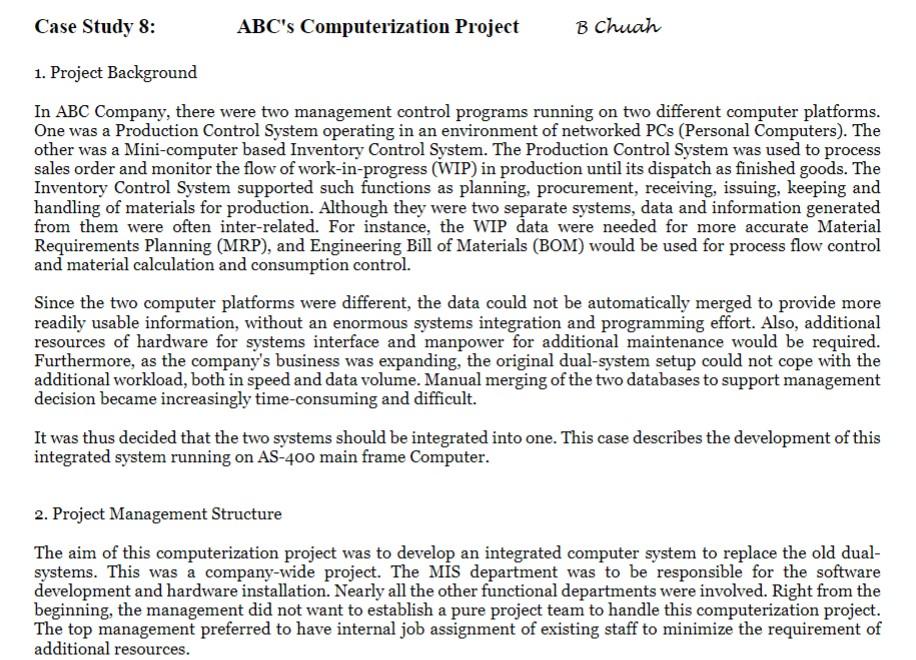
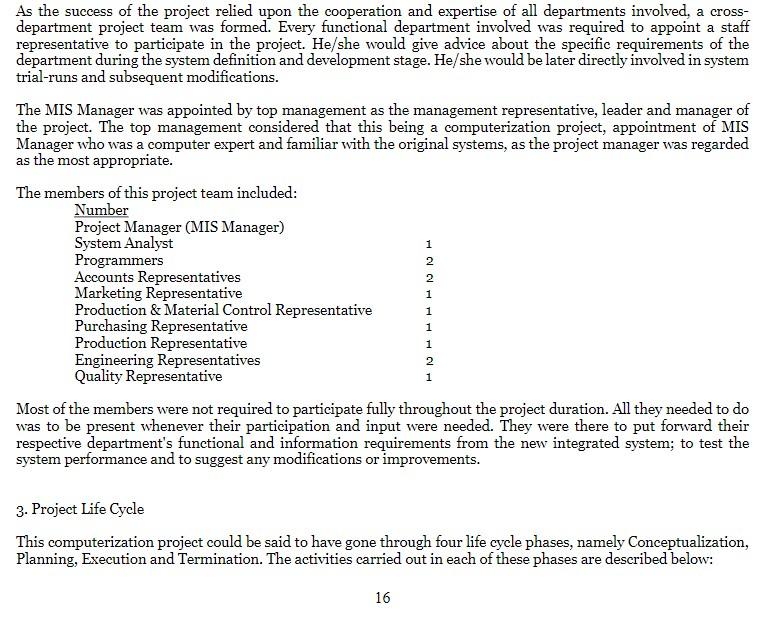
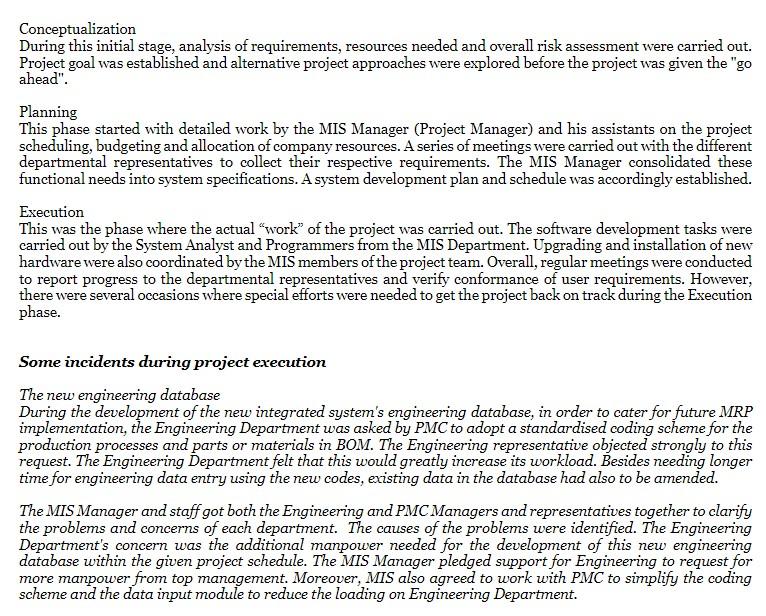
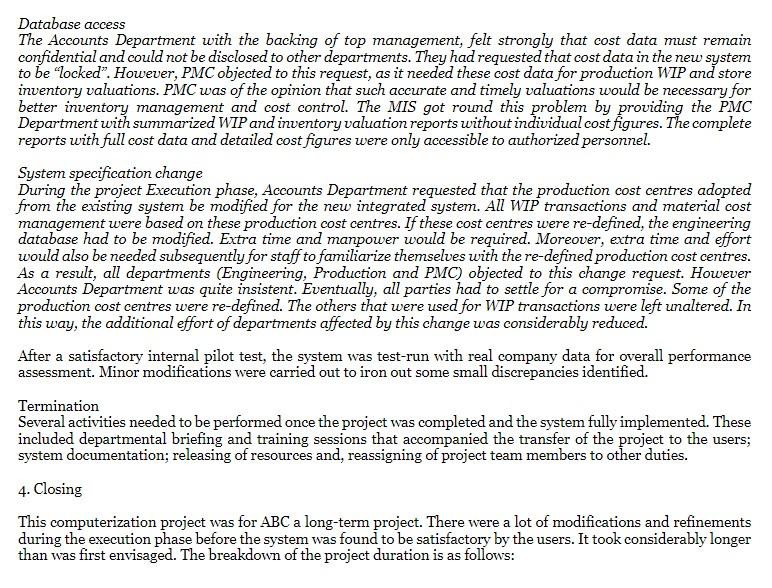
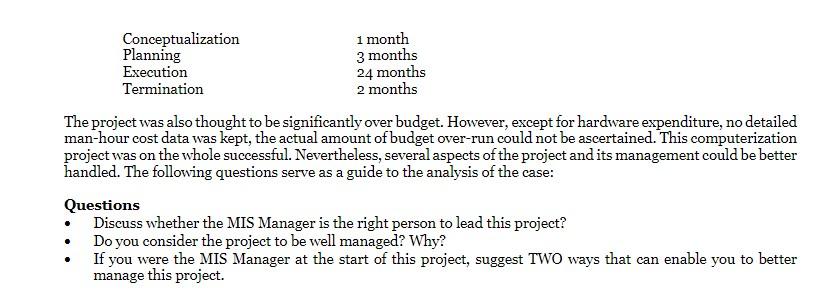
Case Study 8: ABC's Computerization Project B Chuah 1. Project Background In ABC Company, there were two management control programs running on two different computer platforms. One was a Production Control System operating in an environment of networked PCs (Personal Computers). The other was a Mini-computer based Inventory Control System. The Production Control System was used to process sales order and monitor the flow of work-in-progress (WIP) in production until its dispatch as finished goods. The Inventory Control System supported such functions as planning, procurement, receiving, issuing, keeping and handling of materials for production. Although they were two separate systems, data and information generated from them were often inter-related. For instance, the WIP data were needed for more accurate Material Requirements Planning (MRP), and Engineering Bill of Materials (BOM) would be used for process flow control and material calculation and consumption control. Since the two computer platforms were different, the data could not be automatically merged to provide more readily usable information, without an enormous systems integration and programming effort. Also, additional resources of hardware for systems interface and manpower for additional maintenance would be required. Furthermore, as the company's business was expanding, the original dual-system setup could not cope with the additional workload, both in speed and data volume. Manual merging of the two databases to support management decision became increasingly time-consuming and difficult. It was thus decided that the two systems should be integrated into one. This case describes the development of this integrated system running on AS-400 main frame Computer. 2. Project Management Structure The aim of this computerization project was to develop an integrated computer system to replace the old dual- systems. This was a company-wide project. The MIS department was to be responsible for the software development and hardware installation. Nearly all the other functional departments were involved. Right from the beginning, the management did not want to establish a pure project team to handle this computerization project. The top management preferred to have internal job assignment of existing staff to minimize the requirement of additional resources. As the success of the project relied upon the cooperation and expertise of all departments involved, a cross- department project team was formed. Every functional department involved was required to appoint a staff representative to participate in the project. He/she would give advice about the specific requirements of the department during the system definition and development stage. He/she would be later directly involved in system trial-runs and subsequent modifications. The MIS Manager was appointed by top management as the management representative, leader and manager of the project. The top management considered that this being a computerization project, appointment of MIS Manager who was a computer expert and familiar with the original systems, as the project manager was regarded as the most appropriate. The members of this project team included: Number Project Manager (MIS Manager) System Analyst Programmers Accounts Representatives Marketing Representative Production & Material Control Representative Purchasing Representative 1 Production Representative 1 Engineering Representatives 2 Quality Representative 1 Most of the members were not required to participate fully throughout the project duration. All they needed to do was to be present whenever their participation and input were needed. They were there to put forward their respective department's functional and information requirements from the new integrated system; to test the system performance and to suggest any modifications or improvements. 2 2 1 NNN 3. Project Life Cycle This computerization project could be said to have gone through four life cycle phases, namely Conceptualization, Planning, Execution and Termination. The activities carried out in each of these phases are described below: 16 Conceptualization During this initial stage, analysis of requirements, resources needed and overall risk assessment were carried out. Project goal was established and alternative project approaches were explored before the project was given the "go ahead". Planning This phase started with detailed work by the MIS Manager (Project Manager) and his assistants on the project scheduling, budgeting and allocation of company resources. A series of meetings were carried out with the different departmental representatives to collect their respective requirements. The MIS Manager consolidated these functional needs into system specifications. A system development plan and schedule was accordingly established. Execution This was the phase where the actual work" of the project was carried out. The software development tasks were carried out by the System Analyst and Programmers from the MIS Department. Upgrading and installation of new hardware were also coordinated by the MIS members of the project team. Overall, regular meetings were conducted to report progress to the departmental representatives and verify conformance of user requirements. However, there were several occasions where special efforts were needed to get the project back on track during the Execution phase. Some incidents during project execution The new engineering database During the development of the new integrated system's engineering database, in order to cater for future MRP implementation, the Engineering Department was asked by PMC to adopt a standardised coding scheme for the production processes and parts or materials in BOM. The Engineering representative objected strongly to this request. The Engineering Department felt that this would greatly increase its workload. Besides needing longer time for engineering data entry using the new codes, existing data in the database had also to be amended. The MIS Manager and staff got both the Engineering and PMC Managers and representatives together to clarify the problems and concerns of each department. The causes of the problems were identified. The Engineering Department's concern was the additional manpower needed for the development of this new engineering database within the given project schedule. The MIS Manager pledged support for Engineering to request for more manpower from top management. Moreover, MIS also agreed to work with PMC to simplify the coding scheme and the data input module to reduce the loading on Engineering Department. Database access The Accounts Department with the backing of top management, felt strongly that cost data must remain confidential and could not be disclosed to other departments. They had requested that cost data in the new system to be locked". However, PMC objected to this request, as it needed these cost data for production WIP and store inventory valuations. PMC was of the opinion that such accurate and timely valuations would be necessary for better inventory management and cost control. The MIS got round this problem by providing the PMC Department with summarized WIP and inventory valuation reports without individual cost figures. The complete reports with full cost data and detailed cost figures were only accessible to authorized personnel. System specification change During the project Execution phase, Accounts Department requested that the production cost centres adopted from the existing system be modified for the new integrated system. All WIP transactions and material cost management were based on these production cost centres. If these cost centres were re-defined, the engineering database had to be modified. Extra time and manpower would be required. Moreover, extra time and effort would also be needed subsequently for staff to familiarize themselves with the re-defined production cost centres. As a result, all departments (Engineering, Production and PMC) objected to this change request. However Accounts Department was quite insistent. Eventually, all parties had to settle for a compromise. Some of the production cost centres were re-defined. The others that were used for WIP transactions were left unaltered. In this way, the additional effort of departments affected by this change was considerably reduced. After a satisfactory internal pilot test, the system was test-run with real company data for overall performance assessment. Minor modifications were carried out to iron out some small discrepancies identified. Termination Several activities needed to be performed once the project was completed and the system fully implemented. These included departmental briefing and training sessions that accompanied the transfer of the project to the users; system documentation; releasing of resources and, reassigning of project team members to other duties. 4. Closing This computerization project was for ABC a long-term project. There were a lot of modifications and refinements during the execution phase before the system was found to be satisfactory by the users. It took considerably longer than was first envisaged. The breakdown of the project duration is as follows: Conceptualization 1 month Planning 3 months Execution 24 months Termination 2 months The project was also thought to be significantly over budget. However, except for hardware expenditure, no detailed man-hour cost data was kept, the actual amount of budget over-run could not be ascertained. This computerization project was on the whole successful. Nevertheless, several aspects of the project and its management could be better handled. The following questions serve as a guide to the analysis of the case: Questions Discuss whether the MIS Manager is the right person to lead this project? Do you consider the project to be well managed? Why? If you were the MIS Manager at the start of this project, suggest TWO ways that can enable you to better manage this project









 Study Help