





Question: CASE STUDY 8-1 Discharged for Facebook Comments free speech which she was entitled to make. Employees have a right to discuss terms and conditions of
CASE STUDY 8-1 Discharged for Facebook Comments
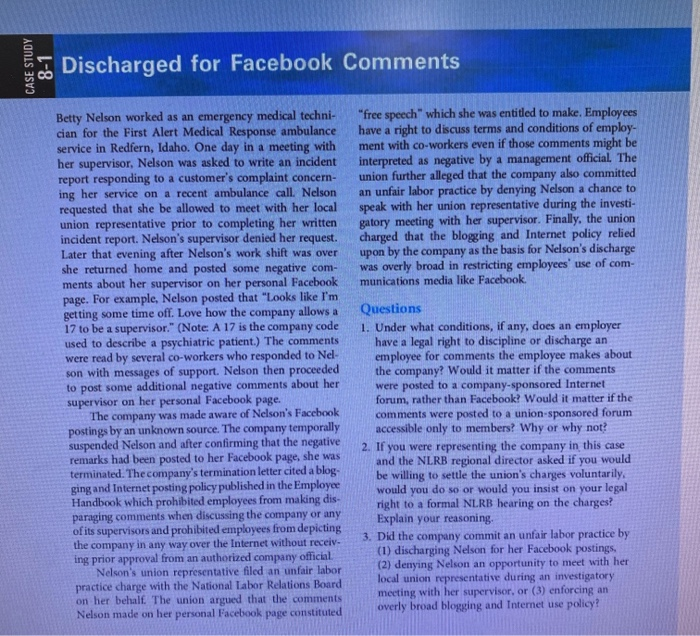
CASE STUDY 8-1 Discharged for Facebook Comments "free speech" which she was entitled to make. Employees have a right to discuss terms and conditions of employ- ment with co-workers even if those comments might be interpreted as negative by a management official. The union further alleged that the company also committed an unfair labor practice by denying Nelson a chance to speak with her union representative during the investi- gatory meeting with her supervisor. Finally, the union charged that the blogging and Internet policy relied upon by the company as the basis for Nelson's discharge was overly broad in restricting employees' use of com- munications media like Facebook Betty Nelson worked as an emergency medical techni- cian for the First Alert Medical Response ambulance service in Redfern, Idaho. One day in a meeting with her supervisor, Nelson was asked to write an incident report responding to a customer's complaint concern- ing her service on a recent ambulance call. Nelson requested that she be allowed to meet with her local union representative prior to completing her written incident report. Nelson's supervisor denied her request. Later that evening after Nelson's work shift was over she returned home and posted some negative com- ments about her supervisor on her personal Facebook page. For example, Nelson posted that "Looks like I'm getting some time off. Love how the company allows a 17 to be a supervisor." (Note: A 17 is the company code used to describe a psychiatric patient.) The comments were read by several co-workers who responded to Nel- son with messages of support. Nelson then proceeded to post some additional negative comments about her supervisor on her personal Facebook page. The company was made aware of Nelson's Facebook postings by an unknown source. The company temporally suspended Nelson and after confirming that the negative remarks had been posted to her Facebook page, she was terminated. The company's termination letter cited a blog ging and Internet posting policy published in the Employee Handbook which prohibited employees from making dis- paraging comments when discussing the company or any of its supervisors and prohibited employees from depicting the company in any way over the Internet without receiv- ing prior approval from an authorized company official Nelson's union representative filed an unfair labor practice charge with the National Labor Relations Board on her behalf. The union argued that the comments Nelson made on her personal Facebook page constituted Questions 1. Under what conditions, if any, does an employer have a legal right to discipline or discharge an employee for comments the employee makes about the company? Would it matter if the comments were posted to a company-sponsored Internet forum, rather than Facebook? Would it matter if the comments were posted to a union-sponsored forum accessible only to members? Why or why not? 2. If you were representing the company in this case and the NLRB regional director asked if you would be willing to settle the union's charges voluntarily. would you do so or would you insist on your legal right to a formal NLRB bearing on the charges? Explain your reasoning. 3. Did the company commit an unfair labor practice by (1) discharging Nelson for her Facebook postings, (2) denying Nelson an opportunity to meet with her local union representative during an investigatory meeting with her supervisor, or (3) enforcing an overly broad blogging and Internet use policy

Step by Step Solution

There are 3 Steps involved in it

1 Expert Approved Answer
Step: 1 Unlock blur-text-image

Question Has Been Solved by an Expert!

Get step-by-step solutions from verified subject matter experts

Step: 2 Unlock
Step: 3 Unlock

Students Have Also Explored These Related General Management Questions!