



Question: Case study 9:Managing the Emotional Employee in the Work Setting Employees emotional behaviour is a common challenge for any manager. It may be overt and
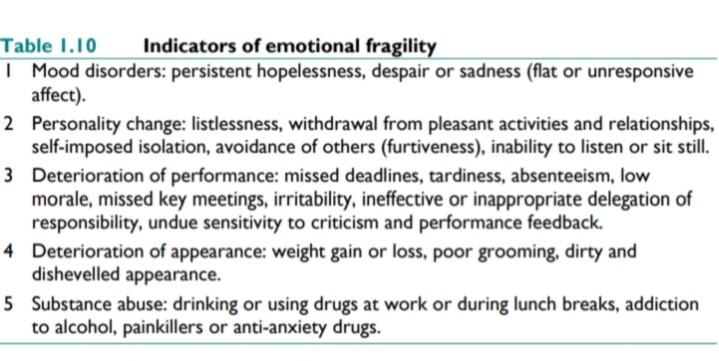
Case study 9:Managing the Emotional Employee in the Work Setting Employees emotional behaviour is a common challenge for any manager. It may be overt and easily detectable, or it can be subtle, because emotional workers (who fear forms of workplace rejection) often direct their subconscious turmoil inward to hide and deny its existence. Over time, emotionally fragile individuals are less able to hide their increasingly obvious psychological, behavioural and physical distress, and it shows up in some combination of the symptoms shown in Table 1.10.
Employees with the above symptoms could be among your work colleagues, so give this widespread phenomenon some thought. When asked privately about their lives (in an environment of perceived psychological safety), emotionally fragile employees frequently report sleeping poorly because they are wrestling with anxiety stemming from financial and job insecurity. As these worries increase in number and severity, emotional employees experience more paralysing self-doubt (they are trapped in a feedback loop: more symptoms trigger more self-doubt and vice versa). The earliest signs of emotional fragility in employees are actions such as suddenly staying late and working too hard (over-compensation) or coming in late, being despondent and detached from work and exhibiting annoyance that is out of proportion to the work demands at hand (reactivity). Helping fragile employees reattach to their jobs Your chances of helping an emotionally fragile employee reattach to his or her job rise when you detect (and act on) the forms of deterioration noted in Table 1.10. If you choose to intervene, you can launch your rescue plan by conveying a sense of understanding (empathy) to the afflicted employee. Your empathetic support slows or Module 1 / The Basics of Organisational Behaviour and Its Relation to Management Organisational Behaviour Edinburgh Business School 1/47 stops his growing sense of aloneness and self-imposed isolation. To get this going in the right direction, you can ask your employee how he is doing. This is a non-intrusive way of inviting empathy-based communication as opposed to demanding answers (or assigning labels like mental illness), which probably would only reignite his self-imposed isolation. Stick to describing behaviour instead of using labels, because the former aligns and supports your empathetic tone. Lets pound this point home one more time with an example. You dont want to say: I think you are anorexic. Rather, you want to say: I am concerned by your weight loss; perhaps you are losing too much weight. Remember, empathy (the reduction of emotional distance) always avoids the assignment of stigma. If your co-worker or subordinate is receptive to your concern, he may decide to seek professional help through a licensed therapist or the companys employee assistance programme. This would surely be a significant step in the right direction. Please note that you will go in the wrong direction if you impulsively agree to help the employee outside of work. This misstep gives your dependence-prone subordinate or co-worker the mistaken impression that it will be all right for him to rely on you for much more than you bargained for. You will soon lose control of the helping relationship, and your authority will be undermined (perhaps along with other things too). Your consideration for a distressed employee must remain job centred and performance oriented. You are a manager or executive not a trained professional therapist and you should point that out early on if you sense your subordinates growing dependence on you. If you immerse yourself in your fragile employees problems calling doctors, making appointments, being an after-hours counsellor then you have undertaken the duty to help. This duty then continues, and you could be sued for negligence in the future if you decide to suspend your assistance. In this instance, please remember: No good deed goes unpunished! If you are the boss, you stick with work-related assistance. Hand out your firms employee-assistance number when you think you have to. Lighten a workload here and there or suggest to the too hard-working employee that it is time for a holiday or a day off (with pay if you are feeling generous). These and related actions signal your continued empathy. Maybe the employee you are trying to help resists your assistance for some reason. If he or she is still performing, and not undermining operational effectiveness, then back off. You have done your job, and you have clearly shown the employee that you care. Sometimes that alone is enough. Further Reading: Emotionality 1. Grant, J. (2008) Impulse Control Disorders: A Clinicians Guide to Understanding and Treating Behavioral Addictions. New York, NY: Norton. 2. Kelly, K. (2008) Lost Opportunities Haunt Final Days of Bear Stearns. Wall Street Journal, Vol. CCLI, No. 123 A1,
A17. Case Question: 1. How much responsibility does the firm have to assist troubled employees? 2. What would be the reactions of high-performing employees upon learning that their well-liked and once productive but fragile colleague was just sacked?
Table 1.10 Indicators of emotional fragility | Mood disorders: persistent hopelessness, despair or sadness (flat or unresponsive affect). 2 Personality change: listlessness, withdrawal from pleasant activities and relationships, self-imposed isolation, avoidance of others (furtiveness), inability to listen or sit still. 3 Deterioration of performance: missed deadlines, tardiness, absenteeism, low morale, missed key meetings, irritability, ineffective or inappropriate delegation of responsibility, undue sensitivity to criticism and performance feedback. 4 Deterioration of appearance: weight gain or loss, poor grooming, dirty and dishevelled appearance. 5 Substance abuse: drinking or using drugs at work or during lunch breaks, addiction to alcohol, painkillers or anti-anxiety drugs
Step by Step Solution
There are 3 Steps involved in it

Get step-by-step solutions from verified subject matter experts