







Question: Case Study: Absorption Costing and Its Implications for Decision-Making XYZ Manufacturing Inc. is a medium-sized company that specializes in producing industrial machinery. The company
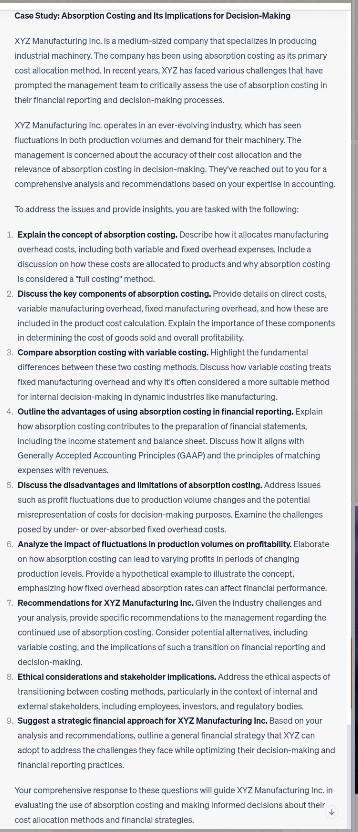
Case Study: Absorption Costing and Its Implications for Decision-Making XYZ Manufacturing Inc. is a medium-sized company that specializes in producing industrial machinery. The company has been using absorption costing as its primary cost allocation method. In recent years, XYZ has faced various challenges that have prompted the management team to critically assess the use of absorption costing in their financial reporting and decision-making processes. XYZ Manufacturing Inc. operates in an ever-evolving industry, which has seen fluctuations in both production volumes and demand for their machinery. The management is concerned about the accuracy of their cost allocation and the relevance of absorption costing in decision-making. They've reached out to you for a comprehensive analysis and recommendations based on your expertise in accounting. To address the issues and provide insights you are tasked with the following: 1. Explain the concept of absorption costing. Describe how it allocates manufacturing overhead costs, including both variable and fixed overhead expenses. Include a discussion on how these costs are allocated to products and why absorption costing is considered a "tull costing method. 2. Discuss the key components of absorption costing. Provide details on direct costs, variable manufacturing overhead, fixed manufacturing overhead, and how these are included in the product cost calculation. Explain the importance of these components in determining the cost of goods sold and overall profitability. 3. Compare absorption costing with variable costing. Highlight the fundamental differences between these two casting methods. Discuss how variable costing treats fixed manufacturing overhead and why it's often considered a more suitable method for internal decision-making in dynamic industries like manufacturing. 4. Outline the advantages of using absorption costing in financial reporting. Explain how absorption costing contributes to the preparation of financial statements, Including the income statement and balance sheet. Discuss how it aligns with Generally Accepted Accounting Principles (GAAP) and the principles of matching expenses with revenues. 5. Discuss the disadvantages and limitations of absorption costing. Address issues such as profit fluctuations due to production volume changes and the potential misrepresentation of costs for decision-making purposes. Examine the challenges posed by under-or over-absorbed fixed overhead costs, 6. Analyze the impact of fluctuations in production volumes on profitability. Elaborate on how absorption costing can lead to varying profits in periods of changing production levels. Provide a hypothetical example to illustrate the concept. emphasizing how fixed overhead absorption rates can affect financial performance. 7. Recommendations for XYZ Manufacturing Inc. Given the Industry challenges and your analysis, provide specific recommendations to the management regarding the continued use of absorption costing. Consider potential alternatives, including variable costing, and the implications of such a transition on financial reporting and decision-making. 8. Ethical considerations and stakeholder implications. Address the ethical aspects of transitioning between costing methods, particularly in the context of internal and external stakeholders, including employees, investors, and regulatory bodies. 9. Suggest a strategic financial approach for XYZ Manufacturing Inc. Based on your analysis and recommendations, outline a general financial strategy that XYZ can adopt to address the challenges they face while optimizing their decision-making and financial reporting practices. Your comprehensive response to these questions will guide XYZ Manufacturing Inc. in evaluating the use of absorption costing and making Informed decisions about their cost allocation methods and financial strategies.
Step by Step Solution
There are 3 Steps involved in it
ANSWER 1 Absorption costing is a traditional method of cost allocation that assigns both variable and fixed manufacturing overhead costs to products It is called absorption costing because it aims to ... View full answer

Get step-by-step solutions from verified subject matter experts
 Study Help