



Question: Case study: Alibaba in Europe (please answer the questions) 1. What are the opportunities and challenges when internationalizing into Europe? Which opportunities and challenges specifically
Case study: Alibaba in Europe (please answer the questions)
1. What are the opportunities and challenges when internationalizing into Europe? Which opportunities and challenges specifically related to the Alibaba Group and why?
2. How does the expansion of Alibaba into the EU affect European e-commerce market? How and why do the strategies pursued by Alibaba, Amazon and eBay differ?
3. How does Alibaba seek to become 'the enabler' for the European consumers and companies? Is the scale and scope of European International relations a likely advantage to Alibaba and its clients?
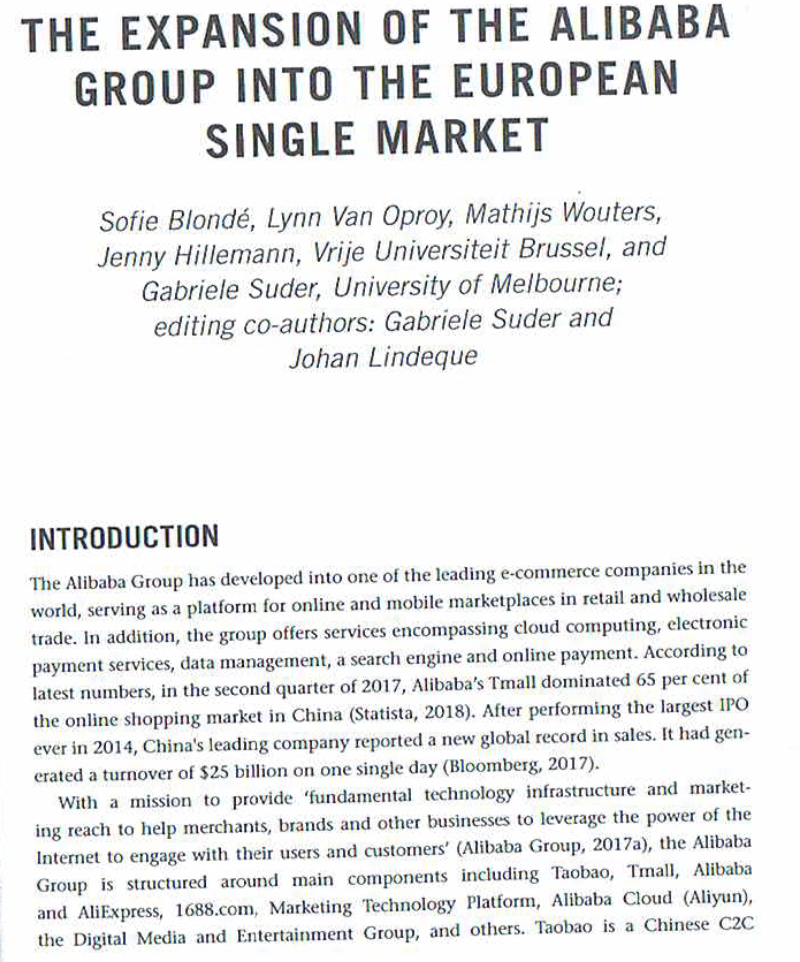
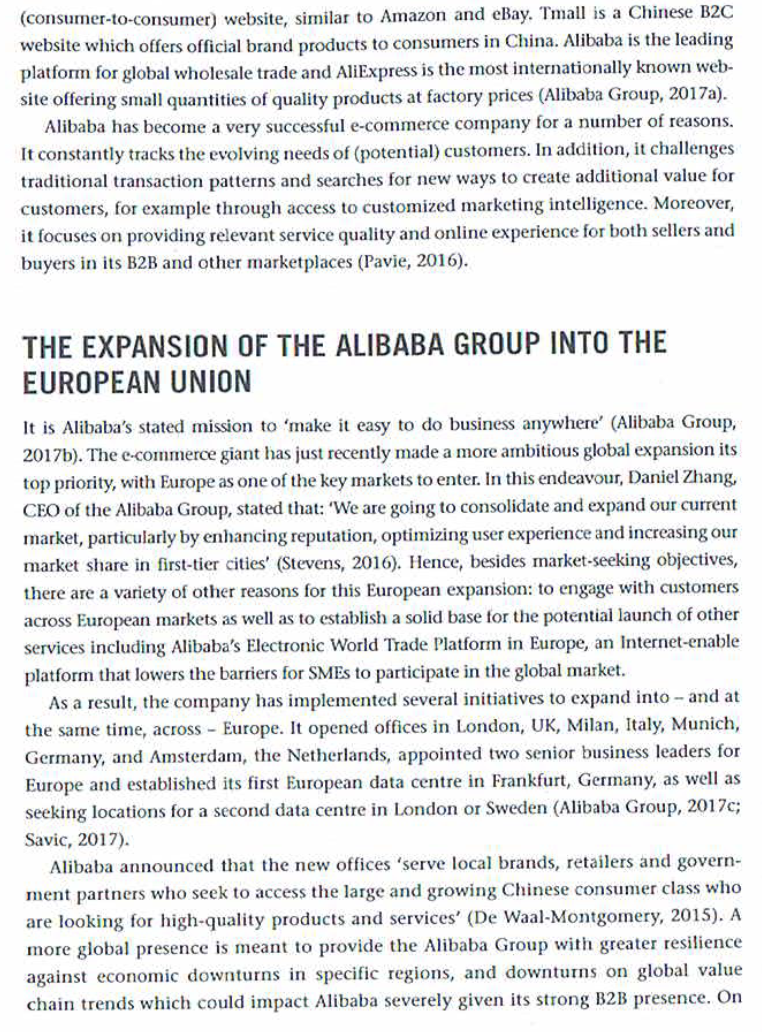
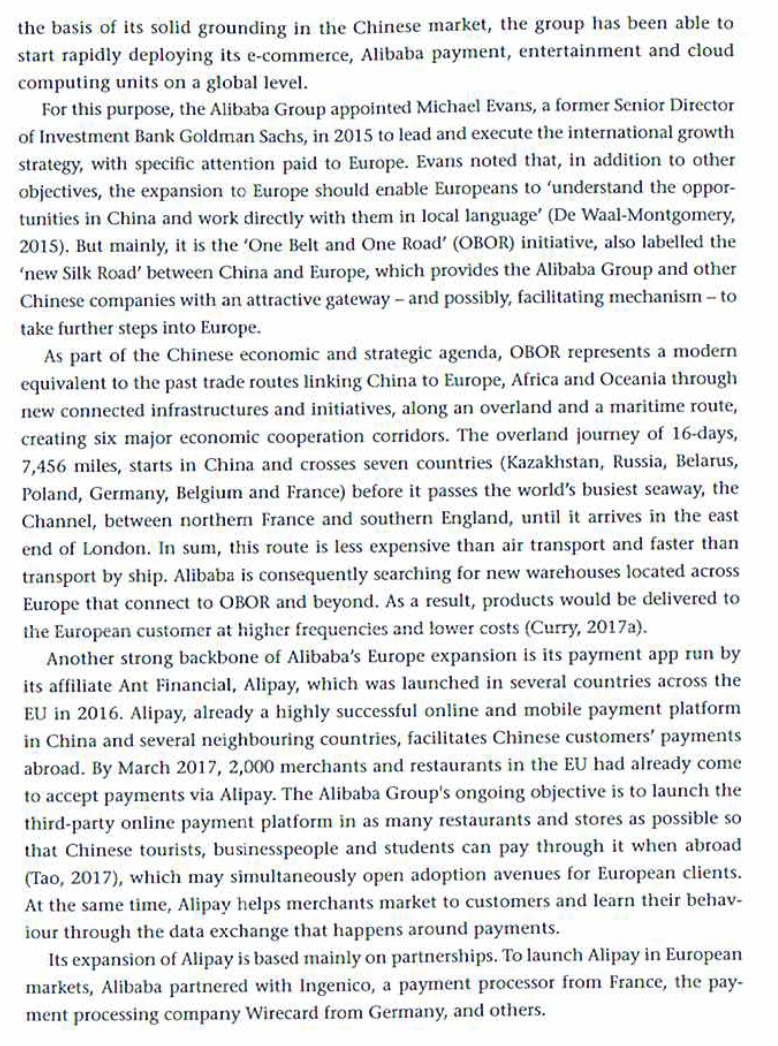
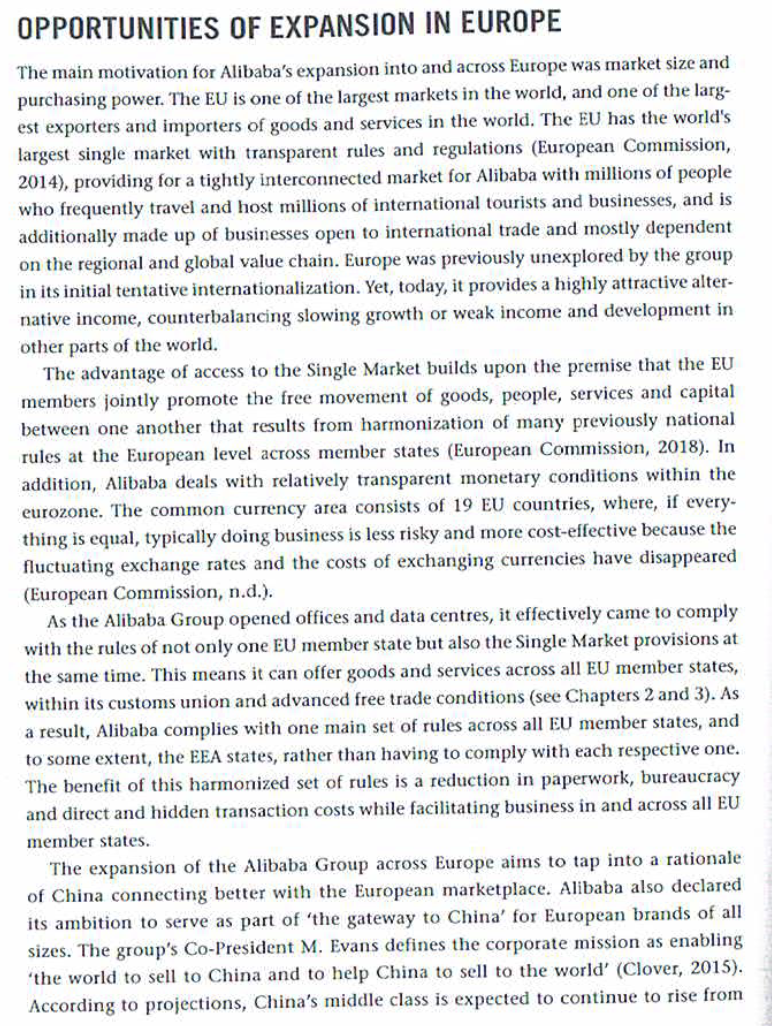
THE EXPANSION OF THE ALIBABA GROUP INTO THE EUROPEAN SINGLE MARKET Sofie Blond, Lynn Van Oproy, Mathijs Wouters, Jenny Hillemann, Vrije Universiteit Brussel, and Gabriele Suder, University of Melbourne; editing co-authors: Gabriele Suder and Johan Lindeque INTRODUCTION The Alibaba Group has developed into one of the leading e-commerce companies in the world, serving as a platform for online and mobile marketplaces in retail and wholesale trade. In addition, the group offers services encompassing cloud computing, electronic payment services, data management, a search engine and online payment. According to latest numbers, in the second quarter of 2017, Alibaba's Tmall dominated 65 per cent of the online shopping market in China (Statista, 2018). After performing the largest IPO ever in 2014, China's leading company reported a new global record in sales. It had gen- erated a turnover of $25 billion on one single day (Bloomberg, 2017). With a mission to provide 'fundamental technology infrastructure and market- ing reach to help merchants, brands and other businesses to leverage the power of the Internet to engage with their users and customers' (Alibaba Group, 2017a), the Alibaba Group is structured around main components including Taobao, Tmall, Alibaba and AliExpress, 1688.com, Marketing Technology Platform, Alibaba Cloud (Aliyun), the Digital Media and Entertainment Group, and others. Taobao is a Chinese C2C (consumer-to-consumer) website, similar to Amazon and eBay. Tmall is a Chinese B2C website which offers official brand products to consumers in China. Alibaba is the leading platform for global wholesale trade and AliExpress is the most internationally known web- site offering small quantities of quality products at factory prices (Alibaba Group, 2017a). Alibaba has become a very successful e-commerce company for a number of reasons. It constantly tracks the evolving needs of (potential) customers. In addition, it challenges traditional transaction patterns and searches for new ways to create additional value for customers, for example through access to customized marketing intelligence. Moreover, it focuses on providing relevant service quality and online experience for both sellers and buyers in its B2B and other marketplaces (Pavie, 2016). THE EXPANSION OF THE ALIBABA GROUP INTO THE EUROPEAN UNION It is Alibaba's stated mission to make it easy to do business anywhere' (Alibaba Group, 2017b). The e-commerce giant has just recently made a more ambitious global expansion its top priority, with Europe as one of the key markets to enter. In this endeavour, Daniel Zhang, CEO of the Alibaba Group, stated that: 'We are going to consolidate and expand our current market, particularly by enhancing reputation, optimizing user experience and increasing our market share in first-tier cities' (Stevens, 2016). Hence, besides market-seeking objectives, there are a variety of other reasons for this European expansion: to engage with customers across European markets as well as to establish a solid base for the potential launch of other services including Alibaba's Electronic World Trade Platform in Europe, an Internet-enable platform that lowers the barriers for SMEs to participate in the global market. As a result, the company has implemented several initiatives to expand into - and at the same time, across - Europe. It opened offices in London, UK, Milan, Italy, Munich, Germany, and Amsterdam, the Netherlands, appointed two senior business leaders for Europe and established its first European data centre in Frankfurt, Germany, as well as seeking locations for a second data centre in London or Sweden (Alibaba Group, 2017c; Savic, 2017). Alibaba announced that the new offices 'serve local brands, retailers and govern- ment partners who seek to access the large and growing Chinese consumer class who are looking for high-quality products and services' (De Waal-Montgomery, 2015). A more global presence is meant to provide the Alibaba Group with greater resilience against economic downturns in specific regions, and downturns on global value chain trends which could impact Alibaba severely given its strong B2B presence. On the basis of its solid grounding in the Chinese market, the group has been able to start rapidly deploying its e-commerce, Alibaba payment, entertainment and cloud computing units on a global level. For this purpose, the Alibaba Group appointed Michael Evans, a former Senior Director of Investment Bank Goldman Sachs, in 2015 to lead and execute the international growth strategy, with specific attention paid to Europe. Evans noted that, in addition to other objectives, the expansion to Europe should enable Europeans to understand the oppor- tunities in China and work directly with them in local language' (De Waal-Montgomery, 2015). But mainly, it is the 'One Belt and One Road' (OBOR) initiative, also labelled the 'new Silk Road' between China and Europe, which provides the Alibaba Group and other Chinese companies with an attractive gateway - and possibly, facilitating mechanism - to take further steps into Europe. As part of the Chinese economic and strategic agenda, OBOR represents a modern equivalent to the past trade routes linking China to Europe, Africa and Oceania through new connected infrastructures and initiatives, along an overland and a maritime route, creating six major economic cooperation corridors. The overland journey of 16-days, 7,456 miles, starts in China and crosses seven countries (Kazakhstan, ia, Belarus, Poland, Germany, Belgium and France) before it passes the world's busiest seaway, the Channel, between northern France and southern England, until it arrives in the east end of London. In sum, this route is less expensive than air transport and faster than transport by ship. Alibaba is consequently searching for new warehouses located across Europe that connect to OBOR and beyond. As a result, products would be delivered to the European customer at higher frequencies and lower costs (Curry, 2017a). Another strong backbone of Alibaba's Europe expansion is its payment app run by its affiliate Ant Financial, Alipay, which was launched in several countries across the EU in 2016. Alipay, already a highly successful online and mobile payment platform in China and several neighbouring countries, facilitates Chinese customers' payments abroad. By March 2017, 2,000 merchants and restaurants in the EU had already come to accept payments via Alipay. The Alibaba Group's ongoing objective is to launch the third-party online payment platform in as many restaurants and stores as possible so that Chinese tourists, businesspeople and students can pay through it when abroad (Tao, 2017), which may simultaneously open adoption avenu for European clients. At the same time, Alipay helps merchants market to customers and learn their behav- iour through the data exchange that happens around payments. Its expansion of Alipay is based mainly on partnerships. To launch Alipay in European markets, Alibaba partnered with Ingenico, a payment processor from France, the pay- ment processing company Wirecard from Germany, and others. OPPORTUNITIES OF EXPANSION IN EUROPE The main motivation for Alibaba's expansion into and across Europe was market size and purchasing power. The EU is one of the largest markets in the world, and one of the larg- est exporters and importers of goods and services in the world. The EU has the world's largest single market with transparent rules and regulations (European Commission, 2014), providing for a tightly interconnected market for Alibaba with millions of people who frequently travel and host millions of international tourists and businesses, and is additionally made up of businesses open to international trade and mostly dependent on the regional and global value chain. Europe was previously unexplored by the group in its initial tentative internationalization. Yet, today, it provides a highly attractive alter- native income, counterbalancing slowing growth or weak income and development in other parts of the world. The advantage of access to the Single Market builds upon the prernise that the EU members jointly promote the free movement of goods, people, services and capital between one another that results from harmonization of many previously national rules at the European level across member states (European Commission, 2018). In addition, Alibaba deals with relatively transparent monetary conditions within the eurozone. The common currency area consists of 19 EU countries, where, if every- thing is equal, typically doing business is less risky and more cost-effective because the fluctuating exchange rates and the costs of exchanging currencies have disappeared (European Commission, n.d.). As the Alibaba Group opened offices and data centres, it effectively came to comply with the rules of not only one EU member state but also the Single Market provisions at the same time. This means it can offer goods and services across all EU member states, within its customs union and advanced free trade conditions (see Chapters 2 and 3). As a result, Alibaba complies with one main set of rules across all EU member states, and to some extent, the EEA states, rather than having to comply with each respective one. The benefit of this harmonized set of rules is a reduction in paperwork, bureaucracy and direct and hidden transaction costs while facilitating business in and across all EU member states. The expansion of the Alibaba Group across Europe aims to tap into a rationale of China connecting better with the European marketplace. Alibaba also declared its ambition to serve as part of the gateway to China' for European brands of all sizes. The group's Co-President M. Evans defines the corporate mission as enabling 'the world to sell to China and to help China to sell to the world' (Clover, 2015). According to projections, China's middle class is expected to continue to rise from 300 million to 500 million people in the next decade. Evans predicts that these middle-class customers would seek to buy high-quality and authentic products from well-known international brands (Clover, 2015). Also, he notes that European consumers and businesses obtain more insights into opportunities with China. This growing interconnection is seen as a core advantage to Alibaba's business. Considering the complex business cultures in both the European and the Chinese market, building business relationships remains crucial to gaining access to the respective market. Alibaba's presence in Europe may facilitate the establishment of business relationships between Chinese and European business actors. In addition, the company stated that it aims to support SMEs in host markets in order to expand their business further at a global level. For example, in 2017 the Alibaba Group started to offer workshops for re-sellers of textile products focusing on innovation in technology and online commerce. The main reason for supporting SMEs is their key role in trade and innovation (Economic Times, 2017). SMEs constitute the great proportion of European business and are actively supported by EU and national pro- grammes and initiatives in their cross-border projects. Finally, because of its wide range of unique brands, Europe is also an important and attractive market to enter for others (Kharpal, 2015). Alipay's main competition, Tencent, came to a similar assessment and launched its WeChat Pay payments service in Europe in mid-2017. CHALLENGES TO THE EUROPEAN EXPANSION Legitimacy and counterfeit issues, different business cultures and administrative and legal differences are just some examples of the whole set of challenges that non- European organizations such as the Alibaba Group may face during market entry into the Single Market, especially when yet unknown (liability of foreignness'). First of all, negative perception may continue to prevail around Chinese products in some developed economies. Hence, Alibaba builds up and aims to maintain a pro- file in European markets that deals with prejudices about counterfeit and low-quality products. For example, 38 per cent of British consumers have stated that they would seriously question products that are 'Made in China' when it comes to credibility, quality and ethical production (Hobbs, 2017). In the past Alibaba had been accused of involvement in selling counterfeit goods on their online platforms. The US Trade Representative added Alibaba's Taobao e-commerce site to a list of 'notorious markets' that traffic in counterfeits. A possible cause of this issue could be weak institutional regulation in this space in China. But stricter regulations and/or control alone may not solve this problem, as the complexity of the issue is much larger and more profound (Minter, 2017). Since 2015, Alibaba has worked with police to step up the fight against fake sellers and has hired additional staff to receive and process counterfeit complaints, and boost the company's big-data defence system. Yet the counterfeit industry in China is worth more than $460 billion, truly representing a major ongoing challenge for Alibaba internationally (Petroff, 2016). Another major challenge revolves around the disparity between the Chinese and European business culture. In order to achieve global success, managers must understand the cultural differences in each market and know how to bridge them (see Chapter 6). If European customers (as mentioned above) are doubtful about the promised quality of Chinese products, then trust relations must be created through controls, best practice and relationship building. In addition, contracts between business partners are more formal than in Asia. In Europe, formal contracts build the very basis, whereas in China, personal relationships build the fundamental pillar for successful and lasting business relationships. It is crucial to develop the needed awareness of cultural contexts across a very diverse Europe, which can assure that European partners and consumers feel respected and engaged in the long term (Brooks, 2013, see also Chapter 8). Adjusting Alibaba's business model and branding in a way that corresponds to the difference in shopping expectations and experiences, could then be supported by providing differ- ent suitable incentives to the European customers - does the European merchant have the exact same needs and expectations as the merchant elsewhere? In addition, Alibaba deals with the varying administrative differences - what is similar, what is different? The EU, for example, focuses on strong consumer protection, which may require fur- ther adaptation of Alibaba's established business model. Alibaba.com, launched in 1999 in Hangzhou by Jack Ma and friends, focuses on functioning as a B2B trading platform, connecting manufacturers from various countries with international buyers. Products can be listed for free but normally pay-services, data search options or other revenue-creating mechanisms are opted in. Alipay, Aliyun and its other branches are built upon this model yet vary in applicability and customer target, composing a unique combination of business models. The EU is leading in e-data protection. What does that mean the Alibaba Group and its market intelligence services? Interestingly, Alibaba's main competitors in the European e-commerce market (eBay and Amazon) have divergent business models, unique ways to generate revenue and there- fore different growth opportunities in Europe. eBay serves, besides its 'But It Now' option, as an auction platform and facilitates the sale of products between sellers and buyers. This gives buyers the possibility to search for new or second-hand products and make a bid. When the bidding period has expired, the highest bidder wins the product. In contrast, Amazon sells goods directly to the customer, without the intervention of a third-party seller. Therefore, products are sold through a network of warehouses and have a fixed price (Sydeek, 2017). Enhancing its market opportunity in Europe, Amazon announced in 2017 that it was seeking to launch its one-hour Prime Now delivery system in Europe by establishing 1,300 warehouses across units. Amazon's focus is the expansion of its business outside the UK and consequently an increase in sales in Europe. The underlying reason for this strategic move is the strengthening of its dominant position in the European market (Curry, 2017b), and its resilience to the effects of Brexit and various types of disruptions. In contrast to Amazon, its competitor eBay supports transactions and enables trade, similar thus to Alibaba's business intentions in Europe. eBay's strategy focuses on diver- sification through acquisition (e.g. Terapeak), and seeks strong synergies with other companies (e.g. Yahoo and Google). Following these strategic objectives, eBay has been able to expand vigorously, including into the European market, and therefore constitutes a strong competitor for Alibaba (Zakrzewska, 2014). Utilizing the mobile Chinese client is certainly one of the underlying key strengths for Alibaba's expansion. With its European expansion, Alibaba strengthens its global service coverage for Chinese and international firms selling abroad, aiming to connect countries' output across borders, providing a panoply of additional revenue-raising services, and oper- ations that are promoted through pathways that include governmental agendas regarding Europe-China relations (see Chapter 10), and Chinese tourist mobility when visiting the EU. The business model will be expanded into non-EU countries in Europe. The latter takes place incrementally yet rapidly through Alipay allowing for fast regional revenue genera- tion. The success of a strategy that initially focuses on Chinese tourists and later expansion to local customers across Europe, however, is thought to be contingent on the impact of competitor Tencent's WeChat Pay in the Chinese and European market (Stevens, 2016). And what are other e-commerce giants and disruptive start-ups planning in Europe? QUESTIONS 1. What are the opportunities and challenges when internationalizing into Europe? Which opportunities and challenges specifically relate to the Alibaba Group, and why? 2. How does the expansion of Alibaba into the EU affect the European e-commerce market? How and why do the strategies pursued by Alibaba, Amazon and eBay differ? 3. How does Alibaba seek to become the enabler for European consumers and companies? Is the scale and scope of European international relations a likely advan- tage to Alibaba and its clients
Step by Step Solution
There are 3 Steps involved in it
1 Expert Approved Answer
Step: 1 Unlock

Question Has Been Solved by an Expert!
Get step-by-step solutions from verified subject matter experts
Step: 2 Unlock
Step: 3 Unlock