







Question: Case Study An automated teller machine ( ATM ) is an electronic telecommunications device that enables customers of financial institutions to perform financial transactions, such
Case Study
An automated teller machine ATM is an electronic telecommunications device that enables customers of financial institutions to perform financial transactions, such as cash withdrawals, deposits, transfer funds, or obtaining account information, at any time and without the need for direct interaction with bank staff.
On most modern ATMs, customers are identified by inserting a plastic ATM card into the ATM, with authentication being by the customer entering a personal identification number PIN which must match the PIN stored in the chip on the card or in the issuing financial institution's database. ATM network has to be available hours a day. All the requirements are predefined and well understood.
An ATM allows users to perform basic financial transactions.
Customers should be able to authenticate using their bank card and Personal Identification Number PINTask
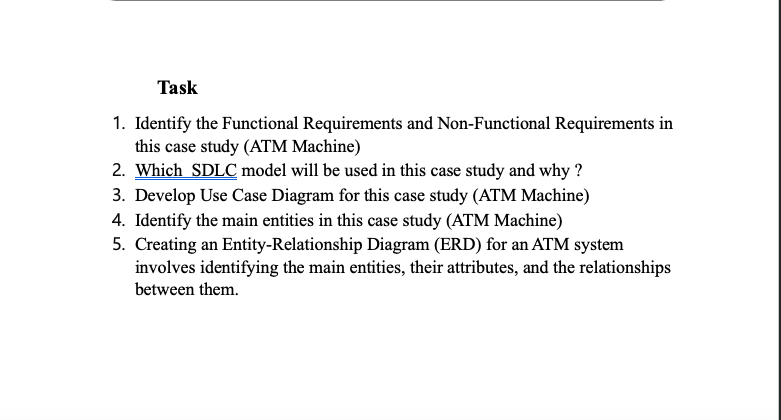
Identify the Functional Requirements and NonFunctional Requirements in
this case study ATM Machine
Which SDLC model will be used in this case study and why
Develop Use Case Diagram for this case study ATM Machine
Identify the main entities in this case study ATM Machine
Creating an EntityRelationship Diagram ERD for an ATM system
involves identifying the main entities, their attributes, and the relationships
between them.
Step by Step Solution
There are 3 Steps involved in it
1 Expert Approved Answer
Step: 1 Unlock

Question Has Been Solved by an Expert!
Get step-by-step solutions from verified subject matter experts
Step: 2 Unlock
Step: 3 Unlock
 Study Help