Question: CASE STUDY (ANSWER BRIEFLY) 1. WHAT IS THE PROBLEM? 2. ANALYZE THE PROBLEM 3. CREATE ATLEAST 5 ALTERNATIVE SOLUTION 4. HOW TO IMPLEMENT THE SOLUTION?
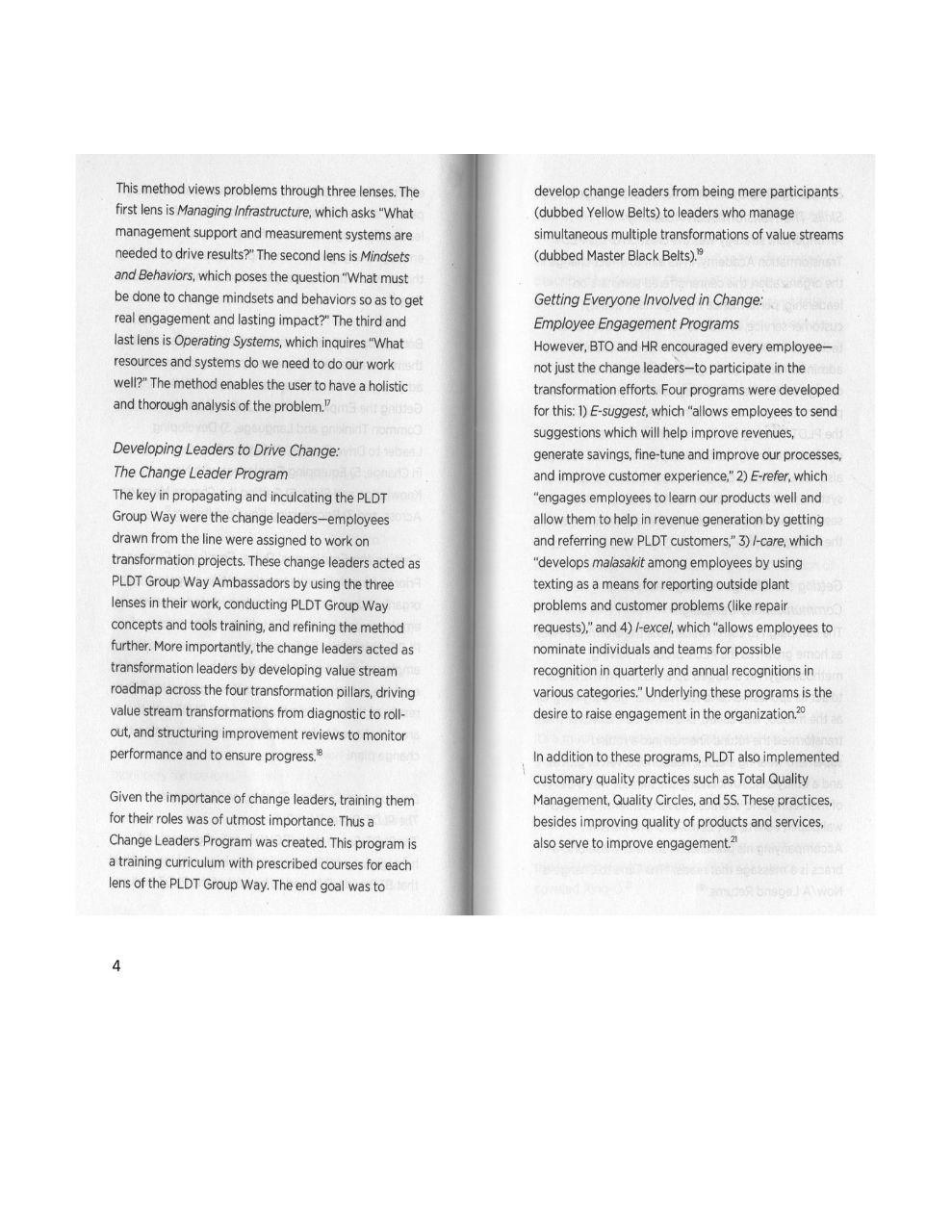
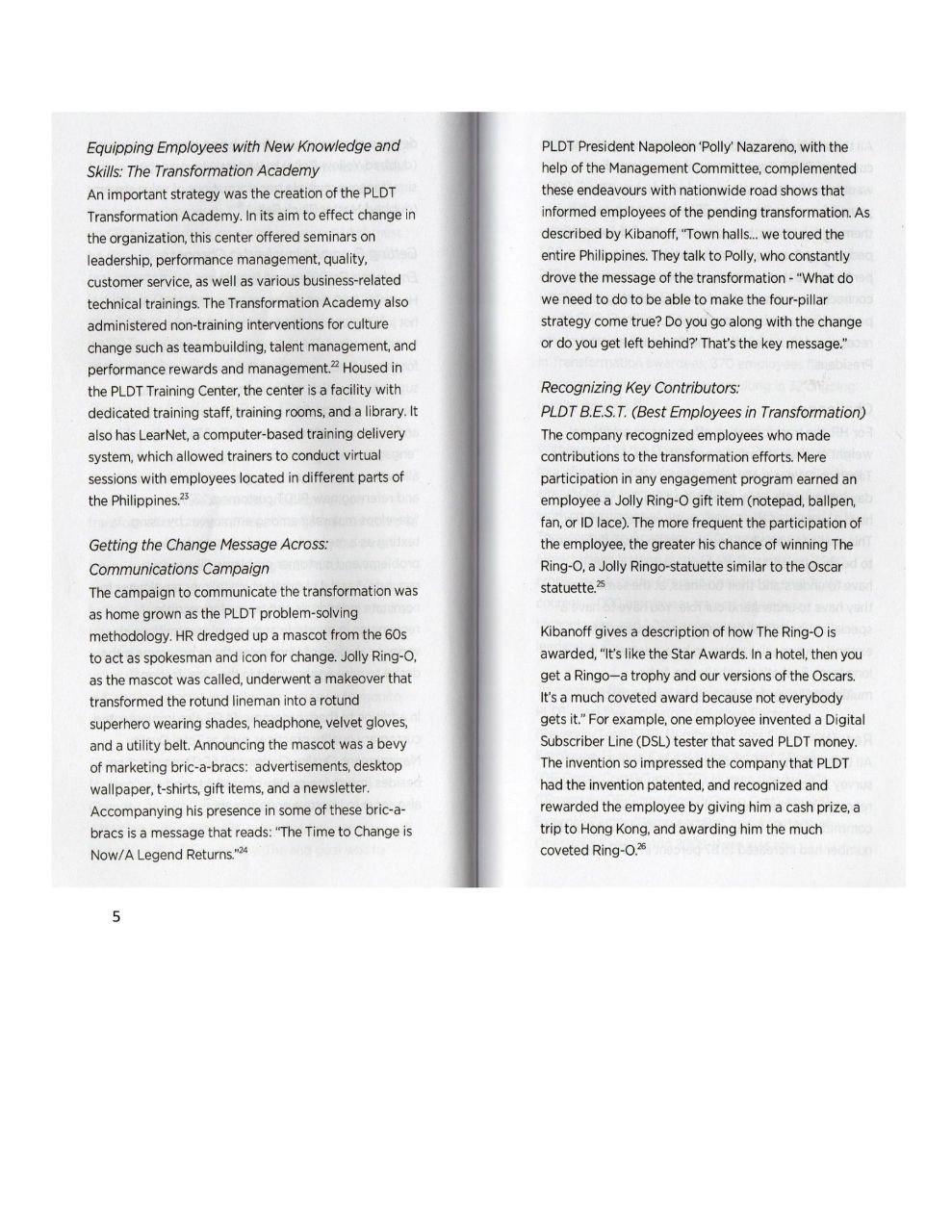
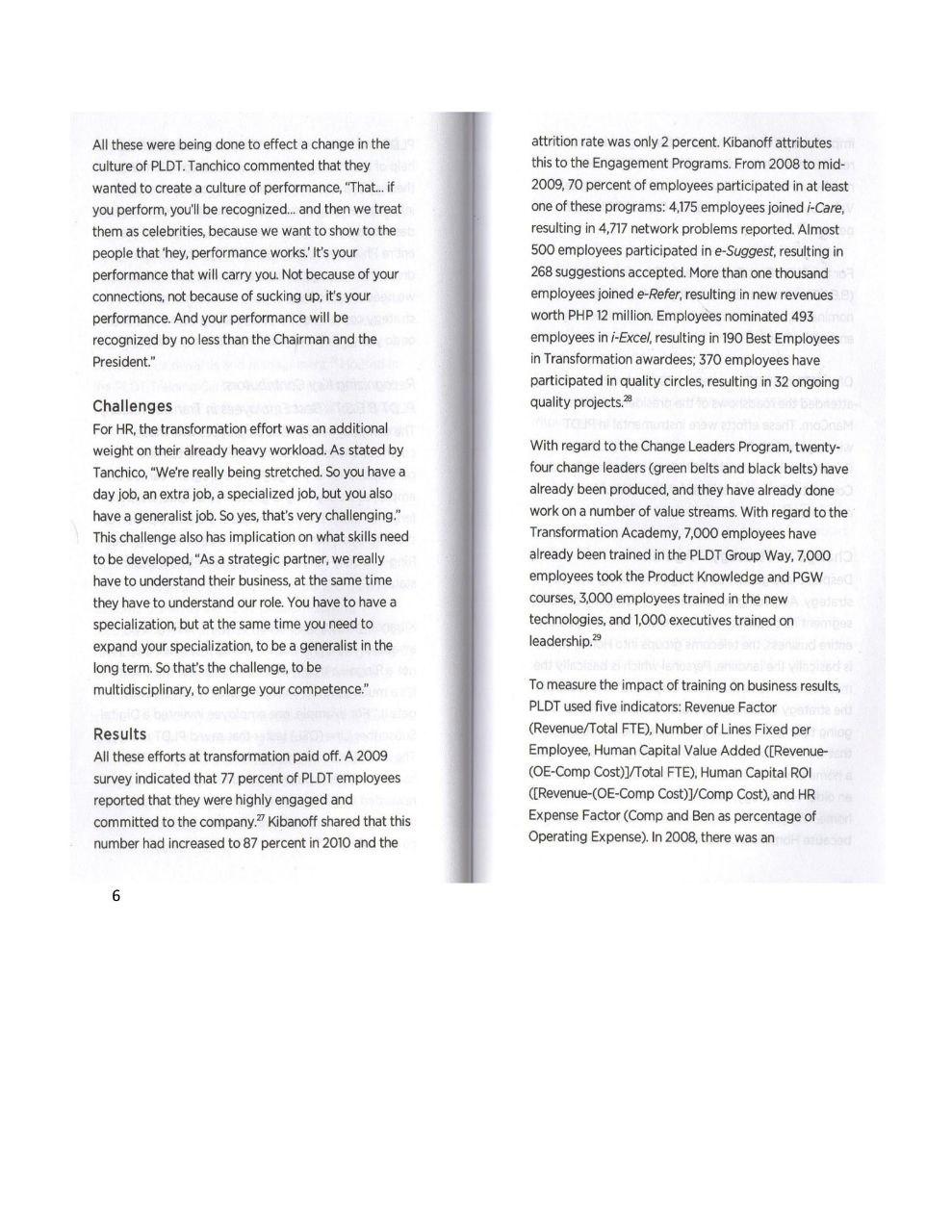
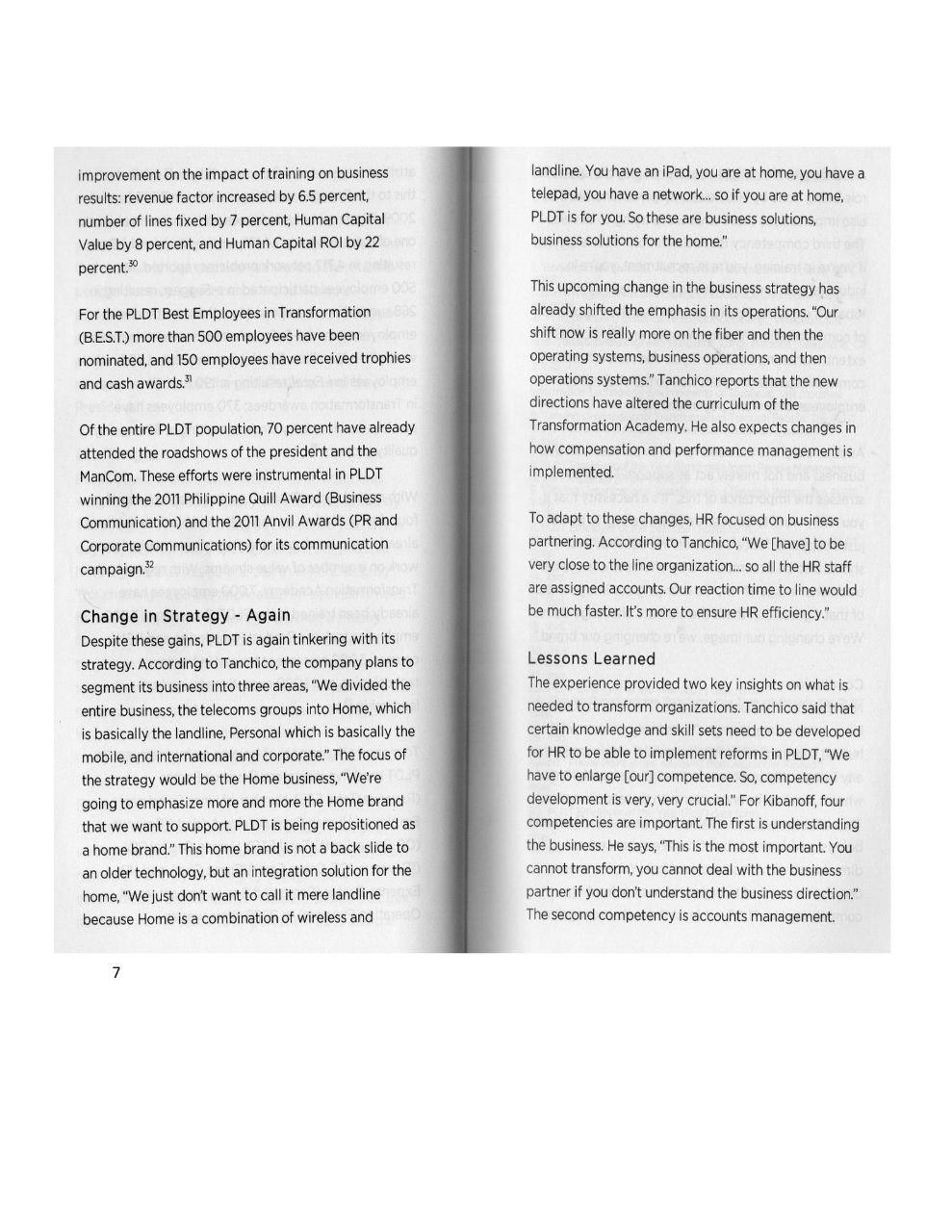
CASE STUDY (ANSWER BRIEFLY) 1. WHAT IS THE PROBLEM? 2. ANALYZE THE PROBLEM 3. CREATE ATLEAST 5 ALTERNATIVE SOLUTION 4. HOW TO IMPLEMENT THE SOLUTION? 5. EVALUATE THE PROBLEM AND SOLUTION 6. USING THE ALTERNATIVE SOLUTION, MAKE THE 14 PRINCIPLE OF MANAGEMENT OF HENRY FAYOL BASE ON THE CASE STUDY Pushing for Lasting and Deep Transformation: The PLDT Story By Joseph C. Sanchez In response to the challenges, the company launched a series of reforms that transformed the manner PLDT conducted its business. In a sense, the 1997 and the 2008 crises served as bookends for the company's transformation. The reforms were of such import that PLDT emerged stronger and more resilient. What follows is the story of these reforms. In 2008, as a consequence of US investors unwisely capitalizing on housing loans of people with no jobs, no income, and no assets, economies all over the world were pummeled with bank closures, massive unemployment, declining stock market prices, and decreased consumer spending.' For the Philippine Long Distance Telephone Company (PLDT), however, the crisis was merely another chapter in its eventful eighty-year history. The country's largest and longest-running telecommunication company had withstood the Second World War, Martial Law, the EDSA Revolution, as well as survived numerous threats to the business. According to Emiliano Tanchico, First Vice President of Human Resources Management and Development, the 2008 financial crisis was nothing new. "The crisis was thrust on us as early as 1998 and it has gone through several cycles... we're still in that cycle." Even before the 2008 Financial Meltdown, PLDT was dealing with its own crisis: a law that opened telecommunications to competition was enacted in the midst of the 1997 Asian Financial Crisis. Dangerous Waters PLDT had the luxury of coasting along smooth waters during the 70s and the 80s. Martial Law allowed the company to purchase the assets of its rival Republic Telephone Company, turning PLDT into a monopoly. In the late 1990s however, PLDT had to navigate between two calamitous forces: deregulation and technological advancement. The Public Telecommunications Act of 19954 opened the telecommunication industry to competition, forcing PLDT to come down from its monopoly tower of controf and confront the encroaching competitors. At the same time, advances in technology steered the telecommunications business away from voice to data and broadband, as well as drove down the prices of telecommunication services. PLDT had to rethink how it conducted its business. Pediment and Pillars of Organizational Transformation PLDT's Business Transformation Office (BTO), a group composed of former PLDT executives, conceived the needed reforms as a structure resembling a Greek temple. The mission-vision of PLDT would be the 1 pediment held aloft by the sturdy pillars of organizational initiatives.? change so that everybody gets engaged in the journey of transformation." The mission-vision was reworded to take advantage of the changing business reality in telecommunications: * PLDT will be the preferred full service provider of voice, video, and data at the most attractive levels of price, service quality, content and coverage, thereby bringing maximum benefit to the Company's stakeholders. The task of implementing these pillars cuts across the organization. Tanchico says. "The pillar heads for revenue, network, and customer service are line heads. HR handles people and leadership and also acts as secretariat. And it's driven by no less than the president himself." The line dividing the hierarchy also becomes blurred when it comes to implementing transformation Kibanoff says, "We get our change leaders from the line. The fantastic thing is that in our change management team, there's a Vice President and there are rank and file [employees]."Tanchico adds, "[They are] all trained. So they have the opportunity to work with the line. It's very heterogenous and protocols are broken. Regardless of level, they are all change leaders acting together." Alexander 'Deng' Kibanoff, Vice President for Training, Development and Career Management, described the four pillars of PLDT's strategy, "The first (pillar is] revenue and cost. Specifically, this pertains to new products and services that will add revenue streams to the corporation. So we have to think about those new products and services that will deliver the money for the organization. Second would be customer service- how do we simplify processes to delight our customers? That's the second pillar. The third pillar is network modernization. It coincided with the time we were pursuing a new generation network. We're transitioning from the legacy network to the more robust and more agile digital system that we're rolling out through the NGN (Next Generation Network). And the fourth pillar which I think is the most important is the people and leadership-how do you come out with a culture that is empowering and allows employees to promote and pursue a culture of performance? Our challenge (was] how to motivate people towards the Initial Salvo The initial transformation efforts were focused on cutting costs. PLDT had to manage its local and foreign debt, as well as deal with declining profits as a result of competition. Cost-cutting measures, plus efforts to raise productivity in the company, enabled the company to restore its profitability after five years. With its finances kept in check, the companying capitalized on new technologies and improved business processes by overhauling the network and infrastructure of PLDT. Investments were made on cable and switching facilities. It also entailed "upgrading [the] current telecoms system from a 2 legacy network composed of huge cabinet-type equipment to a streamlined next generation network that only needs a computer to handle thousands of calls." PLDT also spent on systems that would help better serve its external and internal customers. Purchased were customer management systems such as Clarity and CMS, and Financial and HR Systems, specifically SAP modules.? These activities produced tangible gains, such as reducing service time for DSL repairs from 6.5 days to 12 hours, and improving payroll accuracy to 99.9 percent." efforts fell to the BTO.HR, on the other hand, was a partner of the BTO in developing people and leadership programs. It also focused on building employee engagement and a prescribed way of doing things, which the company dubbed as the PLDT Group Way. Both groups conceived the culture change as a multi- themed endeavor, with a corresponding program to address each theme. The themes were as follows: 1) Getting the Employees' Pulse, 2) Developing a Common Thinking and Language, 3) Developing Leader to Drive Change, 4) Getting Everyone involved in Change, 5) Equipping Employees with New Knowledge and skills, 6) Getting the Change Message Across, and 7) Recognizing Key Contributors.5 Transforming the PLDT Culture A question with regard to these efforts was sustainability-how could they sustain the changes that have been accomplished as well as prepare the one organization for succeeding changes? Tanchico believes organizational culture is the key. He stressed the importance of activities contained in the fourth pillar to effect changes in the PLDT culture, "All of these initiatives [in the fourth pillar) were implemented to foster a culture of performance. We are highly unionized company and being a unionized company, there is a sense of entitlement that we want minimized. One example is overtime. "If I work beyond eight hours, I'm entitled to overtime. Perhaps this sense of entitlement was a lingering effect of working for a monopoly for too long." Getting the Employees' Pulse: Employee Survey Prior to formulating the transformation programs, two organizational surveys were administered to gauge employee opinion as well as diagnose the culture of PLDT. Among the findings of these surveys were that employees felt disempowered and there was a need to enhance communication across the organization. The results of these surveys thus provided PLDT with the areas that need to be addressed when formulating the change plan. The task of transforming the PLDT culture from one of entitlement to one of performance fell to two groups: the Business Transformation Office (BTO) and HR. Designing, leading, and monitoring of transformation Developing a Common Thinking and Language: The PLDT Group Way The PLDT Group Way (PGW) is an indigenous and homegrown problem-solving/decision-making method that BTO and HR hoped to be part of the PLDT culture. 3 develop change leaders from being mere participants (dubbed Yellow Belts) to leaders who manage simultaneous multiple transformations of value streams (dubbed Master Black Belts). This method views problems through three lenses. The first lens is Managing Infrastructure, which asks "What management support and measurement systems are needed to drive results?" The second lens is Mindsets and Behaviors, which poses the question "What must be done to change mindsets and behaviors so as to get real engagement and lasting impact?" The third and last lens is Operating Systems, which inquires "What resources and systems do we need to do our work well?" The method enables the user to have a holistic and thorough analysis of the problem." Developing Leaders to Drive Change: The Change Leader Program The key in propagating and inculcating the PLDT Group Way were the change leaders-employees drawn from the line were assigned to work on transformation projects. These change leaders acted as PLDT Group Way Ambassadors by using the three lenses in their work, conducting PLDT Group Way concepts and tools training, and refining the method further. More importantly, the change leaders acted as transformation leaders by developing value stream roadmap across the four transformation pillars, driving value stream transformations from diagnostic to roll- out, and structuring improvement reviews to monitor performance and to ensure progress. Getting Everyone involved in Change: Employee Engagement Programs However, BTO and HR encouraged every employee- not just the change leaders-to participate in the transformation efforts. Four programs were developed for this: 1) E-suggest, which allows employees to send suggestions which will help improve revenues, generate savings, fine-tune and improve our processes, and improve customer experience," 2) E-refer, which "engages employees to learn our products well and allow them to help in revenue generation by getting and referring new PLDT customers," 3) /-care, which "develops malasakit among employees by using texting as a means for reporting outside planta problems and customer problems (like repair requests)," and 4) /-excel, which allows employees to nominate individuals and teams for possible recognition in quarterly and annual recognitions in various categories." Underlying these programs is the desire to raise engagement in the organization 20 Given the importance of change leaders, training them for their roles was of utmost importance. Thus a Change Leaders Program was created. This program is a training curriculum with prescribed courses for each lens of the PLDT Group Way. The end goal was to In addition to these programs, PLDT also implemented customary quality practices such as Total Quality Management, Quality Circles, and 5S. These practices, besides improving quality of products and services, also serve to improve engagement.21 4 Equipping Employees with New Knowledge and Skills: The Transformation Academy An important strategy was the creation of the PLDT Transformation Academy. In its aim to effect change in the organization, this center offered seminars on leadership, performance management, quality, customer service, as well as various business-related technical trainings. The Transformation Academy also administered non-training interventions for culture change such as teambuilding, talent management, and performance rewards and management.2 Housed in the PLDT Training Center, the center is a facility with dedicated training staff, training rooms, and a library. It also has LearNet, a computer-based training delivery system, which allowed trainers to conduct virtual sessions with employees located in different parts of the Philippines.23 PLDT President Napoleon 'Polly Nazareno, with the help of the Management Committee, complemented these endeavours with nationwide road shows that informed employees of the pending transformation. As described by Kibanoff, "Town halls... we toured the entire Philippines. They talk to Polly, who constantly drove the message of the transformation - "What do we need to do to be able to make the four-pillar strategy come true? Do you go along with the change or do you get left behind?' That's the key message." Recognizing Key Contributors: PLDT B.E.S.T. (Best Employees in Transformation) The company recognized employees who made contributions to the transformation efforts. Mere participation in any engagement program earned an employee a Jolly Ring-O gift item (notepad, ballpen, fan, or ID lace). The more frequent the participation of the employee, the greater his chance of winning The Ring-O, a Jolly Ringo-statuette similar to the Oscar statuette.25 Getting the Change Message Across: Communications Campaign The campaign to communicate the transformation was as home grown as the PLDT problem-solving methodology. HR dredged up a mascot from the 60s to act as spokesman and icon for change. Jolly Ring-o, as the mascot was called, underwent a makeover that transformed the rotund lineman into a rotund superhero wearing shades, headphone, velvet gloves, and a utility belt. Announcing the mascot was a bevy of marketing bric-a-bracs: advertisements, desktop wallpaper, t-shirts, gift items, and a newsletter Accompanying his presence in some of these bric-a- bracs is a message that reads: "The Time to Change is Now/A Legend Returns.24 Kibanoff gives a description of how The Ring-O is awarded, "It's like the Star Awards. In a hotel, then you get a Ringo-a trophy and our versions of the Oscars. It's a much coveted award because not everybody gets it." For example, one employee invented a Digital Subscriber Line (DSL) tester that saved PLDT money. The invention so impressed the company that PLDT had the invention patented, and recognized and rewarded the employee by giving him a cash prize, a trip to Hong Kong, and awarding him the mucho coveted Ring-0.25 5 All these were being done to effect a change in the culture of PLDT. Tanchico commented that they wanted to create a culture of performance, "That...if you perform, you'll be recognized... and then we treat them as celebrities, because we want to show to the people that "hey, performance works.' It's your performance that will carry you. Not because of your connections, not because of sucking up, it's your performance. And your performance will be recognized by no less than the Chairman and the President." attrition rate was only 2 percent. Kibanoff attributes this to the Engagement Programs. From 2008 to mid- 2009, 70 percent of employees participated in at least one of these programs: 4,175 employees joined i-Care, resulting in 4,717 network problems reported. Almost 500 employees participated in e-Suggest, resulting in 268 suggestions accepted. More than one thousand employees joined e-Refer, resulting in new revenues) worth PHP 12 million Employees nominated 493 employees in i-Excel, resulting in 190 Best Employees in Transformation awardees; 370 employees have participated in quality circles, resulting in 32 ongoing quality projects. Challenges For HR, the transformation effort was an additional weight on their already heavy workload. As stated by Tanchico, "We're really being stretched. So you have a day job, an extra job, a specialized job, but you also have a generalist job. So yes, that's very challenging." This challenge also has implication on what skills need to be developed, "As a strategic partner, we really have to understand their business, at the same time they have to understand our role. You have to have a specialization, but at the same time you need to expand your specialization, to be a generalist in the long term. So that's the challenge, to be multidisciplinary, to enlarge your competence." With regard to the Change Leaders Program, twenty- four change leaders (green belts and black belts) have already been produced, and they have already done work on a number of value streams. With regard to the Transformation Academy, 7,000 employees have already been trained in the PLDT Group Way, 7,000 employees took the Product knowledge and PGW courses, 3,000 employees trained in the news technologies, and 1,000 executives trained on the leadership.29 Results All these efforts at transformation paid off. A 2009 survey indicated that 77 percent of PLDT employees reported that they were highly engaged and committed to the company. Kibanoff shared that this number had increased to 87 percent in 2010 To measure the impact of training on business results, PLDT used five indicators: Revenue Factor (Revenue/Total FTE), Number of Lines Fixed perle Employee, Human Capital Value Added ([Revenue (OE-Comp Cost)]/Total FTE), Human Capital ROI ([Revenue-(OE-Comp Cost)]/Comp Cost), and HR Expense Factor (Comp and Ben as percentage of Operating Expense). In 2008, there was an 6 improvement on the impact of training on business results: revenue factor increased by 6.5 percent, number of lines fixed by 7 percent, Human Capital Value by 8 percent, and Human Capital ROI by 22 percent. landline. You have an iPad, you are at home, you have a telepad, you have a network... so if you are at home, PLDT is for you. So these are business solutions, business solutions for the home." For the PLDT Best Employees in Transformation (B.E.S.T.) more than 500 employees have been nominated, and 150 employees have received trophies and cash awards. This upcoming change in the business strategy has already shifted the emphasis in its operations. "Our shift now is really more on the fiber and then the operating systems, business operations, and then operations systems." Tanchico reports that the new directions have altered the curriculum of the Transformation Academy. He also expects changes in how compensation and performance management is implemented. Of the entire PLDT population, 70 percent have already attended the roadshows of the president and the line ManCom. These efforts were instrumental in PLDT winning the 2011 Philippine Quill Award (Business Communication) and the 2011 Anvil Awards (PR and Corporate Communications) for its communication campaign. 52 To adapt to these changes, HR focused on business partnering. According to Tanchico, "We [have] to be very close to the line organization... so all the HR staff are assigned accounts. Our reaction time to line would be much faster. It's more to ensure HR efficiency." Change in Strategy - Again Despite these gains, PLDT is again tinkering with its strategy. According to Tanchico, the company plans to segment its business into three areas, "We divided the entire business, the telecoms groups into Home, which is basically the landline, Personal which is basically the mobile, and international and corporate." The focus of the strategy would be the Home business, "We're going to emphasize more and more the Home brand that we want to support. PLDT is being repositioned as a home brand." This home brand is not a back slide to an older technology, but an integration solution for the home, "We just don't want to call it mere landline her because Home is a combination of wireless and Lessons Learned The experience provided two key insights on what is needed to transform organizations. Tanchico said that certain knowledge and skill sets need to be developed for HR to be able to implement reforms in PLDT, "We have to enlarge Cour] competence. So, competency development is very, very crucial." For Kibanoff, four competencies are important. The first is understanding the business. He says, "This is the most important. You cannot transform, you cannot deal with the business partner if you don't understand the business direction." The second competency is accounts management. 7 the need to change and face head-on the difficulties that threaten their very existence. According to him, "Right now it's not only the specialist role being done by HR. Relationship with the client is also important, so that's what we're trying to develop." The third competency is specialization. "Your expertise if you're in training, you're in recruitment, you're in industrial relations, you have to be an expert in that," Kibanoff explains. Finally, he identifies the importance of communication, "Communication and, to a certain extent, marketing because if you don't know how to communicate the program well to the client or to employees, they won't pay attention." Another insight is the need for HR to partner with the business and not merely act as support. Tanchico stresses the importance of this, "It's a necessity that if you really want to be seen as empowering, to be not just a supporter but an enabler." He believes this should also be accompanied by efforts to change the traditional image of HR, "So changing our image is part of that. I guess that that's the ultimate challenge there. We're changing our image, we're changing our brand." Conclusion Nietzsche's often quoted maxim, "That which does not kill me makes me stronger," was likely written with human beings in mind. It is the nature of this world that any living entity improves in strength or capabilities when it survives its encounter with threats of any kind. Thus immune systems confronting viruses and human beings confronting tribulations are enhanced, not diminished, with these provocations. Yet, the maxim can also be applied to organizations confronting competition like PLDT-at least those that recognize 8 CASE STUDY (ANSWER BRIEFLY) 1. WHAT IS THE PROBLEM? 2. ANALYZE THE PROBLEM 3. CREATE ATLEAST 5 ALTERNATIVE SOLUTION 4. HOW TO IMPLEMENT THE SOLUTION? 5. EVALUATE THE PROBLEM AND SOLUTION 6. USING THE ALTERNATIVE SOLUTION, MAKE THE 14 PRINCIPLE OF MANAGEMENT OF HENRY FAYOL BASE ON THE CASE STUDY Pushing for Lasting and Deep Transformation: The PLDT Story By Joseph C. Sanchez In response to the challenges, the company launched a series of reforms that transformed the manner PLDT conducted its business. In a sense, the 1997 and the 2008 crises served as bookends for the company's transformation. The reforms were of such import that PLDT emerged stronger and more resilient. What follows is the story of these reforms. In 2008, as a consequence of US investors unwisely capitalizing on housing loans of people with no jobs, no income, and no assets, economies all over the world were pummeled with bank closures, massive unemployment, declining stock market prices, and decreased consumer spending.' For the Philippine Long Distance Telephone Company (PLDT), however, the crisis was merely another chapter in its eventful eighty-year history. The country's largest and longest-running telecommunication company had withstood the Second World War, Martial Law, the EDSA Revolution, as well as survived numerous threats to the business. According to Emiliano Tanchico, First Vice President of Human Resources Management and Development, the 2008 financial crisis was nothing new. "The crisis was thrust on us as early as 1998 and it has gone through several cycles... we're still in that cycle." Even before the 2008 Financial Meltdown, PLDT was dealing with its own crisis: a law that opened telecommunications to competition was enacted in the midst of the 1997 Asian Financial Crisis. Dangerous Waters PLDT had the luxury of coasting along smooth waters during the 70s and the 80s. Martial Law allowed the company to purchase the assets of its rival Republic Telephone Company, turning PLDT into a monopoly. In the late 1990s however, PLDT had to navigate between two calamitous forces: deregulation and technological advancement. The Public Telecommunications Act of 19954 opened the telecommunication industry to competition, forcing PLDT to come down from its monopoly tower of controf and confront the encroaching competitors. At the same time, advances in technology steered the telecommunications business away from voice to data and broadband, as well as drove down the prices of telecommunication services. PLDT had to rethink how it conducted its business. Pediment and Pillars of Organizational Transformation PLDT's Business Transformation Office (BTO), a group composed of former PLDT executives, conceived the needed reforms as a structure resembling a Greek temple. The mission-vision of PLDT would be the 1 pediment held aloft by the sturdy pillars of organizational initiatives.? change so that everybody gets engaged in the journey of transformation." The mission-vision was reworded to take advantage of the changing business reality in telecommunications: * PLDT will be the preferred full service provider of voice, video, and data at the most attractive levels of price, service quality, content and coverage, thereby bringing maximum benefit to the Company's stakeholders. The task of implementing these pillars cuts across the organization. Tanchico says. "The pillar heads for revenue, network, and customer service are line heads. HR handles people and leadership and also acts as secretariat. And it's driven by no less than the president himself." The line dividing the hierarchy also becomes blurred when it comes to implementing transformation Kibanoff says, "We get our change leaders from the line. The fantastic thing is that in our change management team, there's a Vice President and there are rank and file [employees]."Tanchico adds, "[They are] all trained. So they have the opportunity to work with the line. It's very heterogenous and protocols are broken. Regardless of level, they are all change leaders acting together." Alexander 'Deng' Kibanoff, Vice President for Training, Development and Career Management, described the four pillars of PLDT's strategy, "The first (pillar is] revenue and cost. Specifically, this pertains to new products and services that will add revenue streams to the corporation. So we have to think about those new products and services that will deliver the money for the organization. Second would be customer service- how do we simplify processes to delight our customers? That's the second pillar. The third pillar is network modernization. It coincided with the time we were pursuing a new generation network. We're transitioning from the legacy network to the more robust and more agile digital system that we're rolling out through the NGN (Next Generation Network). And the fourth pillar which I think is the most important is the people and leadership-how do you come out with a culture that is empowering and allows employees to promote and pursue a culture of performance? Our challenge (was] how to motivate people towards the Initial Salvo The initial transformation efforts were focused on cutting costs. PLDT had to manage its local and foreign debt, as well as deal with declining profits as a result of competition. Cost-cutting measures, plus efforts to raise productivity in the company, enabled the company to restore its profitability after five years. With its finances kept in check, the companying capitalized on new technologies and improved business processes by overhauling the network and infrastructure of PLDT. Investments were made on cable and switching facilities. It also entailed "upgrading [the] current telecoms system from a 2 legacy network composed of huge cabinet-type equipment to a streamlined next generation network that only needs a computer to handle thousands of calls." PLDT also spent on systems that would help better serve its external and internal customers. Purchased were customer management systems such as Clarity and CMS, and Financial and HR Systems, specifically SAP modules.? These activities produced tangible gains, such as reducing service time for DSL repairs from 6.5 days to 12 hours, and improving payroll accuracy to 99.9 percent." efforts fell to the BTO.HR, on the other hand, was a partner of the BTO in developing people and leadership programs. It also focused on building employee engagement and a prescribed way of doing things, which the company dubbed as the PLDT Group Way. Both groups conceived the culture change as a multi- themed endeavor, with a corresponding program to address each theme. The themes were as follows: 1) Getting the Employees' Pulse, 2) Developing a Common Thinking and Language, 3) Developing Leader to Drive Change, 4) Getting Everyone involved in Change, 5) Equipping Employees with New Knowledge and skills, 6) Getting the Change Message Across, and 7) Recognizing Key Contributors.5 Transforming the PLDT Culture A question with regard to these efforts was sustainability-how could they sustain the changes that have been accomplished as well as prepare the one organization for succeeding changes? Tanchico believes organizational culture is the key. He stressed the importance of activities contained in the fourth pillar to effect changes in the PLDT culture, "All of these initiatives [in the fourth pillar) were implemented to foster a culture of performance. We are highly unionized company and being a unionized company, there is a sense of entitlement that we want minimized. One example is overtime. "If I work beyond eight hours, I'm entitled to overtime. Perhaps this sense of entitlement was a lingering effect of working for a monopoly for too long." Getting the Employees' Pulse: Employee Survey Prior to formulating the transformation programs, two organizational surveys were administered to gauge employee opinion as well as diagnose the culture of PLDT. Among the findings of these surveys were that employees felt disempowered and there was a need to enhance communication across the organization. The results of these surveys thus provided PLDT with the areas that need to be addressed when formulating the change plan. The task of transforming the PLDT culture from one of entitlement to one of performance fell to two groups: the Business Transformation Office (BTO) and HR. Designing, leading, and monitoring of transformation Developing a Common Thinking and Language: The PLDT Group Way The PLDT Group Way (PGW) is an indigenous and homegrown problem-solving/decision-making method that BTO and HR hoped to be part of the PLDT culture. 3 develop change leaders from being mere participants (dubbed Yellow Belts) to leaders who manage simultaneous multiple transformations of value streams (dubbed Master Black Belts). This method views problems through three lenses. The first lens is Managing Infrastructure, which asks "What management support and measurement systems are needed to drive results?" The second lens is Mindsets and Behaviors, which poses the question "What must be done to change mindsets and behaviors so as to get real engagement and lasting impact?" The third and last lens is Operating Systems, which inquires "What resources and systems do we need to do our work well?" The method enables the user to have a holistic and thorough analysis of the problem." Developing Leaders to Drive Change: The Change Leader Program The key in propagating and inculcating the PLDT Group Way were the change leaders-employees drawn from the line were assigned to work on transformation projects. These change leaders acted as PLDT Group Way Ambassadors by using the three lenses in their work, conducting PLDT Group Way concepts and tools training, and refining the method further. More importantly, the change leaders acted as transformation leaders by developing value stream roadmap across the four transformation pillars, driving value stream transformations from diagnostic to roll- out, and structuring improvement reviews to monitor performance and to ensure progress. Getting Everyone involved in Change: Employee Engagement Programs However, BTO and HR encouraged every employee- not just the change leaders-to participate in the transformation efforts. Four programs were developed for this: 1) E-suggest, which allows employees to send suggestions which will help improve revenues, generate savings, fine-tune and improve our processes, and improve customer experience," 2) E-refer, which "engages employees to learn our products well and allow them to help in revenue generation by getting and referring new PLDT customers," 3) /-care, which "develops malasakit among employees by using texting as a means for reporting outside planta problems and customer problems (like repair requests)," and 4) /-excel, which allows employees to nominate individuals and teams for possible recognition in quarterly and annual recognitions in various categories." Underlying these programs is the desire to raise engagement in the organization 20 Given the importance of change leaders, training them for their roles was of utmost importance. Thus a Change Leaders Program was created. This program is a training curriculum with prescribed courses for each lens of the PLDT Group Way. The end goal was to In addition to these programs, PLDT also implemented customary quality practices such as Total Quality Management, Quality Circles, and 5S. These practices, besides improving quality of products and services, also serve to improve engagement.21 4 Equipping Employees with New Knowledge and Skills: The Transformation Academy An important strategy was the creation of the PLDT Transformation Academy. In its aim to effect change in the organization, this center offered seminars on leadership, performance management, quality, customer service, as well as various business-related technical trainings. The Transformation Academy also administered non-training interventions for culture change such as teambuilding, talent management, and performance rewards and management.2 Housed in the PLDT Training Center, the center is a facility with dedicated training staff, training rooms, and a library. It also has LearNet, a computer-based training delivery system, which allowed trainers to conduct virtual sessions with employees located in different parts of the Philippines.23 PLDT President Napoleon 'Polly Nazareno, with the help of the Management Committee, complemented these endeavours with nationwide road shows that informed employees of the pending transformation. As described by Kibanoff, "Town halls... we toured the entire Philippines. They talk to Polly, who constantly drove the message of the transformation - "What do we need to do to be able to make the four-pillar strategy come true? Do you go along with the change or do you get left behind?' That's the key message." Recognizing Key Contributors: PLDT B.E.S.T. (Best Employees in Transformation) The company recognized employees who made contributions to the transformation efforts. Mere participation in any engagement program earned an employee a Jolly Ring-O gift item (notepad, ballpen, fan, or ID lace). The more frequent the participation of the employee, the greater his chance of winning The Ring-O, a Jolly Ringo-statuette similar to the Oscar statuette.25 Getting the Change Message Across: Communications Campaign The campaign to communicate the transformation was as home grown as the PLDT problem-solving methodology. HR dredged up a mascot from the 60s to act as spokesman and icon for change. Jolly Ring-o, as the mascot was called, underwent a makeover that transformed the rotund lineman into a rotund superhero wearing shades, headphone, velvet gloves, and a utility belt. Announcing the mascot was a bevy of marketing bric-a-bracs: advertisements, desktop wallpaper, t-shirts, gift items, and a newsletter Accompanying his presence in some of these bric-a- bracs is a message that reads: "The Time to Change is Now/A Legend Returns.24 Kibanoff gives a description of how The Ring-O is awarded, "It's like the Star Awards. In a hotel, then you get a Ringo-a trophy and our versions of the Oscars. It's a much coveted award because not everybody gets it." For example, one employee invented a Digital Subscriber Line (DSL) tester that saved PLDT money. The invention so impressed the company that PLDT had the invention patented, and recognized and rewarded the employee by giving him a cash prize, a trip to Hong Kong, and awarding him the mucho coveted Ring-0.25 5 All these were being done to effect a change in the culture of PLDT. Tanchico commented that they wanted to create a culture of performance, "That...if you perform, you'll be recognized... and then we treat them as celebrities, because we want to show to the people that "hey, performance works.' It's your performance that will carry you. Not because of your connections, not because of sucking up, it's your performance. And your performance will be recognized by no less than the Chairman and the President." attrition rate was only 2 percent. Kibanoff attributes this to the Engagement Programs. From 2008 to mid- 2009, 70 percent of employees participated in at least one of these programs: 4,175 employees joined i-Care, resulting in 4,717 network problems reported. Almost 500 employees participated in e-Suggest, resulting in 268 suggestions accepted. More than one thousand employees joined e-Refer, resulting in new revenues) worth PHP 12 million Employees nominated 493 employees in i-Excel, resulting in 190 Best Employees in Transformation awardees; 370 employees have participated in quality circles, resulting in 32 ongoing quality projects. Challenges For HR, the transformation effort was an additional weight on their already heavy workload. As stated by Tanchico, "We're really being stretched. So you have a day job, an extra job, a specialized job, but you also have a generalist job. So yes, that's very challenging." This challenge also has implication on what skills need to be developed, "As a strategic partner, we really have to understand their business, at the same time they have to understand our role. You have to have a specialization, but at the same time you need to expand your specialization, to be a generalist in the long term. So that's the challenge, to be multidisciplinary, to enlarge your competence." With regard to the Change Leaders Program, twenty- four change leaders (green belts and black belts) have already been produced, and they have already done work on a number of value streams. With regard to the Transformation Academy, 7,000 employees have already been trained in the PLDT Group Way, 7,000 employees took the Product knowledge and PGW courses, 3,000 employees trained in the news technologies, and 1,000 executives trained on the leadership.29 Results All these efforts at transformation paid off. A 2009 survey indicated that 77 percent of PLDT employees reported that they were highly engaged and committed to the company. Kibanoff shared that this number had increased to 87 percent in 2010 To measure the impact of training on business results, PLDT used five indicators: Revenue Factor (Revenue/Total FTE), Number of Lines Fixed perle Employee, Human Capital Value Added ([Revenue (OE-Comp Cost)]/Total FTE), Human Capital ROI ([Revenue-(OE-Comp Cost)]/Comp Cost), and HR Expense Factor (Comp and Ben as percentage of Operating Expense). In 2008, there was an 6 improvement on the impact of training on business results: revenue factor increased by 6.5 percent, number of lines fixed by 7 percent, Human Capital Value by 8 percent, and Human Capital ROI by 22 percent. landline. You have an iPad, you are at home, you have a telepad, you have a network... so if you are at home, PLDT is for you. So these are business solutions, business solutions for the home." For the PLDT Best Employees in Transformation (B.E.S.T.) more than 500 employees have been nominated, and 150 employees have received trophies and cash awards. This upcoming change in the business strategy has already shifted the emphasis in its operations. "Our shift now is really more on the fiber and then the operating systems, business operations, and then operations systems." Tanchico reports that the new directions have altered the curriculum of the Transformation Academy. He also expects changes in how compensation and performance management is implemented. Of the entire PLDT population, 70 percent have already attended the roadshows of the president and the line ManCom. These efforts were instrumental in PLDT winning the 2011 Philippine Quill Award (Business Communication) and the 2011 Anvil Awards (PR and Corporate Communications) for its communication campaign. 52 To adapt to these changes, HR focused on business partnering. According to Tanchico, "We [have] to be very close to the line organization... so all the HR staff are assigned accounts. Our reaction time to line would be much faster. It's more to ensure HR efficiency." Change in Strategy - Again Despite these gains, PLDT is again tinkering with its strategy. According to Tanchico, the company plans to segment its business into three areas, "We divided the entire business, the telecoms groups into Home, which is basically the landline, Personal which is basically the mobile, and international and corporate." The focus of the strategy would be the Home business, "We're going to emphasize more and more the Home brand that we want to support. PLDT is being repositioned as a home brand." This home brand is not a back slide to an older technology, but an integration solution for the home, "We just don't want to call it mere landline her because Home is a combination of wireless and Lessons Learned The experience provided two key insights on what is needed to transform organizations. Tanchico said that certain knowledge and skill sets need to be developed for HR to be able to implement reforms in PLDT, "We have to enlarge Cour] competence. So, competency development is very, very crucial." For Kibanoff, four competencies are important. The first is understanding the business. He says, "This is the most important. You cannot transform, you cannot deal with the business partner if you don't understand the business direction." The second competency is accounts management. 7 the need to change and face head-on the difficulties that threaten their very existence. According to him, "Right now it's not only the specialist role being done by HR. Relationship with the client is also important, so that's what we're trying to develop." The third competency is specialization. "Your expertise if you're in training, you're in recruitment, you're in industrial relations, you have to be an expert in that," Kibanoff explains. Finally, he identifies the importance of communication, "Communication and, to a certain extent, marketing because if you don't know how to communicate the program well to the client or to employees, they won't pay attention." Another insight is the need for HR to partner with the business and not merely act as support. Tanchico stresses the importance of this, "It's a necessity that if you really want to be seen as empowering, to be not just a supporter but an enabler." He believes this should also be accompanied by efforts to change the traditional image of HR, "So changing our image is part of that. I guess that that's the ultimate challenge there. We're changing our image, we're changing our brand." Conclusion Nietzsche's often quoted maxim, "That which does not kill me makes me stronger," was likely written with human beings in mind. It is the nature of this world that any living entity improves in strength or capabilities when it survives its encounter with threats of any kind. Thus immune systems confronting viruses and human beings confronting tribulations are enhanced, not diminished, with these provocations. Yet, the maxim can also be applied to organizations confronting competition like PLDT-at least those that recognize 8









 Study Help