





Question: CASE STUDY ASSIGNMENT 2 4. Incorporate his goals and resources available from the first assignment here and provide Jake a complete HOUSING AND DEBT set
CASE STUDY ASSIGNMENT 2 4. Incorporate his goals
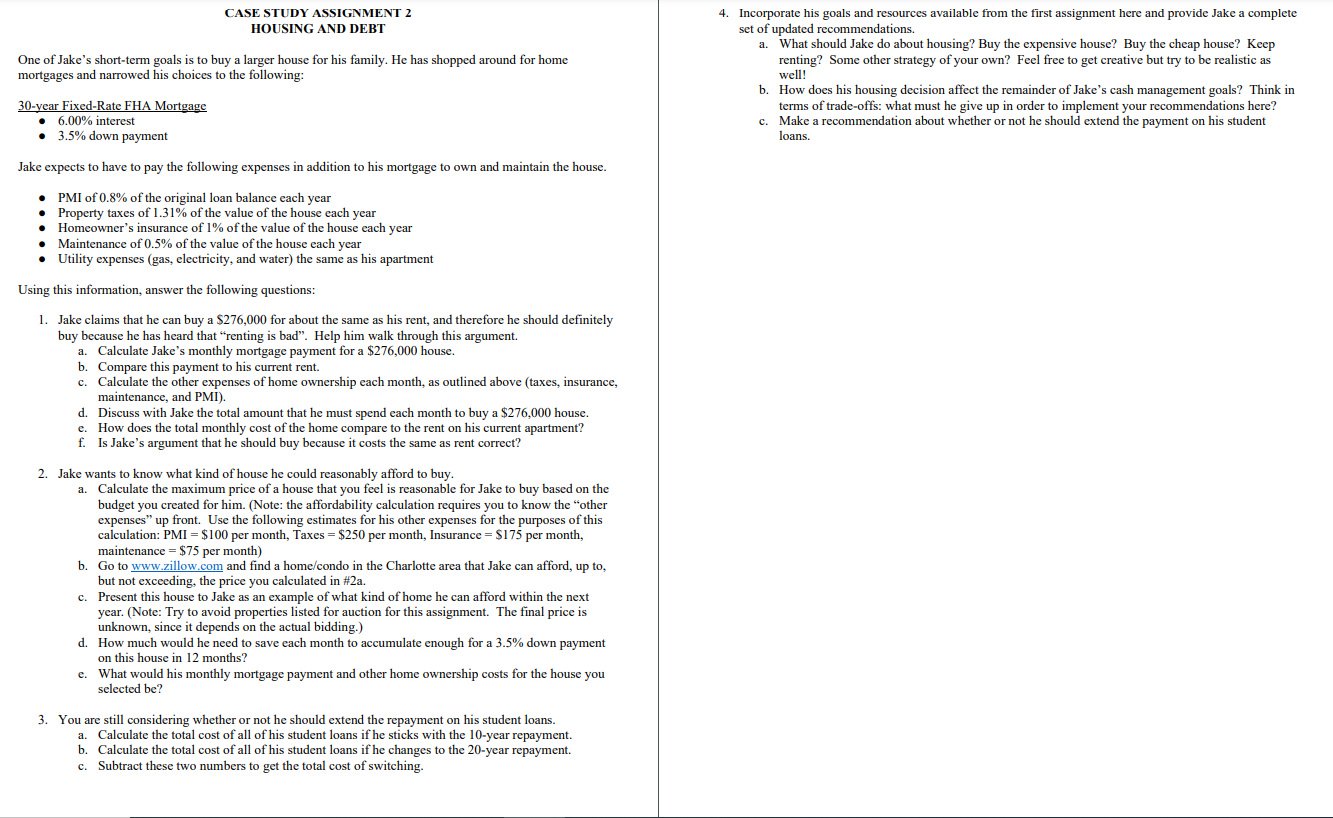
CASE STUDY ASSIGNMENT 2 4. Incorporate his goals and resources available from the first assignment here and provide Jake a complete HOUSING AND DEBT set of updated recommendations. a. What should Jake do about housing? Buy the expensive house? Buy the cheap house? Keep One of Jake's short-term goals is to buy a larger house for his family. He has shopped around for home renting? Some other strategy of your own? Feel free to get creative but try to be realistic as mortgages and narrowed his choices to the following: well! b. How does his housing decision affect the remainder of Jake's cash management goals? Think in 30-year Fixed-Rate FHA Mortgage terms of trade-offs: what must he give up in order to implement your recommendations here? 6.00% interest c. Make a recommendation about whether or not he should extend the payment on his student 3.5% down payment loans. Jake expects to have to pay the following expenses in addition to his mortgage to own and maintain the house. PMI of 0.8% of the original loan balance each year Property taxes of 1.31% of the value of the house each year Homeowner's insurance of 1% of the value of the house each year Maintenance of 0.5% of the value of the house each year Utility expenses (gas, electricity, and water) the same as his apartment Using this information, answer the following questions: 1. Jake claims that he can buy a $276,000 for about the same as his rent, and therefore he should definitely buy because he has heard that "renting is bad". Help him walk through this argument. a. Calculate Jake's monthly mortgage payment for a $276,000 house. b. Compare this payment to his current rent. c. Calculate the other expenses of home ownership each month, as outlined above (taxes, insurance, maintenance, and PMI). d. Discuss with Jake the total amount that he must spend each month to buy a $276,000 house. c. How does the total monthly cost of the home compare to the rent on his current apartment? f. Is Jake's argument that he should buy because it costs the same as rent correct? 2. Jake wants to know what kind of house he could reasonably afford to buy. Calculate the maximum price of a house that you feel is reasonable for Jake to buy based on the budget you created for him. (Note: the affordability calculation requires you to know the "other expenses" up front. Use the following estimates for his other expenses for the purposes of this calculation: PMI = $100 per month, Taxes = $250 per month, Insurance = $175 per month, maintenance = $75 per month) b. Go to www.zillow.com and find a home/condo in the Charlotte area that Jake can afford, up to, but not exceeding, the price you calculated in #2a. C. Present this house to Jake as an example of what kind of home he can afford within the next year. (Note: Try to avoid properties listed for auction for this assignment. The final price is unknown, since it depends on the actual bidding.) . How much would he need to save each month to accumulate enough for a 3.5% down payment on this house in 12 months? What would his monthly mortgage payment and other home ownership costs for the house you selected be? 3. You are still considering whether or not he should extend the repayment on his student loans. a. Calculate the total cost of all of his student loans if he sticks with the 10-year repayment. b. Calculate the total cost of all of his student loans if he changes to the 20-year repayment. c. Subtract these two numbers to get the total cost of switching

Step by Step Solution

There are 3 Steps involved in it

1 Expert Approved Answer
Step: 1 Unlock blur-text-image
Question Has Been Solved by an Expert!

Get step-by-step solutions from verified subject matter experts

Step: 2 Unlock
Step: 3 Unlock

Students Have Also Explored These Related Finance Questions!