



Question: Case Study: David Solomon & Goldman Sachs (Palmer, 2022) Instructions: 1. Read and digest the case study. 2. Highlight the problem/issue/topic and the symptoms (if
Case Study: David Solomon & Goldman Sachs (Palmer, 2022)
Instructions: 1. Read and digest the case study. 2. Highlight the problem/issue/topic and the symptoms (if any). 3. Relate with organizational culture. 4. Provide your view and ideas on the application to your workplace etc. 5. You may relate to your experience.
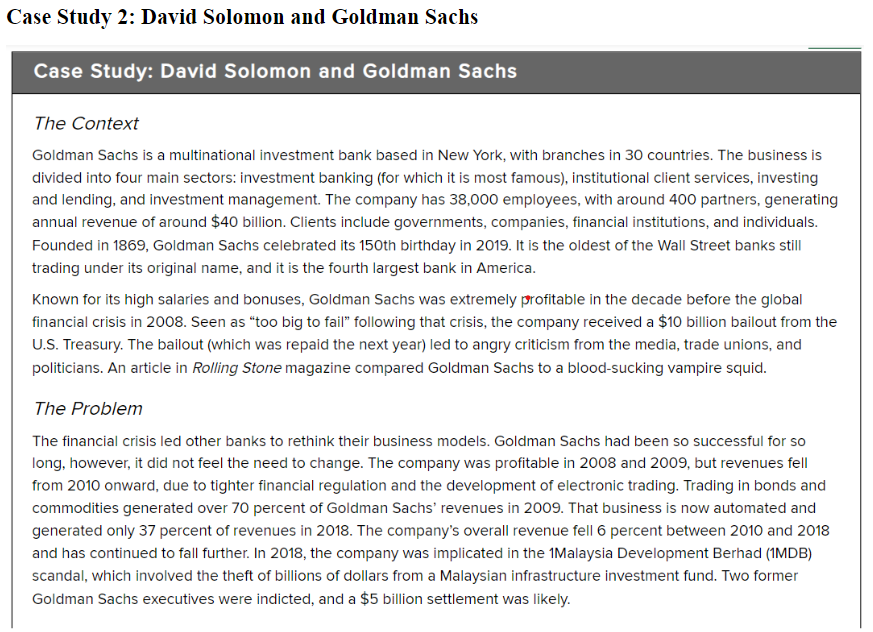
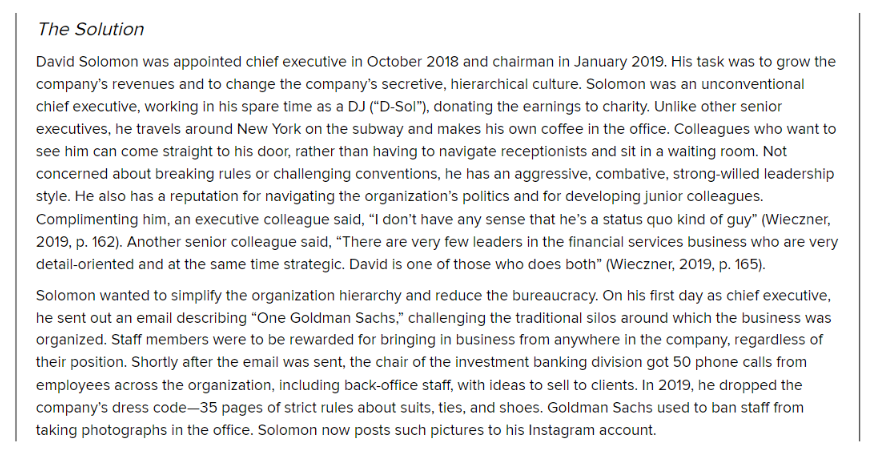
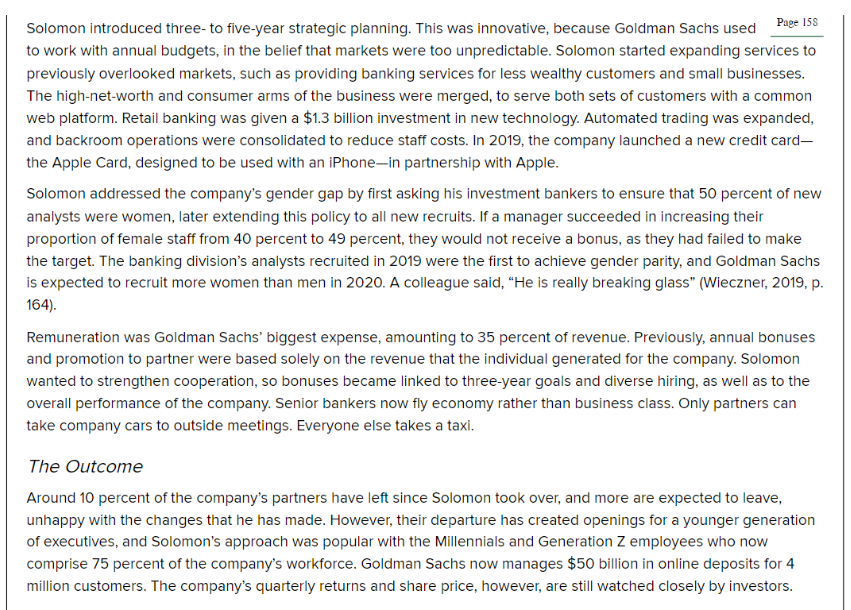
Case Study 2: David Solomon and Goldman Sachs Case Study: David Solomon and Goldman Sachs The Context Goldman Sachs is a multinational investment bank based in New York, with branches in 30 countries. The business is divided into four main sectors: investment banking (for which it is most famous), institutional client services, investing and lending, and investment management. The company has 38,000 employees, with around 400 partners, generating annual revenue of around $40 billion. Clients include governments, companies, financial institutions, and individuals. Founded in 1869, Goldman Sachs celebrated its 150th birthday in 2019. It is the oldest of the Wall Street banks still trading under its original name, and it is the fourth largest bank in America. Known for its high salaries and bonuses, Goldman Sachs was extremely profitable in the decade before the global financial crisis in 2008. Seen as "too big to fail" following that crisis, the company received a $10 billion bailout from the U.S. Treasury. The bailout (which was repaid the next year) led to angry criticism from the media, trade unions, and politicians. An article in Rolling Stone magazine compared Goldman Sachs to a blood-sucking vampire squid. The Problem The financial crisis led other banks to rethink their business models. Goldman Sachs had been so successful for so long, however, it did not feel the need to change. The company was profitable in 2008 and 2009 , but revenues fell from 2010 onward, due to tighter financial regulation and the development of electronic trading. Trading in bonds and commodities generated over 70 percent of Goldman Sachs' revenues in 2009. That business is now automated and generated only 37 percent of revenues in 2018. The company's overall revenue fell 6 percent between 2010 and 2018 and has continued to fall further. In 2018, the company was implicated in the 1Malaysia Development Berhad (1MDB) scandal, which involved the theft of billions of dollars from a Malaysian infrastructure investment fund. Two former Goldman Sachs executives were indicted, and a $5 billion settlement was likely. The Solution David Solomon was appointed chief executive in October 2018 and chairman in January 2019. His task was to grow the company's revenues and to change the company's secretive, hierarchical culture. Solomon was an unconventional chief executive, working in his spare time as a DJ ("D-Sol"), donating the earnings to charity. Unlike other senior executives, he travels around New York on the subway and makes his own coffee in the office. Colleagues who want to see him can come straight to his door, rather than having to navigate receptionists and sit in a waiting room. Not concerned about breaking rules or challenging conventions, he has an aggressive, combative, strong-willed leadership style. He also has a reputation for navigating the organization's politics and for developing junior colleagues. Complimenting him, an executive colleague said, "I don't have any sense that he's a status quo kind of guy" (Wieczner, 2019, p. 162). Another senior colleague said, "There are very few leaders in the financial services business who are very detail-oriented and at the same time strategic. David is one of those who does both" (Wieczner, 2019, p. 165). Solomon wanted to simplify the organization hierarchy and reduce the bureaucracy. On his first day as chief executive, he sent out an email describing "One Goldman Sachs," challenging the traditional silos around which the business was organized. Staff members were to be rewarded for bringing in business from anywhere in the company, regardless of their position. Shortly after the email was sent, the chair of the investment banking division got 50 phone calls from employees across the organization, including back-office staff, with ideas to sell to clients. In 2019, he dropped the company's dress code-35 pages of strict rules about suits, ties, and shoes. Goldman Sachs used to ban staff from taking photographs in the office. Solomon now posts such pictures to his Instagram account. Solomon introduced three- to five-year strategic planning. This was innovative, because Goldman Sachs used to work with annual budgets, in the belief that markets were too unpredictable. Solomon started expanding services to previously overlooked markets, such as providing banking services for less wealthy customers and small businesses. The high-net-worth and consumer arms of the business were merged, to serve both sets of customers with a common web platform. Retail banking was given a $1.3 billion investment in new technology. Automated trading was expanded, and backroom operations were consolidated to reduce staff costs. In 2019 , the company launched a new credit cardthe Apple Card, designed to be used with an iPhone-in partnership with Apple. Solomon addressed the company's gender gap by first asking his investment bankers to ensure that 50 percent of new analysts were women, later extending this policy to all new recruits. If a manager succeeded in increasing their proportion of female staff from 40 percent to 49 percent, they would not receive a bonus, as they had failed to make the target. The banking division's analysts recruited in 2019 were the first to achieve gender parity, and Goldman Sachs is expected to recruit more women than men in 2020. A colleague said, "He is really breaking glass" (Wieczner, 2019, p. 164). Remuneration was Goldman Sachs' biggest expense, amounting to 35 percent of revenue. Previously, annual bonuses and promotion to partner were based solely on the revenue that the individual generated for the company. Solomon wanted to strengthen cooperation, so bonuses became linked to three-year goals and diverse hiring, as well as to the overall performance of the company. Senior bankers now fly economy rather than business class. Only partners can take company cars to outside meetings. Everyone else takes a taxi. The Outcome Around 10 percent of the company's partners have left since Solomon took over, and more are expected to leave, unhappy with the changes that he has made. However, their departure has created openings for a younger generation of executives, and Solomon's approach was popular with the Millennials and Generation Z employees who now comprise 75 percent of the company's workforce. Goldman Sachs now manages $50 billion in online deposits for 4 million customers. The company's quarterly returns and share price, however, are still watched closely by investors
Step by Step Solution
There are 3 Steps involved in it

Get step-by-step solutions from verified subject matter experts