







Question: CASE STUDY Direction. Read, understand each statement, and answer them using your own words. Rubrics will be used for marking your output. Your answers will
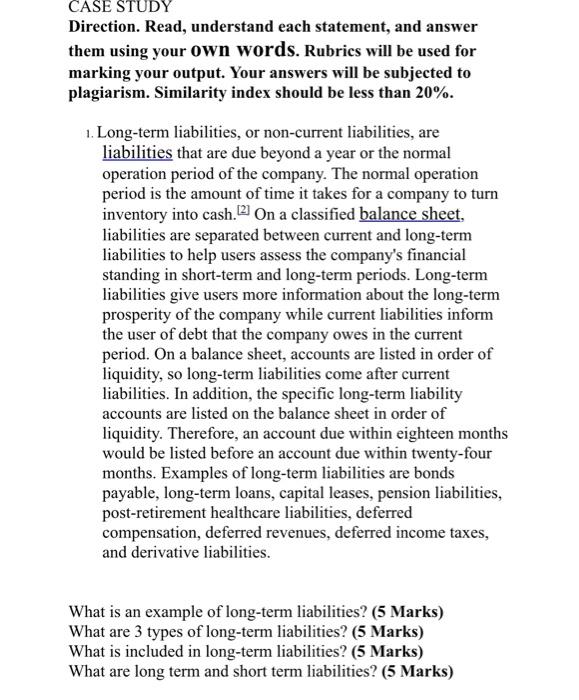
CASE STUDY Direction. Read, understand each statement, and answer them using your own words. Rubrics will be used for marking your output. Your answers will be subjected to plagiarism. Similarity index should be less than 20%. 1. Long-term liabilities, or non-current liabilities, are liabilities that are due beyond a year or the normal operation period of the company. The normal operation period is the amount of time it takes for a company to turn inventory into cash.2 On a classified balance sheet, liabilities are separated between current and long-term liabilities to help users assess the company's financial standing in short-term and long-term periods. Long-term liabilities give users more information about the long-term prosperity of the company while current liabilities inform the user of debt that the company owes in the current period. On a balance sheet, accounts are listed in order of liquidity, so long-term liabilities come after current liabilities. In addition, the specific long-term liability accounts are listed on the balance sheet in order of liquidity. Therefore, an account due within eighteen months would be listed before an account due within twenty-four months. Examples of long-term liabilities are bonds payable, long-term loans, capital leases, pension liabilities, post-retirement healthcare liabilities, deferred compensation, deferred revenues, deferred income taxes, and derivative liabilities. What is an example of long-term liabilities? (5 Marks) What are 3 types of long-term liabilities? (5 Marks) What is included in long-term liabilities? (5 Marks) What are long term and short term liabilities
Step by Step Solution
There are 3 Steps involved in it

Get step-by-step solutions from verified subject matter experts
 Study Help