







Question: Case study Emergent strategy at Virgin Group Under the strong and populist leadership of its chief executive, Sir Richard Branson, Virgin Group has pursued an
Case study Emergent strategy at Virgin Group Under the strong and populist leadership of its chief executive, Sir Richard Branson, Virgin Group has pursued an opportunistic strategy to build a company with estimated annual sales of over US$10 billion by 2007. Starting from nothing in 1968, Virgin Group tried a series of strategies over the next 30 years. Its aim was to find opportunities to grow the business on the basis of what became the Virgin brand name and on the strong reputation of its founder and chief executive. The strategic trial-and-error process was essentially emergent, rather than prescriptive. This case outlines some of the main strategies with Virgins successes, failures and continuing business developments.
Background to the early years After an experimental launch of a student magazine, the young Richard Branson developed a small record mail-order business in 1969 to take advantage of the end of resale price maintenance in the UK. He opened his first record shop two years later and subsequently developed it into the Virgin Megastore chain. At the same time, he was attempting to develop a record label by signing up various pop artists of the time. None of these businesses possessed any clear competitive advantage, though arguably contractual rights to popular musicians and the Virgin brand itself had some real value. He continued to seek business opportunities using the Virgin brand and, by chance, met up with an entrepreneur wishing to develop an airline business. This eventually led to the Virgin airline business with its first route to New York in 1984.ii In later years, the company moved into a variety of business ventures from Virgin Bride and Virgin Cola to Virgin Trains and Virgin Mobile telephones see Table 2.2. In terms of its strategy, Virgin Group claims to examine business opportunities carefully, seeking an opportunity for restructuring the market and creating competitive advantage.
Virgin Groups underlying business strategy The company has developed its strategy over a number of years. Essentially, Virgin takes the view that there are always opportunities available for the hungry business executive. The underlying business logic has been summarised by Branson thus: Business opportunities are like buses . . . Theres always another coming along. In practice, what this means is that Virgin examines new opportunities to see if the group can offer something better, fresher and more valuable than existing companies. It looks particularly at markets where the existing customers are not always receiving value for money and where the existing companies have in some cases become complacent trains, insurance and banking for example and where the new internet might deliver a business opportunity. This means that the main thrust of the strategy has been to find new market opportunities where the company believes its brand name can create competitive advantage. Contrary to what people may think, our constantly expanding and eclectic empire is neither random nor reckless. Each new business demonstrates our skill at picking the right market and the right opportunity, says the Virgin website.
Outcome of emergent strategies: Virgin focuses on geographical expansion In the last few years, Virgin has focused its strategy on geographical expansion of its existing product portfolio rather than adding products. For example, it has taken its highly successful concept of Virgin Mobile telephones to other countries beyond its UK base. However, it remains opportunistic in its main product areas for example, its bid to rescue the failed UK bank Northern Rock in 2007. The strategy continues to emerge both into new countries and into new product 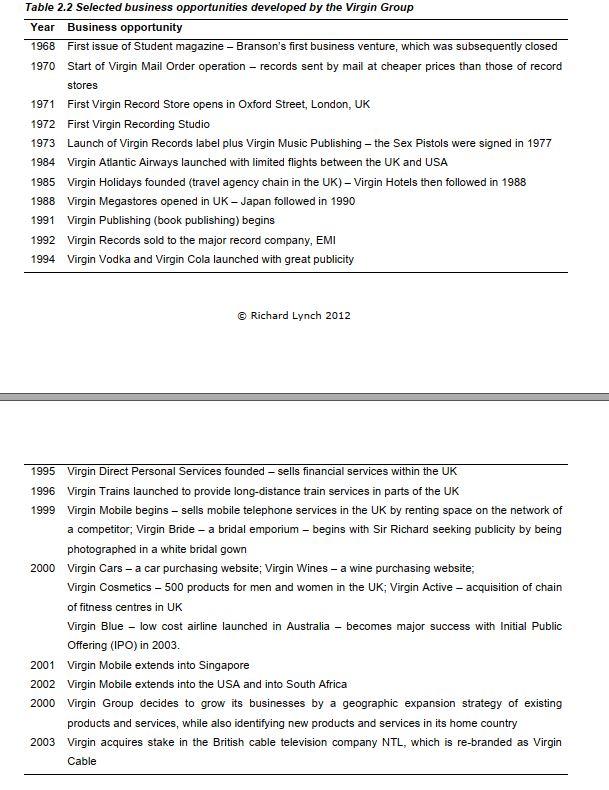
 areas.
Step by Step Solution
There are 3 Steps involved in it

Get step-by-step solutions from verified subject matter experts
 Study Help