





Question: Case Study EOQ Data Sheet The US Postal Service (USPS) is projected to use the new developed ASD's (Automatic Stamper Device) a device manufacture by
Case Study EOQ Data Sheet The US Postal Service
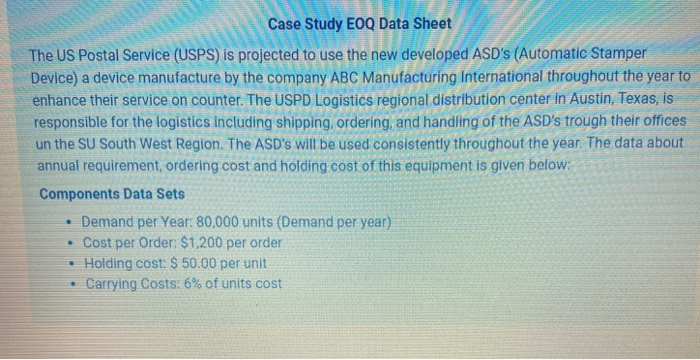
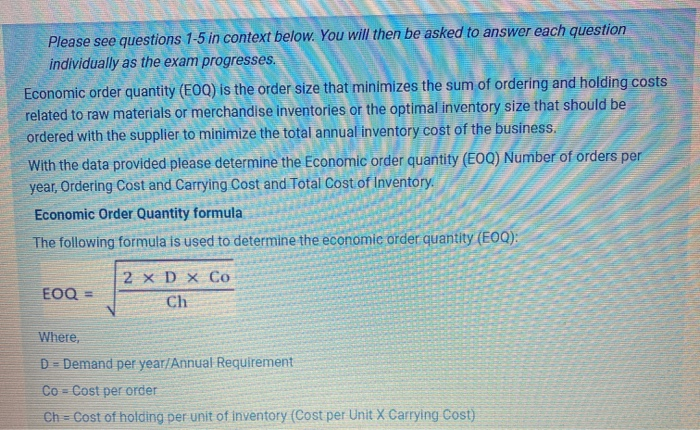
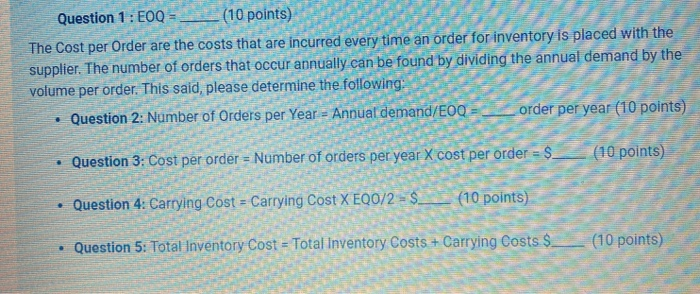
Case Study EOQ Data Sheet The US Postal Service (USPS) is projected to use the new developed ASD's (Automatic Stamper Device) a device manufacture by the company ABC Manufacturing International throughout the year to enhance their service on counter. The USPD Logistics regional distribution center in Austin, Texas, is responsible for the logistics including shipping, ordering, and handling of the ASD's trough their offices un the SU South West Region. The ASD's will be used consistently throughout the year. The data about annual requirement, ordering cost and holding cost of this equipment is given below: Components Data Sets Demand per Year: 80,000 units (Demand per year) Cost per Order: $1,200 per order Holding cost: $ 50.00 per unit Carrying Costs: 6% of units cost . Please see questions 1-5 in context below. You will then be asked to answer each question individually as the exam progresses. Economic order quantity (E00) is the order size that minimizes the sum of ordering and holding costs related to raw materials or merchandise inventories or the optimal inventory size that should be ordered with the supplier to minimize the total annual inventory cost of the business. With the data provided please determine the Economic order quantity (E0Q) Number of orders per year, Ordering Cost and Carrying Cost and Total Cost of Inventory. Economic Order Quantity formula The following formula is used to determine the economic order quantity (E0Q): EOQ = 2 x D x Co Ch Where, D = Demand per year/Annual Requirement Co - Cost per order Ch = Cost of holding per unit of inventory (Cost per Unit X Carrying Cost) Question 1 : E0Q (10 points) The Cost per Order are the costs that are incurred every time an order for inventory is placed with the supplier. The number of orders that occur annually can be found by dividing the annual demand by the volume per order. This said, please determine the following: Question 2: Number of Orders per Year = Annual demand/EOQ - order per year (10 points) Question 3: Cost per order = Number of orders per year X cost per order = $_. (10 points) . Question 4: Carrying Cost = Carrying Cost X EQ0/2 = $(10 points) Question 5: Total Inventory Cost = Total Inventory Costs + Carrying Costs $(10 points)
Step by Step Solution

There are 3 Steps involved in it

1 Expert Approved Answer
Step: 1 Unlock blur-text-image

Question Has Been Solved by an Expert!

Get step-by-step solutions from verified subject matter experts

Step: 2 Unlock
Step: 3 Unlock

Students Have Also Explored These Related General Management Questions!