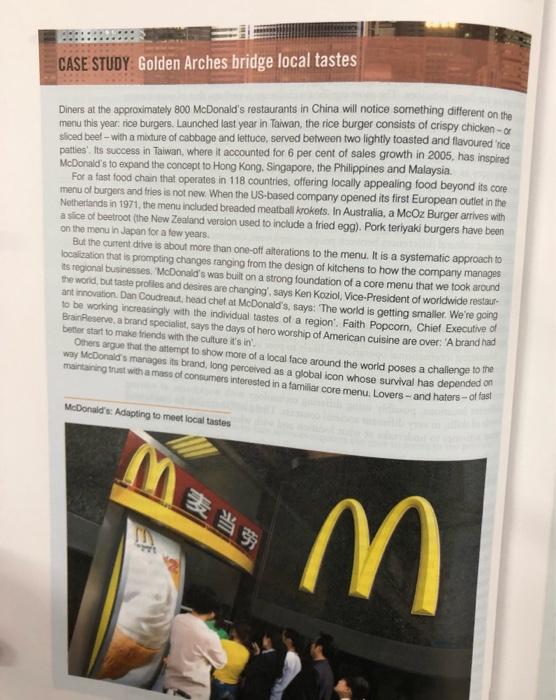
CASE STUDY Golden Arches bridge local tastes Diners at the approximately 800 McDonald's restaurants in China will notice something different on the menu this year , rice burgers. Launched last year in Taiwan, the rice burger consists of crispy chicken- siced beef -- with a modure of cabbage and lettuce, served between two lightly toasted and flavoured Price patties'. Its success in Taiwan, where it accounted for 6 per cent of sales growth in 2005, has inspired McDonald's to expand the concept to Hong Kong, Singapore, the Philippines and Malaysia. For a tast food chain that operates in 118 countries, offering locally appealing food beyond its core menu of burgers and tries is not new. When the US-based company opened its first European outlet in the Netherlands in 1971, the menu included breaded meatball krokets. In Australia, a McOz Burger arrives with asice of beetroot (the New Zealand version used to include a fried egg). Pork teriyaki burgers have been on the menu in Japan for a few years But the current drive is about more than one-off alterations to the menu. It is a systematic approach to localization that is prompting changes ranging from the design of kitchens to how the company manages ts regional businesses. 'McDonald's was built on a strong foundation of a core menu that we took around the world, but taste profiles and desires are changing', says Ken Koziol, Vice-President of worldwide restaur art rovation. Dan Coudreaut, head chet at McDonald's, says: The world is getting smaller. We're going to be working increasingly with the individual tastes of a region. Faith Popcorn, Chief Executive of Bran Reserve, a brand specialist, says the days of hero worship of American cuisine are over: 'A brand had better start to make friends with the culture it's in Others argue that the attempt to show more of a local face around the world poses a challenge 20 the way McDonald's manages ts brand, long perceived as a global icon whose survival has depended on martaring at with a mass of consumers interested in a familiar core menu. Lovers - and haters-ol fast McDonald's: Adapting to meet local tastes 3 food have for decades known the Golden Arches as the global flag carrier for convenience eating, US-style Simon Arholt, a British author and founder of Nations Brand Index, a quarterly gobal survey of countries as brands, says the increasing localization of McDonald's menus may end up being counter-productive While the anti-American mood in many parts of the world appears to be punishing sales of US-branded goods, he says, McDonald's brand identity means, paradically, it cannot stray too far trom its cove menu. He says By putting local food on the menu all you are doing is removing the logic of the brand, because this is an American brand. 1 McDonald's serves a poor imitation at your local cuisine, it's going to be an insur Such dilemmas may have prompted the company to do some soul-searching of its own. In its first European Corporate Responsibility Report, issued in November. McDonald's says: "Ask people a simple question: "Do you trust McDonald's? and you will get a huge variety of answers'. It continues: "Many of those answers reflect the fact that people's opinions about McDonald's are shaped by factors that go way beyond what we actualy do as a company Attitudes towards the USA. Perceptions of "fast food'. Views about globalization itself Yet the company believes it is possible to be global and local at the same time. Mary Dillon, chief mar- keting manager, says: The business at McDonald's is much more about local relevance than a global archetype. Globally we think of ourselves as the custodian of the brand but it's all about relevance to the local markets. McDonald's current advertising drive - which uses the slogan Tm lovin' - is the com pany's first unified global marketing campaign. Yet I'm lovin' It is also translated into the local language of the country wherever it runs Asia is where the localization strategy faces arguably its biggest test. Tim Fenton, McDonald's head of Asia-Pacific, Middle East and Africa, manages a business spanning 15 time zones and embracing a region that includes people speaking 800 different languages and dialects. A new food studio will open in Hong Kong in May, where chefs will devise meals aimed at specific local markets in the region. The studio s similar to one already open in Paris, which is doing a similar job for European polatos. Mr Fenton ac- knowledges that McDonald's competition in Asia - where the most popular menu item is not a burger, but the Fiet-O-Fish - will be tough. "Most consumers frequent market stals, food courts, hawior stands and convenience stores for fast meals. This is our competition, it's non-traditional and at times very random', he says. McDonald's is already meeting the needs of our consumers local tastes in ways that are different from the comer noodle shop By 2007. McDonald's will also be ready to roll out a few ble operating platform-a modular kitchen that Gan cook more than one type of meal in the sarne restaurant. This involves a comb over-still at the pro- type stage - that can cook several varieties of dishes at once. These include as yet Undeveloped offer non such as a tilapia sandwich, McRoasters (a type of root potato), salmon with lemon and dil sauce and Putos', a Mocan dish consisting of tighty rolled com tots with a variety of filings Robert Goldin, Executive Vice President at Technornic, a Chicago-based food service consultancy, says nevitably add complexity to McDonald's business. Ym not sure that the retun tas there to support Me Kariel says the company wary aware of the extra investment needed but say: Tua migration to De done in a staged manner. Such concerns are lay to stop McDonald's for now im Sinnet Cher Excerpted from the artide by Jeremy Grant , Financial Times, London San February 2006) Efective. We're a local business with a local face in each country we operate in Questions abundan tional operation? What are the most significare factors that have diven MecDonde 10 choroo e basis stora what problema e McDonald's face in trying to make a baturce between a deure to mendirenze boency by standardizing operations dels and the preure to customize its operations to meet el seguromont