Question: Case Study: Grocery Wars On June 16, 2017 Amazon announced that it was purchasing the upscale food marketchain Whole Foods for $13.7 billion. The acquisition,
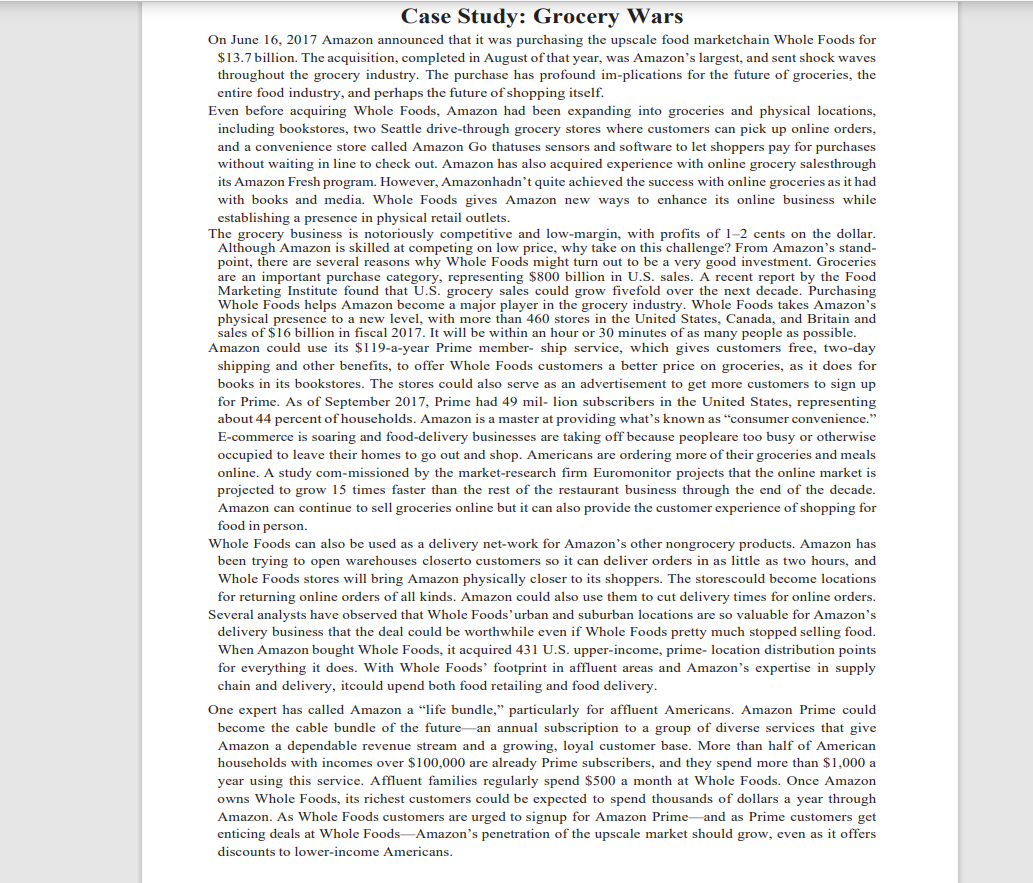
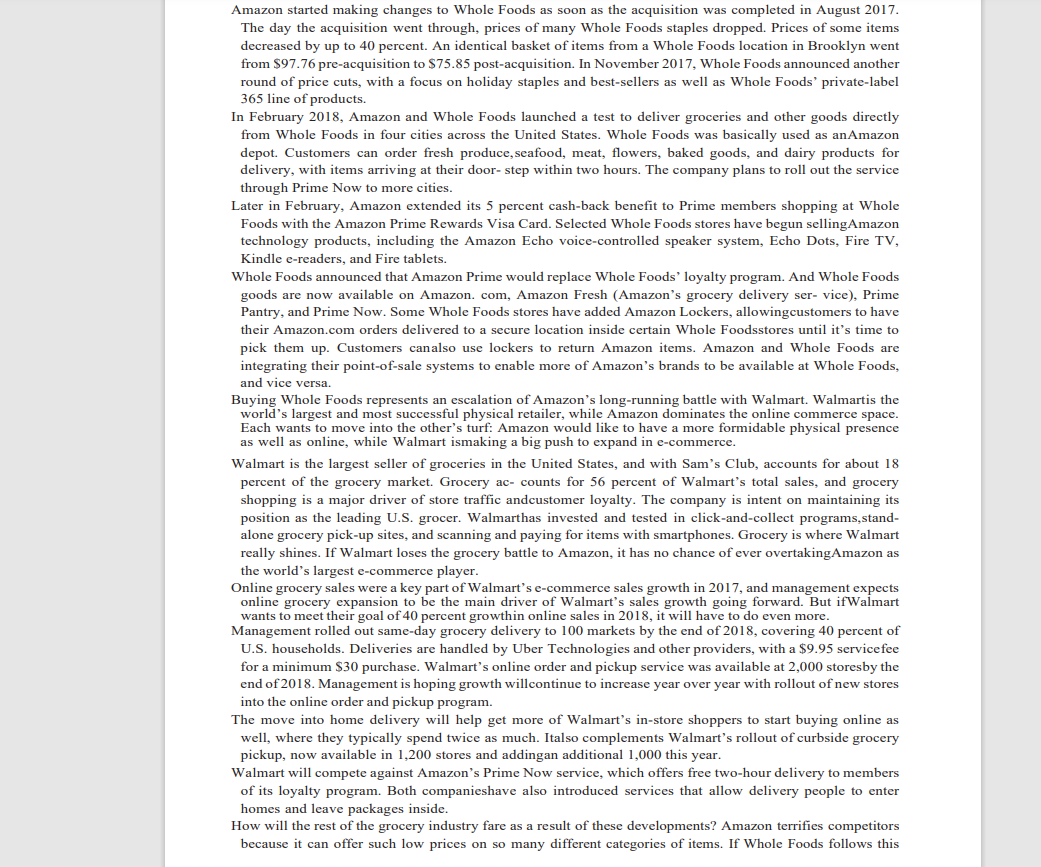
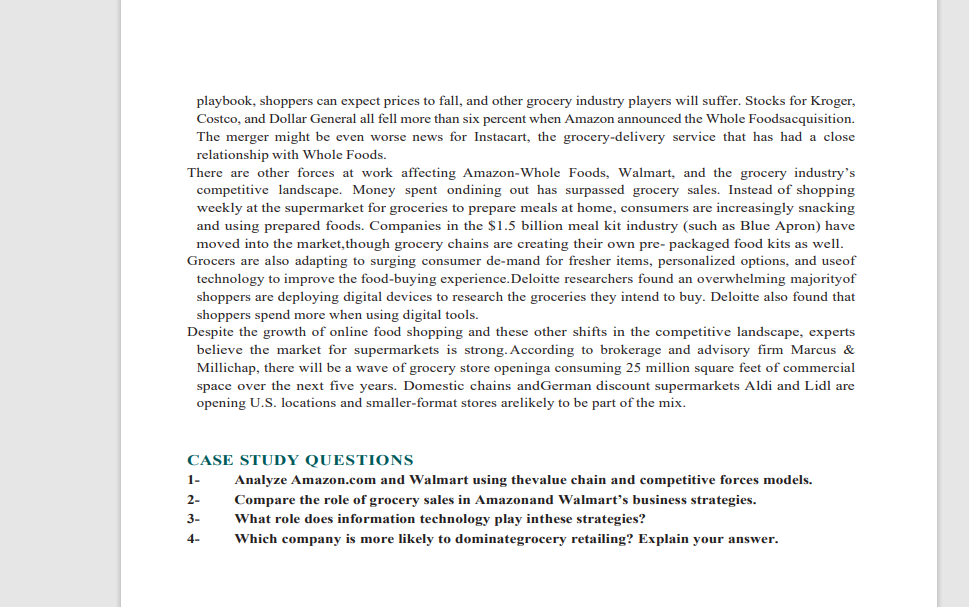
Case Study: Grocery Wars On June 16, 2017 Amazon announced that it was purchasing the upscale food marketchain Whole Foods for $13.7 billion. The acquisition, completed in August of that year, was Amazon's largest, and sent shock waves throughout the grocery industry. The purchase has profound im-plications for the future of groceries, the entire food industry, and perhaps the future of shopping itself. Even before acquiring Whole Foods, Amazon had been expanding into groceries and physical locations, including bookstores, two Seattle drive-through grocery stores where customers can pick up online orders, and a convenience store called Amazon Go thatuses sensors and software to let shoppers pay for purchases without waiting in line to check out. Amazon has also acquired experience with online grocery salesthrough its Amazon Fresh program. However, Amazonhadn't quite achieved the success with online groceries as it had with books and media. Whole Foods gives Amazon new ways to enhance its online business while establishing a presence in physical retail outlets. The grocery business is notoriously competitive and low-margin, with profits of 1-2 cents on the dollar. Although Amazon is skilled at competing on low price, why take on this challenge? From Amazon's stand- point, there are several reasons why Whole Foods might turn out to be a very good investment. Groceries are an important purchase category, representing $800 billion in U.S. sales. A recent report by the Food Marketing Institute found that U.S. grocery sales could grow fivefold over the next decade. Purchasing Whole Foods helps Amazon become a major player in the grocery industry. Whole Foods takes Amazon's physical presence to a new level, with more than 460 stores in the United States, Canada, and Britain and sales of $16 billion in fiscal 2017. It will be within an hour or 30 minutes of as many people as possible. Amazon could use its $119-a-year Prime member- ship service, which gives customers free, two-day shipping and other benefits, to offer Whole Foods customers a better price on groceries, as it does for books in its bookstores. The stores could also serve as an advertisement to get more customers to sign up for Prime. As of September 2017, Prime had 49 mil- lion subscribers in the United States, representing about 44 percent of households. Amazon is a master at providing what's known as "consumer convenience." E-commerce is soaring and food delivery businesses are taking off because peopleare too busy or otherwise occupied to leave their homes to go out and shop. Americans are ordering more of their groceries and meals online. A study com-missioned by the market-research firm Euromonitor projects that the online market is projected to grow 15 times faster than the rest of the restaurant business through the end of the decade. Amazon can continue to sell groceries online but it can also provide the customer experience of shopping for food in person. Whole Foods can also be used as a delivery net-work for Amazon's other nongrocery products. Amazon has been trying to open warehouses closerto customers so it can deliver orders in as little as two hours, and Whole Foods stores will bring Amazon physically closer to its shoppers. The storescould become locations for returning online orders of all kinds. Amazon could also use them to cut delivery times for online orders. Several analysts have observed that Whole Foods'urban and suburban locations are so valuable for Amazon's delivery business that the deal could be worthwhile even if Whole Foods pretty much stopped selling food. When Amazon bought Whole Foods, it acquired 431 U.S. upper-income, prime- location distribution points for everything it does. With Whole Foods' footprint in affluent areas and Amazon's expertise in supply chain and delivery, itcould upend both food retailing and food delivery. One expert has called Amazon a life bundle," particularly for affluent Americans. Amazon Prime could become the cable bundle of the futurean annual subscription to a group of diverse services that give Amazon a dependable revenue stream and a growing, loyal customer base. More than half of American households with incomes over $100,000 are already Prime subscribers, and they spend more than $1,000 a year using this service. Affluent families regularly spend $500 a month at Whole Foods. Once Amazon owns Whole Foods, its richest customers could be expected to spend thousands of dollars a year through Amazon. As Whole Foods customers are urged to signup for Amazon Primeand as Prime customers get enticing deals at Whole Foods-Amazon's penetration of the upscale market should grow, even as it offers discounts to lower-income Americans. playbook, shoppers can expect prices to fall, and other grocery industry players will suffer. Stocks for Kroger, Costco, and Dollar General all fell more than six percent when Amazon announced the Whole Foodsacquisition. The merger might be even worse news for Instacart, the grocery-delivery service that has had a close relationship with Whole Foods. There are other forces at work affecting Amazon-Whole Foods, Walmart, and the grocery industry's competitive landscape. Money spent ondining out has surpassed grocery sales. Instead of shopping weekly at the supermarket for groceries to prepare meals at home, consumers are increasingly snacking and using prepared foods. Companies in the $1.5 billion meal kit industry (such as Blue Apron) have moved into the market, though grocery chains are creating their own pre-packaged food kits as well. Grocers are also adapting to surging consumer de-mand for fresher items, personalized options, and useof technology to improve the food-buying experience. Deloitte researchers found an overwhelming majorityof shoppers are deploying digital devices to research the groceries they intend to buy. Deloitte also found that shoppers spend more when using digital tools. Despite the growth of online food shopping and these other shifts in the competitive landscape, experts believe the market for supermarkets is strong. According to brokerage and advisory firm Marcus & Millichap, there will be a wave of grocery store openinga consuming 25 million square feet of commercial space over the next five years. Domestic chains and German discount supermarkets Aldi and Lidl are opening U.S. locations and smaller-format stores arelikely to be part of the mix. CASE STUDY QUESTIONS 1- Analyze Amazon.com and Walmart using thevalue chain and competitive forces models. 2- Compare the role of grocery sales in Amazonand Walmart's business strategies. 3- What role does information technology play inthese strategies? 4- Which company is more likely to dominategrocery retailing? Explain your









 Study Help