Question: Case study Hallmark totally dominates the U.S. greeting card industry. Despite its success, the company decided to embark on a reengineering program with the objective
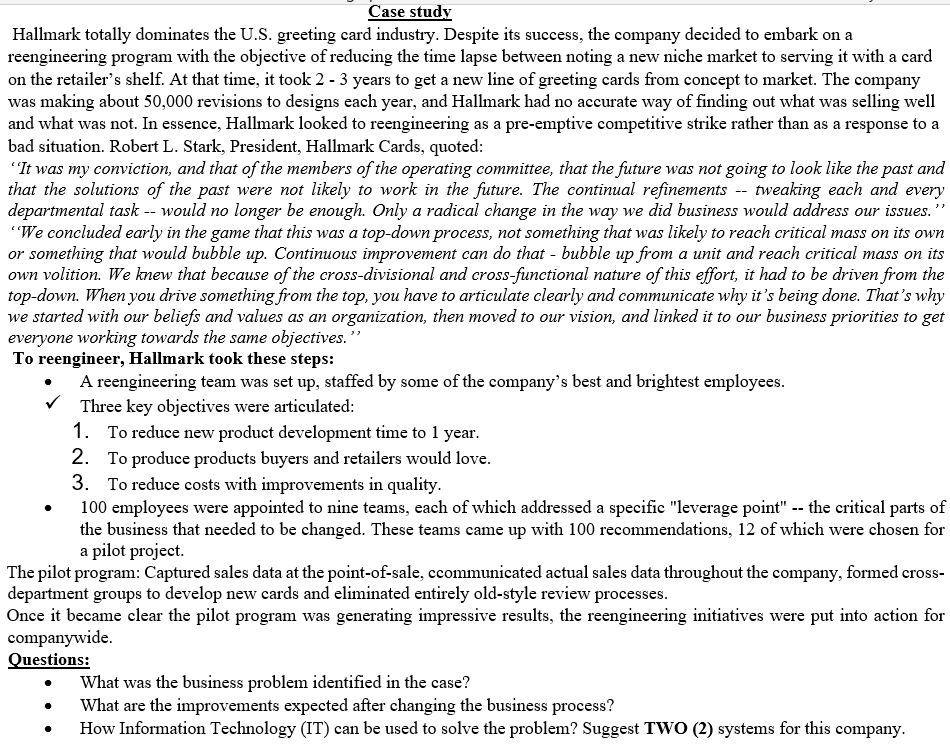
Case study Hallmark totally dominates the U.S. greeting card industry. Despite its success, the company decided to embark on a reengineering program with the objective of reducing the time lapse between noting a new niche market to serving it with a card on the retailer's shelf. At that time, it took 2 - 3 years to get a new line of greeting cards from concept to market. The company was making about 50,000 revisions to designs each year, and Hallmark had no accurate way of finding out what was selling well and what was not. In essence, Hallmark looked to reengineering as a pre-emptive competitive strike rather than as a response to a bad situation. Robert L. Stark, President, Hallmark Cards, quoted: "It was my conviction, and that of the members of the operating committee, that the future was not going to look like the past and that the solutions of the past were not likely to work in the future. The continual refinements -- tweaking each and every departmental task -- would no longer be enough. Only a radical change in the way we did business would address our issues. We concluded early in the game that this was a top-down process, not something that was likely to reach critical mass on its own or something that would bubble up. Continuous improvement can do that - bubble up from a unit and reach critical mass on its own volition. We knew that because of the cross-divisional and cross-functional nature of this effort, it had to be driven from the top-down. When you drive something from the top, you have to articulate clearly and communicate why it's being done. That's why we started with our beliefs and values as an organization, then moved to our vision, and linked it to our business priorities to get everyone working towards the same objectives. To reengineer, Hallmark took these steps: A reengineering team was set up, staffed by some of the company's best and brightest employees. Three key objectives were articulated: 1. To reduce new product development time to 1 year. 2. To produce products buyers and retailers would love. 3. To reduce costs with improvements in quality. 100 employees were appointed to nine teams, each of which addressed a specific "leverage point" -- the critical parts of the business that needed to be changed. These teams came up with 100 recommendations, 12 of which were chosen for a pilot project. The pilot program: Captured sales data at the point-of-sale, ccommunicated actual sales data throughout the company, formed cross- department groups to develop new cards and eliminated entirely old-style review processes. Once it became clear the pilot program was generating impressive results, the reengineering initiatives were put into action for companywide. Questions: What was the business problem identified in the case? What are the improvements expected after changing the business process? How Information Technology (IT) can be used to solve the problem? Suggest TWO (2) systems for this company




