


Question: Case Study Hamish was satisfied. The home and office Ready Meal catering business he had started five years ago seemed to be doing well. It
Case Study Hamish was satisfied. The home and
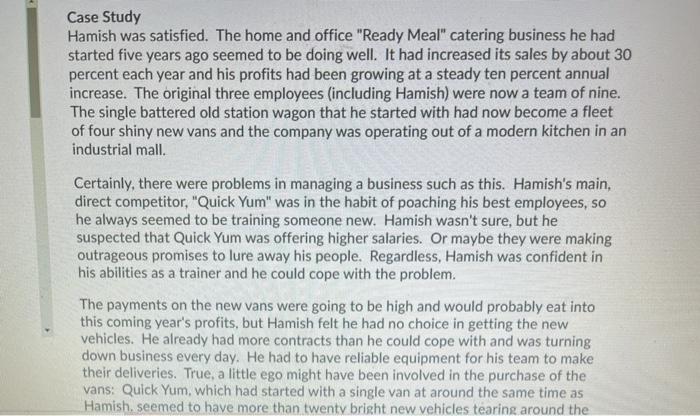
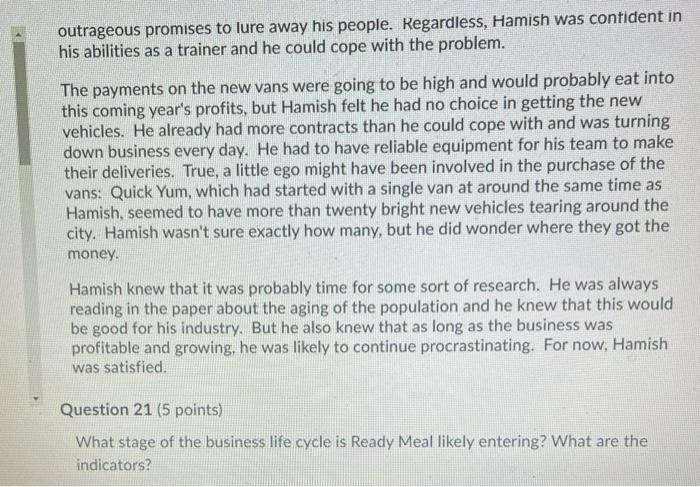
Case Study Hamish was satisfied. The home and office "Ready Meal" catering business he had started five years ago seemed to be doing well. It had increased its sales by about 30 percent each year and his profits had been growing at a steady ten percent annual increase. The original three employees (including Hamish) were now a team of nine. The single battered old station wagon that he started with had now become a fleet of four shiny new vans and the company was operating out of a modern kitchen in an industrial mall. Certainly, there were problems in managing a business such as this. Hamish's main, direct competitor, "Quick Yum" was in the habit of poaching his best employees, so he always seemed to be training someone new. Hamish wasn't sure, but he suspected that Quick Yum was offering higher salaries. Or maybe they were making outrageous promises to lure away his people. Regardless, Hamish was confident in his abilities as a trainer and he could cope with the problem. The payments on the new vans were going to be high and would probably eat into this coming year's profits, but Hamish felt he had no choice in getting the new vehicles. He already had more contracts than he could cope with and was turning down business every day. He had to have reliable equipment for his team to make their deliveries. True, a little ego might have been involved in the purchase of the vans: Quick Yum, which had started with a single van at around the same time as Hamish, seemed to have more than twenty bright new vehicles tearing around the outrageous promises to lure away his people. Regardless, Hamish was contident in his abilities as a trainer and he could cope with the problem. The payments on the new vans were going to be high and would probably eat into this coming year's profits, but Hamish felt he had no choice in getting the new vehicles. He already had more contracts than he could cope with and was turning down business every day. He had to have reliable equipment for his team to make their deliveries. True, a little ego might have been involved in the purchase of the vans: Quick Yum, which had started with a single van at around the same time as Hamish, seemed to have more than twenty bright new vehicles tearing around the city. Hamish wasn't sure exactly how many, but he did wonder where they got the money. Hamish knew that it was probably time for some sort of research. He was always reading in the paper about the aging of the population and he knew that this would be good for his industry. But he also knew that as long as the business was profitable and growing, he was likely to continue procrastinating. For now, Hamish was satisfied. Question 21 (5 points) What stage of the business life cycle is Ready Meal likely entering? What are the indicators? What steps should Hamish take with his challenge to address employee turnover? Why? Question 23 (5 points) What do we know about the company's operating capacity? What decisions should this lead to, why
Step by Step Solution

There are 3 Steps involved in it

1 Expert Approved Answer
Step: 1 Unlock blur-text-image

Question Has Been Solved by an Expert!

Get step-by-step solutions from verified subject matter experts

Step: 2 Unlock
Step: 3 Unlock

Students Have Also Explored These Related General Management Questions!