Question: CASE STUDY Henry Bergson, the inventory manager at ABC Electronics, has been charged with solving a growing problem in the warehouse's small items bin area.
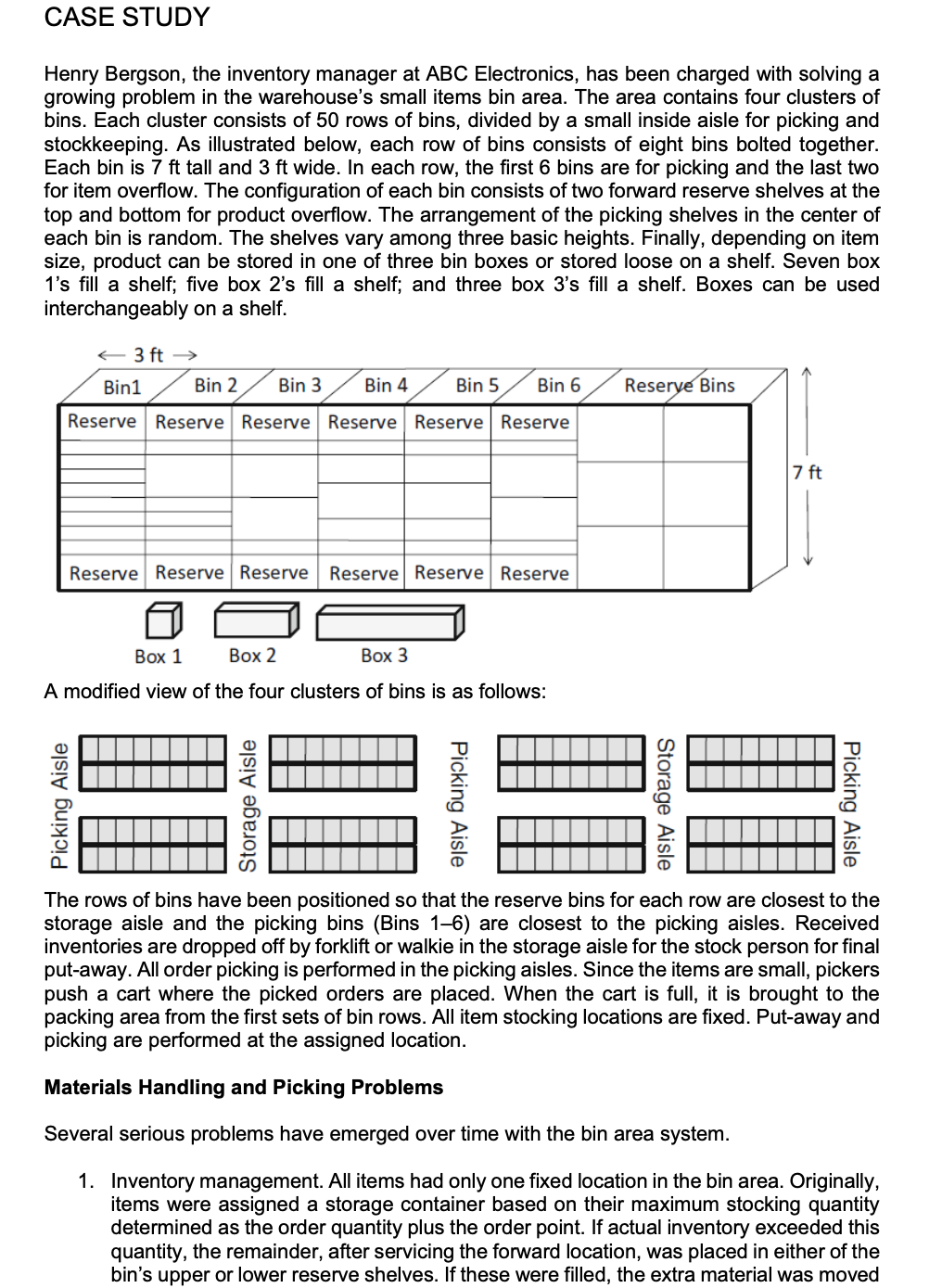
CASE STUDY Henry Bergson, the inventory manager at ABC Electronics, has been charged with solving a growing problem in the warehouse's small items bin area. The area contains four clusters of bins. Each cluster consists of 50 rows of bins, divided by a small inside aisle for picking and stockkeeping. As illustrated below, each row of bins consists of eight bins bolted together. Each bin is 7 ft tall and 3 ft wide. In each row, the first 6 bins are for picking and the last two for item overflow. The configuration of each bin consists of two forward reserve shelves at the top and bottom for product overflow. The arrangement of the picking shelves in the center of each bin is random. The shelves vary among three basic heights. Finally, depending on item size, product can be stored in one of three bin boxes or stored loose on a shelf. Seven box 1's fill a shelf; five box 2's fill a shelf; and three box 3's fill a shelf. Boxes can be used interchangeably on a shelf. 3 ft Bin1 Bin 2 Bin 3 Bin 4 Bin 5 Bin 6 Reserve Bins Reserve Reserve Reserve Reserve Reserve Reserve 7 ft Reserve Reserve Reserve Reserve Reserve Reserve Box 1 Box 2 Box 3 A modified view of the four clusters of bins is as follows: Storage Aisle Picking Aisle Picking Aisle Storage Aisle Picking Aisle The rows of bins have been positioned so that the reserve bins for each row are closest to the storage aisle and the picking bins (Bins 1-6) are closest to the picking aisles. Received inventories are dropped off by forklift or walkie in the storage aisle for the stock person for final put-away. All order picking is performed in the picking aisles. Since the items are small, pickers push a cart where the picked orders are placed. When the cart is full, it is brought to the packing area from the first sets of bin rows. All item stocking locations are fixed. Put-away and picking are performed at the assigned location. Materials Handling and Picking Problems Several serious problems have emerged over time with the bin area system. 1. Inventory management. All items had only one fixed location in the bin area. Originally, items were assigned a storage container based on their maximum stocking quantity determined as the order quantity plus the order point. If actual inventory exceeded this quantity, the remainder, after servicing the forward location, was placed in either of the bin's upper or lower reserve shelves. If these were filled, the extra material was moved3. to the last two bins in the row. Over time, the original space allocation for many items had become seriously out of date with the result that many items had too much, or too little forward stock space allotted to them. For example, ABC stocked hundreds of very small items that poorly utilized Box #1 cube space. The allotted reserve space in many rows was lled. Stock was often lined up in the aisles by the dock-receiving team. Complaints were often heard that vehicles could not get down the storage aisles, and received items began to pile up at the front of each stocking aisle. With so much reserve, items were getting lost and picking shortages had become a chronic nuisance. Stock personnel was spending too much time searching for reserves and normal put- away and servicing was chronically behind, resulting in even more shortages. Often the bin area personnel were working overtime to catch up. Picking. Besides the chronic shortages, picking had become a time-consuming task that perpetually exceeded the warehouse standard of 60 lines per hour per picker. In the beginning, items had been located in the bins by product family. Over time, however, items had been moved around so much that picking by product family had become impossible. Pickers were often traversing the entire bin area to complete their paper order packet of 60 lines. Another problem was the available room on the carts. Often the cart was lled before all 60 lines were completed. The picker had then to take the cart to the packing area, retrieve an empty cart, and complete the original order packet. Often the number of orders allotted by sales to be fllled each day were being carried over to the next day or had to be filled using overtime hours. Since the business prided itself on next-day delivery, these picking problems had become management's number one issue. As Henry's assistant, how would you help him tackle these problems? Be specic and offer reasonable advice
Step by Step Solution
There are 3 Steps involved in it
1 Expert Approved Answer
Step: 1 Unlock
Question Has Been Solved by an Expert!
Get step-by-step solutions from verified subject matter experts
Step: 2 Unlock
Step: 3 Unlock
Students Have Also Explored These Related General Management Questions!









 Study Help