



Question: Case Study I: Jules T. Jules is a 36-year-old white male. He is married and the couple just had their first child, a baby girl.
Case Study I: Jules T.
Jules is a 36-year-old white male. He is married and the couple just had their first child, a baby girl. Six months ago, Jules was diagnosed with Lou Gehrigs disease, and has rapidly lost body function.
This disease is amyotrophic lateral sclerosis (a-my-o-TROE-fik LAT-ur-ul skluh-ROE-sis), or ALS, it is a progressive nervous system disease that affects nerve cells in the brain and spinal cord, causing loss of muscle control.
ALS is often called Lou Gehrig's disease, after the baseball player who was diagnosed with it. Doctors usually don't know why ALS occurs. Some cases are inherited.
ALS often begins with muscle twitching and weakness in a limb, or slurred speech. Eventually, ALS affects control of the muscles needed to move, speak, eat and breathe. There is no cure for this fatal disease.
The ethics problem is while Jules has received treatment at home to care for him as he progressively loses bodily function his main goal was to see his child born. Now that he has seen his daughter he wants to be allowed to die, to avoid the pain and suffering found with the end stage of this disease and to not be a burden on his wife.
The home care agency has a stated mission to help the ill and infirm to live a quality of life for as long as possible. The nurses assigned to oversee the case are concerned that this case borders on euthanasia and are seeking guidance from the Director of Nursing on how to deal with this request. The question is Can the agency ethically assist or continue to care for someone who is actively seeking to die? Prepare the response that the Director of Nursing will use to guide her staff.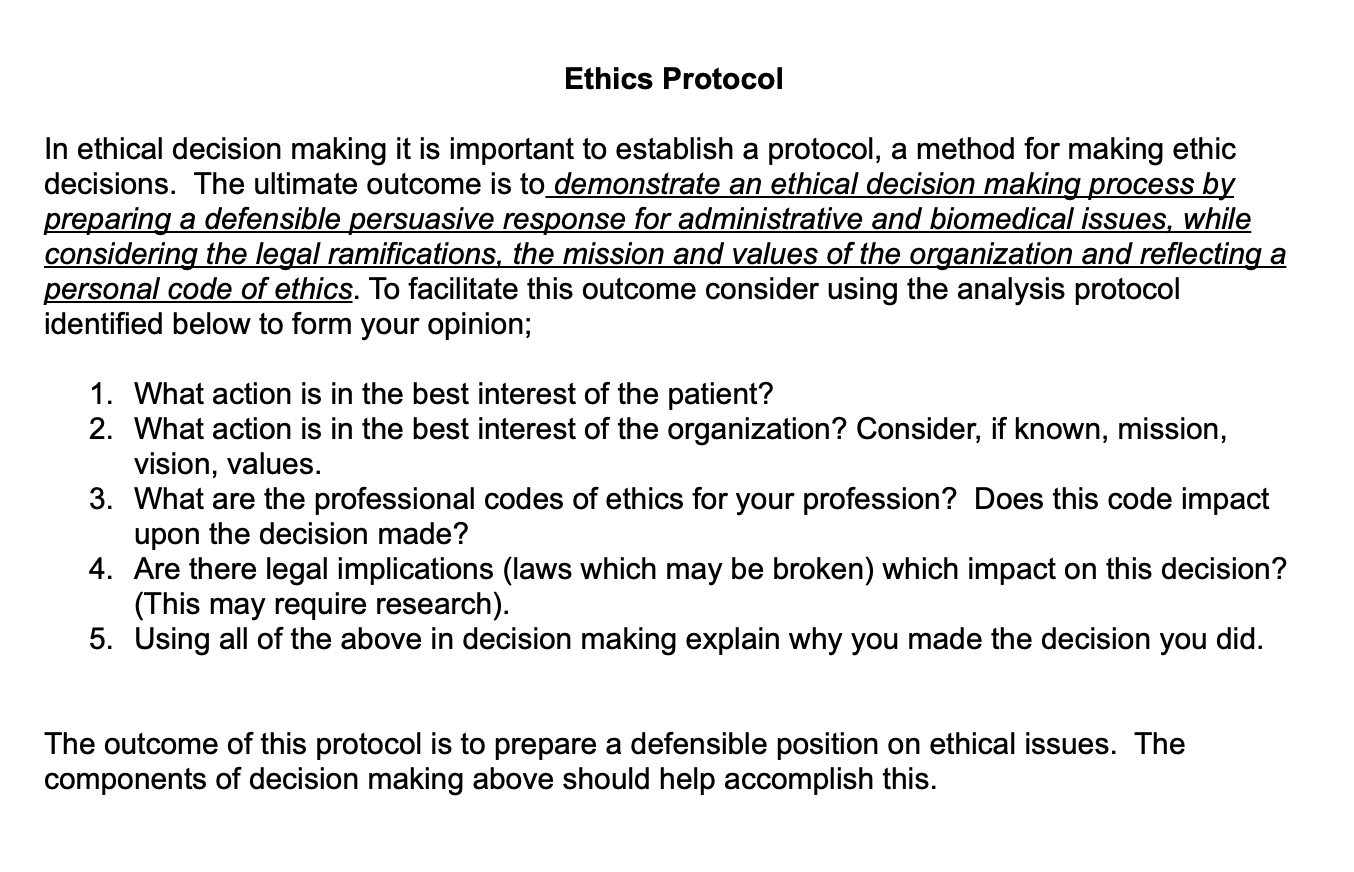
Step by Step Solution
There are 3 Steps involved in it

Get step-by-step solutions from verified subject matter experts