







Question: CASE STUDY INFO 1. Do you agree with the supreme court's reasoning in dicling to order a remedy for the violation of Khadr's charter rights?
CASE STUDY INFO 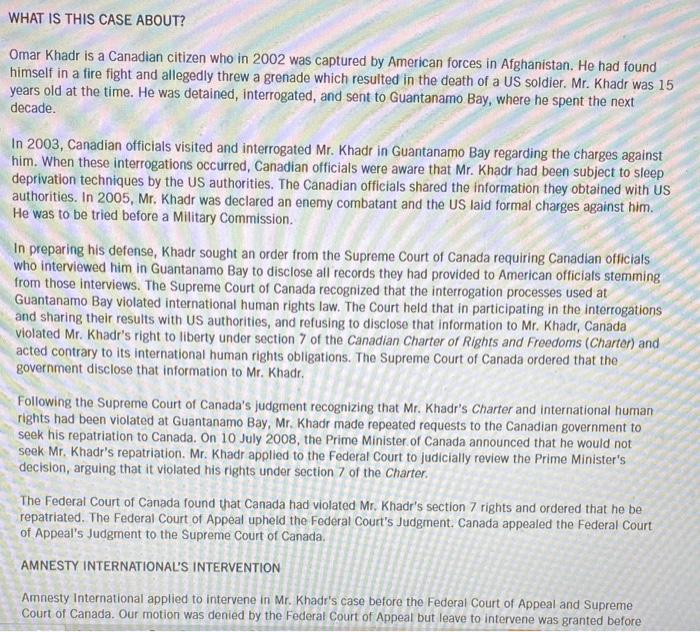
1. Do you agree with the supreme court's reasoning in dicling to order a remedy for the violation of Khadr's charter rights?
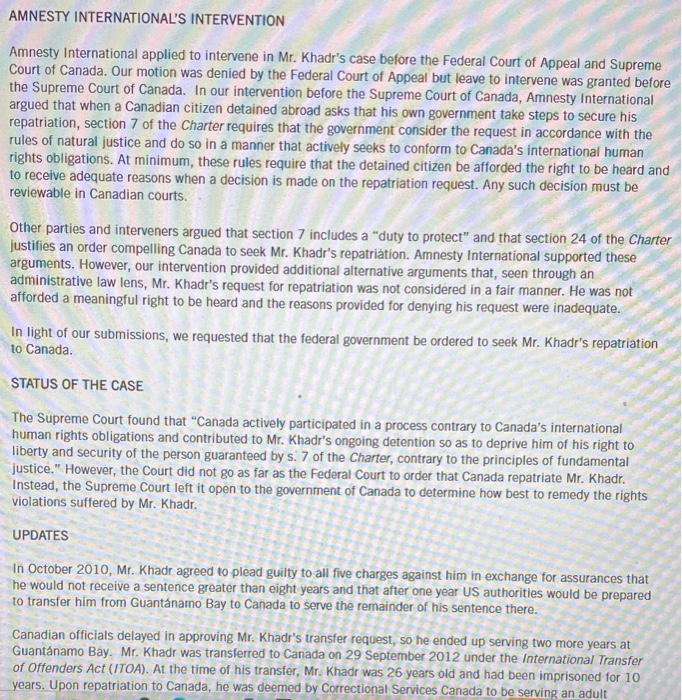
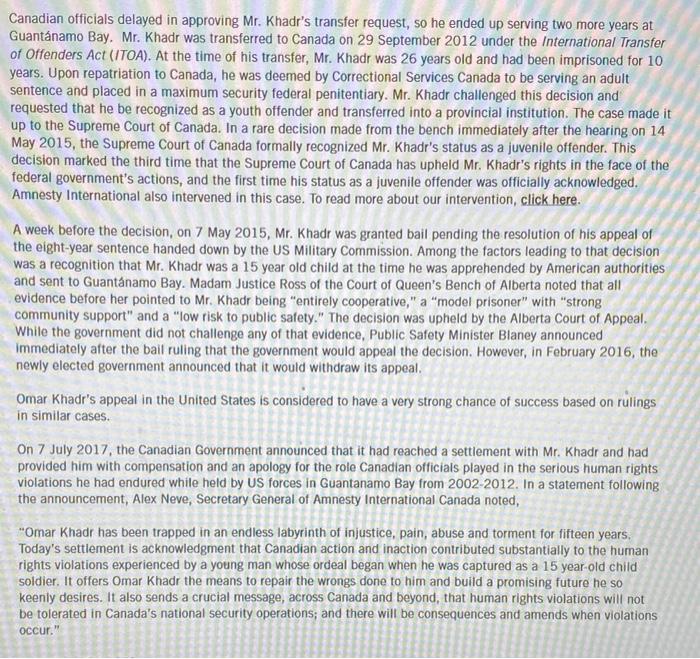
WHAT IS THIS CASE ABOUT? Omar Khadr is a Canadian citizen who in 2002 was captured by American forces in Afghanistan. He had found himself in a fire fight and allegedly threw a grenade which resulted in the death of a US soldier. Mr. Khadr was 15 years old at the time. He was detained, interrogated, and sent to Guantanamo Bay, where he spent the next decade. In 2003, Canadian officials visited and interrogated Mr. Khadr in Guantanamo Bay regarding the charges against him. When these interrogations occurred, Canadian officials were aware that Mr. Khadr had been subject to sleep deprivation techniques by the US authorities. The Canadian officials shared the information they obtained with US authorities. In 2005, Mr. Khadr was declared an enemy combatant and the US laid formal charges against him. He was to be tried before a Military Commission. one di carnet de In preparing his defense, Khadr sought an order from the Supreme Court of Canada requiring Canadian officials who interviewed him in Guantanamo Bay to disclose all records they had provided to American officials stemming from those interviews. The Supreme Court of Canada recognized that the interrogation processes used at Guantanamo Bay violated international human rights law. The Court held that in participating in the interrogations and sharing their results with US authorities, and refusing to disclose that information to Mr. Khadr, Canada violated Mr. Khadr's right to liberty under section 7 of the Canadian Charter of Rights and Freedoms (Charter) and acted contrary to its international human rights obligations. The Supreme Court of Canada ordered that the government disclose that information to Mr. Khadr. Following the Supreme Court of Canada's judgment recognizing that Mr. Khadr's Charter and international human rights had been violated at Guantanamo Bay, Mr. Khadr made repeated requests to the Canadian government to seek his repatriation to Canada. On 10 July 2008, the Prime Minister of Canada announced that he would not seek Mr. Khadr's repatriation. Mr. Khadr applied to the Federal Court to judicially review the Prime Minister's decision, arguing that it violated his rights under section 7 of the Charter. The Federal Court of Canada found that Canada had violated Mr. Khadr's section 7 rights and ordered that he be repatriated. The Federal Court of Appeal upheld the Federal Court's Judgment. Canada appealed the Federal Court of Appeal's Judgment to the Supreme Court of Canada, AMNESTY INTERNATIONAL'S INTERVENTION Amnesty International applied to intervene in Mr. Khade's case before the Federal Court of Appeal and Supreme Court of Canada. Our motion was denied by the Federal Court of Appeal but leave to intervene was granted before AMNESTY INTERNATIONAL'S INTERVENTION Amnesty International applied to intervene in Mr. Khadr's case before the Federal Court of Appeal and Supreme Court of Canada. Our motion was denied by the Federal Court of Appeal but leave to intervene was granted before the Supreme Court of Canada. In our intervention before the Supreme Court of Canada, Amnesty International argued that when a Canadian citizen detained abroad asks that his own government take steps to secure his repatriation, section 7 of the Charter requires that the government consider the request in accordance with the rules of natural justice and do so in a manner that actively seeks to conform to Canada's international human rights obligations. At minimum, these rules require that the detained citizen be afforded the right to be heard and to receive adequate reasons when a decision is made on the repatriation request. Any such decision must be reviewable in Canadian courts. Other parties and interveners argued that section 7 includes a "duty to protect" and that section 24 of the Charter justifies an order compelling Canada to seek Mr. Khadr's repatriation. Amnesty International supported these arguments. However, our intervention provided additional alternative arguments that, seen through an administrative law lens, Mr. Khadr's request for repatriation was not considered in a fair manner. He was not afforded a meaningful right to be heard and the reasons provided for denying his request were inadequate. In light of our submissions, we requested that the federal government be ordered to seek Mr. Khadr's repatriation to Canada. STATUS OF THE CASE The Supreme Court found that "Canada actively participated in a process contrary to Canada's international human rights obligations and contributed to Mr. Khadr's ongoing detention so as to deprive him of his right to liberty and security of the person guaranteed by s. 7 of the Charter, contrary to the principles of fundamental justice." However, the Court did not go as far as the Federal Court to order that Canada repatriate Mr. Khadr. Instead, the Supreme Court left it open to the government of Canada to determine how best to remedy the rights violations suffered by Mr. Khadr. UPDATES In October 2010, Mr. Khadr agreed to plead guilty to all five charges against him in exchange for assurances that he would not receive a sentence greater than eight years and that after one year US authorities would be prepared to transfer him from Guantnamo Bay to Canada to serve the remainder of his sentence there. Canadian officials delayed in approving Mr. Khadr's transfer request, so he ended up serving two more years at Guantanamo Bay. Mr. Khadr was transferred to Canada on 29 September 2012 under the International Transfer of Offenders Act (ITOA). At the time of his transfer, Mr. Khadr was 26 years old and had been imprisoned for 10 years. Upon repatriation to Canada, he was deemed by Correctional Services Canada to be serving an adult Canadian officials delayed in approving Mr. Khadr's transfer request, so he ended up serving two more years at Guantnamo Bay. Mr. Khadr was transferred to Canada on 29 September 2012 under the International Transfer of Offenders Act (TOA). At the time of his transfer, Mr. Khadr was 26 years old and had been imprisoned for 10 years. Upon repatriation to Canada, he was deemed by Correctional Services Canada to be serving an adult sentence and placed in a maximum security federal penitentiary. Mr. Khadr challenged this decision and requested that he be recognized as a youth offender and transferred into a provincial institution. The case made it up to the Supreme Court of Canada. In a rare decision made from the bench immediately after the hearing on 14 May 2015, the Supreme Court of Canada formally recognized Mr. Khadr's status as a juvenile offender. This decision marked the third time that the Supreme Court of Canada has upheld Mr. Khadr's rights in the face of the federal government's actions, and the first time his status as a juvenile offender was officially acknowledged. Amnesty International also intervened in this case. To read more about our intervention, click here. bonus no A week before the decision, on 7 May 2015, Mr. Khadr was granted bail pending the resolution of his appeal of the eight-year sentence handed down by the US Military Commission. Among the factors leading to that decision was a recognition that Mr. Khadr was a 15 year old child at the time he was apprehended by American authorities and sent to Guantanamo Bay. Madam Justice Ross of the Court of Queen's Bench of Alberta noted that all evidence before her pointed to Mr. Khadr being "entirely cooperative," a "model prisoner" with "strong community support" and a "low risk to public safety." The decision was upheld by the Alberta Court of Appeal. While the government did not challenge any of that evidence, Public Safety Minister Blaney announced immediately after the ball ruling that the government would appeal the decision. However, in February 2016, the newly elected government announced that it would withdraw its appeal. Omar Khadr's appeal in the United States is considered to have a very strong chance of success based on rulings in similar cases. On 7 July 2017, the Canadian Government announced that it had reached a settlement with Mr. Khadr and had provided him with compensation and an apology for the role Canadian officials played in the serious human rights violations he had endured while held by US forces in Guantanamo Bay from 2002-2012. In a statement following the announcement, Alex Neve, Secretary General of Amnesty International Canada noted, "Omar Khadr has been trapped in an endless labyrinth of injustice, pain, abuse and torment for fifteen years, Today's settlement is acknowledgment that Canadian action and inaction contributed substantially to the human rights violations experienced by a young man whose ordeal began when he was captured as a 15 year-old child soldier. It offers Omar Khadr the means to repair the wrongs done to him and build a promising future he so keenly desires. It also sends a crucial message, across Canada and beyond, that human rights violations will not be tolerated in Canada's national security operations; and there will be consequences and amends when violations occur 2. Do you believe the Supreme Court decisions are very influential, somewhat influential, or have no influence at all on the action of the executive branch of the government?
3. How can the public support the influence of decisions like the Khadr decision?
4. in 2017, the Canadian government announced a $10.5 million settlement with Khadr to compenate the damages arising from its previous handling of the case. Do you agree with the action of the Canadian government?
Step by Step Solution
There are 3 Steps involved in it
1 Expert Approved Answer
Step: 1 Unlock

Question Has Been Solved by an Expert!
Get step-by-step solutions from verified subject matter experts
Step: 2 Unlock
Step: 3 Unlock
 Study Help