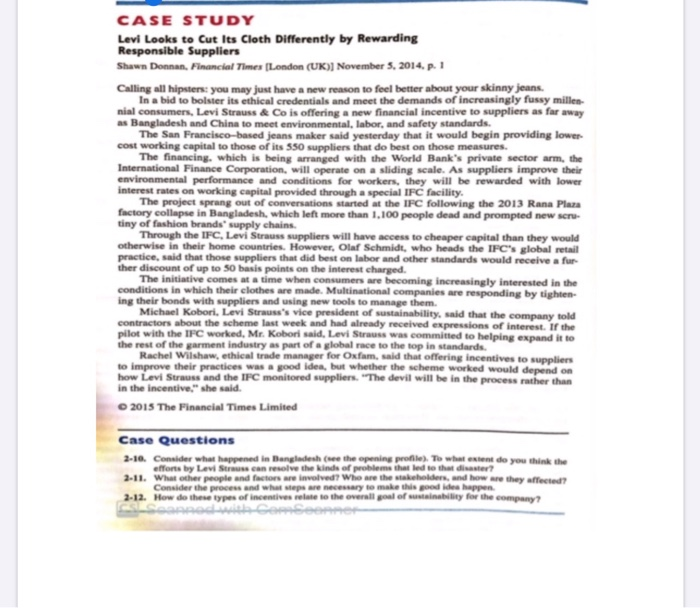
Question: CASE STUDY Levi Looks to Cut Its Cloth Differently by Rewarding Responsible Suppliers Shawn Donnan, Financial Times London (UK)] November 5, 2014, p. 1 Calling
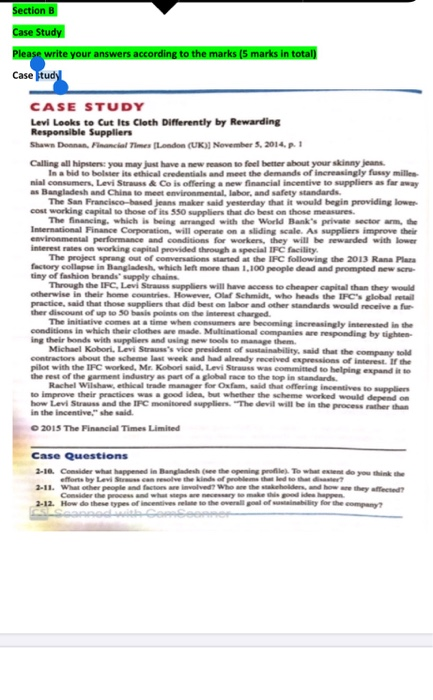
CASE STUDY Levi Looks to Cut Its Cloth Differently by Rewarding Responsible Suppliers Shawn Donnan, Financial Times London (UK)] November 5, 2014, p. 1 Calling all hipsters: you may just have a new reason to feel better about your skinny jeans In a bid to bolster its ethical credentials and meet the demands of increasingly fussy millen nial consumers, Levi Strauss & Co is offering a new financial incentive to suppliers as far away as Bangladesh and China to meet environmental, labor, and safety standards. The San Francisco-based jeans maker said yesterday that it would begin providing lower cost working capital to those of its 550 suppliers that do best on those measures. The financing, which is being arranged with the World Bank's private sector arm, the International Finance Corporation, will operate on a sliding scale. As suppliers improve their environmental performance and conditions for workers, they will be rewarded with lower interest rates on working capital provided through a special IFC facility. The project sprang out of conversations started at the IPC following the 2013 Rana Plaza factory collapse in Bangladesh, which left more than 1,100 people dead and prompted new seru tiny of fashion brands supply chains. Through the IFC, Levi Strauss suppliers will have access to cheaper capital than they would otherwise in their home countries. However, Olaf Schmidt, who heads the IFC's global retail practice, said that those suppliers that did best on labor and other standards would receive a fur ther discount of up to 50 basis points on the interest charged The initiative comes at a time when consumers are becoming increasingly interested in the conditions in which their clothes are made. Multinational companies are responding by tighten ing their bonds with suppliers and using new tools to manage them. Michael Kobori, Levi Strauss's vice president of sustainability, said that the company told contractors about the scheme last week and had already received expressions of interest. If the pilot with the IFC worked. Mr. Kobori said, Levi Strauss was committed to helping expand it to the rest of the garment industry as part of a global race to the top in standards. Rachel Wilshaw, ethical trade manager for Oxfam, said that offering incentives to suppliers to improve their practices was a good idea, but whether the scheme worked would depend on how Levi Strauss and the IFC monitored suppliers. "The devil will be in the process rather than in the incentive." she said. 2015 The Financial Times Limited Case Questions 2-10. Consider what happened in Bangladesh (see the opening profile. To what extent do you think the efforts by Levi Strus can resolve the kinds of problems that led to the disaster? 2-11. What other people and factors are involved? Who are the stakeholders, and how are they affected? 2-12. How do these types of incentives relate to the overall goal of sustainability for the company? Section B Case Study Please write your answers according to the marks (5 marks in total) Case tudy CASE STUDY Levi Looks to Cut Its Cloth Differently by Rewarding Responsible Suppliers Showa Donna Financial Times London (UK) November 5, 2014. p. 1 Calling all hipsters: you may just have a new reason to feel better about your skinny jeans In a bid to bolster its ethical credentials and meet the demands of increasingly fussy mille nisl consumers, Levi Strauss & Co is offering a new financial incentive to suppliers as far away as Bangladesh and China to meet environmental, labor, and safety standards The San Francisco-based jeans maker said yesterday that it would begin providing lower cost working capital to those of its 550 suppliers that do best on those measures. The financing. which is being arranged with the World Bank's private sector arm, the International Finance Corporation, will operate on a sliding scale. As suppliers improve their environmental performance and conditions for workers, they will be rewarded with lower interest rates on working capital provided through a special IFC facility The project sprang out of conversations started at the IPC following the 2013 Rana Plaza factory collapse in Bangladesh, which left more than 1,100 people dead and prompted news tiny of fashion brands supply chains Through the IFC, Levi Strauss suppliers will have access to cheaper capital than they would otherwise in their home countries. However, Olaf Schmidt, who heads the IFC's global retail practice, said that those suppliers that did hest on labor and other standards would receive a fur ther discount of up to 50 basis points on the interest charged The initiative comes at a time when consumers are becoming increasingly interested in the conditions in which their clothes are made. Multinational companies are responding by tighten ing their hands with suppliers and using new tools to manage them. Michael Kobori, Levi Strauss's vice president of sustainability, said that the company told contractors about the scheme last week and had already received expressions of interest. If the pilot with the IPC worked. Mr. Kobori said. Levi Strauss was committed to helping expand it to the rest of the garment industry as part of a global race to the top in standards Rachel Wilshaw, ethical trade manager for Oxfum, said that offering incentives to suppliers to improve their practices was a good idea, but whether the scheme worked would depend on how Levi Strauss and the IPC monitored suppliers. The devil will be in the process rather than in the incentive," she said. 2015 The Financial Times Limited Case Questions 2-10. Consider what happened in Bangladesh (see the opening profile. To what do you think the efforts by Levi Stres can resolve the kind of problems that led to that draster? 2-11. What other people and factors are involved? Who are the stakeholders, and how are they affected? Consider the process and what we way to make the red we happen 2-12. How do these types of incentives relate to the overall goal of stainabiley for the company









 Study Help