







Question: Case Study of Ritz-Carlton 4. In what may be a first for the hospitality industry, Brian Collins, hotel owner, has asked James McBride, Ritz-Carlton general
Case Study of Ritz-Carlton
4. In what may be a first for the hospitality industry, Brian Collins, hotel owner, has asked James McBride, Ritz-Carlton general manager, to lengthen the amount of time spent training hotel employees before hotel opening. Should McBride lengthen the 7 Day Countdown? Why or why not?
Conclusion
5. Summarize the key issues from your analysis and what steps McBrideshould take now.
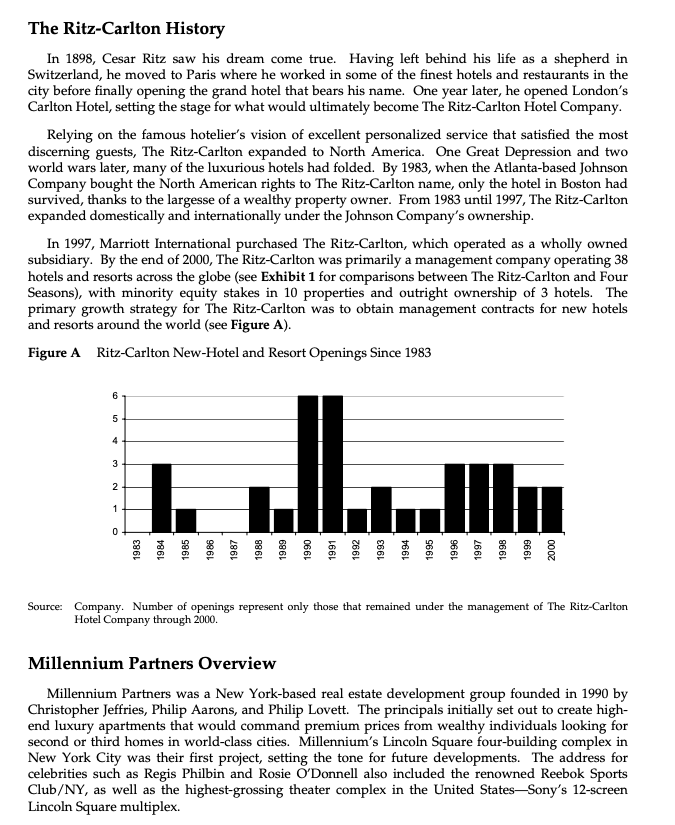
The Ritz-Carlton Hotel Company The Master said, Govern the people by regulations, keep order among them by chastisements, and they will flee from you, and lose all self-respect. Govern them by moral force, keep order among them by ritual, and they will keep their self-respect and come to you of their own accord. The Analects of Confucius James McBride, general manager of the new Ritz-Carlton in Washington, D.C., faced the largest challenge of his successful career. A proven veteran of the luxury hotel chain's march across Asia, McBride's most recent assignment was as the general manager of the 248-room Ritz-Carlton in Kuala Lumpur. Opened in 1998, the hotel was named "Best Hotel in Asia-Pacific" in the eighth Business Traveler Asia/Pacific magazine Travel Awards Subscribers' Survey and, for two consecutive years, "Best Business Hotel in Malaysia" by Business Asia and Bloomberg Television. As Nikheel Advani, food and beverage services director for the Washington hotel, noted: "James is excellent-we have opened many hotels together. In the place where you didn't think that it had a chance, he made it the best hotel. That's his talent. That's what he can do really well. It's for the entrepreneurial person who wants to get involved and who thinks they can make a difference." But this was a new situation, even for McBride. For the first time, The Ritz-Carlton was opening a hotel that was part of a multi-use facility. Owned by Millennium Partners and located in the historic Foggy Bottom district of Washington, D.C., the $225 million "hospitality complex" covered two-and- a-half acres and included 162 luxury condominiums, a 100,000 square-foot Sports Club/LA, a Splash Spa, three restaurants, 40,000 square feet of street-level restaurants and retail shops featuring the latest designs from Italy and other countries, as well as the 300-room hotel. While The Ritz-Carlton had already signed contracts to manage five other hotels for Millennium Partners, the upscale property developers had also inked deals with the Ritz's foremost competitorthe Four Seasons. Brian Collins, manager of hotels for Millennium Partners, had his own ideas about what constituted luxury service and how the hotel's general manager should approach the new-hotel opening. Under pressure from Collins, McBride was reexamining the "Seven Day Countdown," a hallmark of The Ritz-Carlton's well-defined hotel-opening process. Any changes McBride made could not only affect his company's future relationship with Millennium Partners but also the carefully guarded Ritz- Carlton brand. The Ritz-Carlton History In 1898, Cesar Ritz saw his dream come true. Having left behind his life as a shepherd in Switzerland, he moved to Paris where he worked in some of the finest hotels and restaurants in the city before finally opening the grand hotel that bears his name. One year later, he opened London's Carlton Hotel, setting the stage for what would ultimately become The Ritz-Carlton Hotel Company. Relying on the famous hotelier's vision of excellent personalized service that satisfied the most discerning guests, The Ritz-Carlton expanded to North America. One Great Depression and two world wars later, many of the luxurious hotels had folded. By 1983, when the Atlanta-based Johnson Company bought the North American rights to The Ritz-Carlton name, only the hotel in Boston had survived, thanks to the largesse of a wealthy property owner. From 1983 until 1997, The Ritz-Carlton expanded domestically and internationally under the Johnson Company's ownership. In 1997, Marriott International purchased The Ritz-Carlton, which operated as a wholly owned subsidiary. By the end of 2000, The Ritz-Carlton was primarily a management company operating 38 hotels and resorts across the globe (see Exhibit 1 for comparisons between The Ritz-Carlton and Four Seasons), with minority equity stakes in 10 properties and outright ownership of 3 hotels. The primary growth strategy for The Ritz-Carlton was to obtain management contracts for new hotels and resorts around the world (see Figure A). Figure A Ritz-Carlton New-Hotel and Resort Openings Since 1983 6 5 4 3 ... 2 1 0 1983 1984 1985 1986 1987 1988 1989 1990 1991 1992 1993 1994 1995 1996 1997 1998 1999 2000 Source: Company. Number of openings represent only those that remained under the management of The Ritz-Carlton Hotel Company through 2000. Millennium Partners Overview Millennium Partners was a New York-based real estate development group founded in 1990 by Christopher Jeffries, Philip Aarons, and Philip Lovett. The principals initially set out to create high- end luxury apartments that would command premium prices from wealthy individuals looking for second or third homes in world-class cities. Millennium's Lincoln Square four-building complex in New York City was their first project, setting the tone for future developments. The address for celebrities such as Regis Philbin and Rosie O'Donnell also included the renowned Reebok Sports Club/NY, as well as the highest-grossing theater complex in the United StatesSony's 12-screen Lincoln Square multiplex. Brian Collins joined Millennium Partners Management in December 1996 as their CFO, subsequently becoming the COO and a partner, as well as a principal and the president of Millennium Hospitality Partners. Collins explained how they came to be hotel owners: We are residential developers who ended up in the hotel business. It was not our intention to end up owning eight hotels, which is what we have under construction today-six Ritz- Carltons and two Four Seasons. Our intention was to create a base for our luxury apartments. Our vision is that apartments sell for a substantial premium if they have height, light, and views. The trick then was what to create below those apartments, which is both economical and adds to the residential experience, which also lifts it up in the air. So you try to do it with the best theater company, one who understands our vision. Then we're starting on the third floor. And you try to do it with a Sports Club. Their box, their basketball court, is about 29 feet, and that's another three stories. So if we do nothing else but have those two, we're 60 feet in the air. Washington's a bad example, because we have a 110-foot height limit. In San Francisco, the hotel is 13 stories, so the apartments are starting maybe 250 feet up in the air. And now you don't have any apartments that don't have height, light, and views. The other thing that helps sell residential properties is services. We said "Well, how can we solve this service problem? How do we convince people that they're going to get great, great, great service?" And Chris Jeffries hit on the idea of a luxury hotel. At the high end of the market, there's really two choices: Ritz-Carlton and Four Seasons. Ritz and Four Seasons are clearly the best hotel operators. So we've approached both, and we're doing deals with both. Business Model Millennium Partners was one of the several hotel owners for whom The Ritz-Carlton managed properties. The Ritz-Carlton charged management fees that were typically 3% of gross revenues, augmenting their income stream with revenues from land rent, resort timesharing, franchise fees, management incentives, and profit sharing. While there were many independently owned and operated luxury hotels around the world, The Ritz-Carlton and Four Seasons were the two most internationally recognized chains serving the highest end of the market. Two key indicators of success in the hotel industry were the average daily rate (ADR) and the revenue per available room (RevPAR; see Exhibit 2). While the ADR was bounded on the upper end by what the local markets would bear, RevPAR was influenced by both ADR and occupancy rates. Filling hotel rooms was crucial, and The Ritz-Carlton's general managers aggressively pursued their two main customer groups: (1) independent travelers, and (2) meeting event planners. Guests Independent travelers, whether for business or pleasure, were courted in a variety of ways. For instance, when McBride was the general manager of The Ritz-Carlton in Kuala Lumpur, he greeted travelers at the airport with mimosas and discount coupons presented on silver trays, serenaded them with piano concertos, and even created a hotel room in the airport, complete with an armoire, bed, television, and other accoutrements representative of the hotel's furnishings. As he prepared for the opening of the new hotel in Washington, D.C., McBride held an afternoon tea in Washington Circle, with 100 ambassadors, prominent citizens, and members the media enjoying the city's famed cherry blossoms as they rode to the tea in horse-drawn carriages and open trolleys. Additionally, McBride worked to attract business travelers to The Ritz-Carlton. In Kuala Lumpur, he introduced the "Technology Butler," which comprised a staff of technicians available 24 hours a day to assist guests with computing problems and other technological difficulties. In Washington, McBride created a concierge desk at the Delta Shuttle at National Airport, implementing airport check-in procedures which provided customer convenience that outpaced the competition. Beyond the individual initiatives of general managers, The Ritz-Carlton worldwide focused on the role of meeting events in attracting independent business travelers. The Ritz-Carlton recognized that event attendees were previewing the hotel, making every interaction they had during their stay another step in a "progressive trial. This perspective reflected the organization's recognition that their product pipeline was different from those of many othersthe customers had to come to them. Because they attracted many individual guests at once, meeting event planners were seen as "the vital few" customers, representing a small number of organizations that held many large meetings in various locations around the world. These "vital few" accounted for 40% of annual sales income. According to Patrick Mene, The Ritz-Carlton's corporate vice president of quality: Our event business pays the mortgage. The individual traveler helps us with our profitability. The nature of our business is that a guest room and space is the most perishable product we have. An apple left unsold today can be sold tomorrow, but a room night lost today is lost foreverit's an extremely perishable product . That's why the meeting business is so desirable, because it is presold, it's contracted, and it's a growing market. It's a more controllable segment of our business. Management Contracts Having a strong meeting events business helped The Ritz-Carlton maintain profitability and provided property owners with acceptable returns on their investments (typically 10% to 12%, unleveraged). Nevertheless, the expense involved in operating luxury hotels (see Exhibit 3) sometimes strained relations between the management company and the property owners. During the early 1980s when the hotel industry was growing at a healthy pace, traditional management contracts tended to meet the needs of both owners and operators. However, owners throughout the hotel industry had been agitating for more voice in how their properties were managed. A strong supply of management companies and a sudden decline in hotel demand led to owners gaining leverage in the management contract negotiation process, a change that was facilitated by the U.S. real estate crash of the late 1980s. Many property owners lost their investments, some of whom had contracted the services of The Ritz-Carlton. In fact, had it not been for such difficulties, The Ritz-Carlton might never have been working with Millennium Partners on the new Washington, D.C., multi-use facility. The Ritz-Carlton had previously operated a hotel in that city, but the owner, Saudi Arabian sheik Abdul Aziz bin Ibrahim al-Ibrahim, sued the company in 1995, alleging that The Ritz-Carlton operated for its own profit to the detriment of the property owner's interest. Mene provided his perspective on the situation: The lawsuit involved four hotels located in New York, Washington, Aspen, and Houston, all owned by the same person. It made all the major business publications. Quite frankly, the owner just paid too much for these hotels. Our performance was noble, but he wasn't going to get his return on investment for a while, and his advisors never told him that. He just paid too much for the hotels and wanted to shift the blame to us. It took a little bit of luck, although we did walk away from him. I don't want to say the owner relations are adversarial in a typical hotel contract, but they can become strained. Quality at The Ritz-Carlton When Patrick Mene joined The Ritz-Carlton in 1990 as the chief quality officer, his primary mission was to integrate and prioritize the values and concepts of the Malcolm Baldrige National Quality Award criteria at all the company's hotels around the world. But before financial resources could be allocated to operational process improvements, Mene had to convince Horst Schulze, The Ritz-Carlton's president and COO since 1984 (see Exhibit 4 for a partial organizational chart), of the importance of system and process development. As Mene recalled: When I got here, human resources was literally the dominant function in this company. And I said, "Let's take thiswe hired the right person. They're a perfect Lady and Gentleman, they went through orientation. Let's put them at the front desk. And the desk is too high to work with, and the temperature is too hot, and the computer has the wrong information coming in from another departmentthey can't function." So for the next few years, Schulze would say to me, "Pat, you always try to take the human element out of it." And one day I was bold enough to say, "Yeah, you're right. Because you know what? If there were better people out there, you'd have found them by now. And I'm going to show you that we can have a ham sandwich run a Ritz-Carlton." Well, the battle lines were drawn. While The Ritz-Carlton continued to maintain a heavy emphasis on human resources, the total quality management (TQM) philosophy began to permeate the organization. Using the Malcolm Baldrige National Quality Award criteria as a set of guidelines, Schulze and Mene focused on a variety of new activities and measures, including the cost of poor quality, continuous improvement, quality planning, benchmarking, supplier certification, and quality audits. Other programs were designed to meet specific customer needs, such as safety protocols to protect the children of guests, and the Service Quality Indicators (SQLs) were established (see Exhibit 5). One of the components of the SQIs involved guest-recognition procedures. As an owner, Collins wanted to see that improved for the new Washington, D.C. hotel: I pushed James [McBride) to hire more people than The Ritz-Carlton staffing plan would lead them to hire in Guest Recognition. I think it's the single most important thing we can do. If a guest came in, got what they wanted, and were recognized, all of a sudden that creates a sticky relationship. It's all about organizing your thoughts and creating processes to recognize the person coming in to the hotel. So after a certain number of visits to one of our Ritz hotels, guests will get a monogrammed pillowcase. It will be in their room so that when they check in, they'll go to their room and say, "Oh, my pillow's here. Isn't that great!" And no one expects it, so the first time, it's like "Wow!" We're doing something different from The Ritz-Carlton standardwe're clearly exceeding the standard. But they don't force every owner to abide by that higher standard, so sometimes there is friction about raising the standard outside of the Ritz program. I want to rethink it, rethink it all from start to finish. And it just drives them crazy. Even so, the standards The Ritz-Carlton had already established were recognized as outstanding (see Exhibit 6). The company applied for and won the Baldrige Award in 1992, becoming the first organization in the hospitality industry to receive the coveted honor. The extensive feedback report from the Baldrige evaluators identified an additional 75 areas for improvement and, using those suggestions as action guidelines, The Ritz-Carlton applied for and won the award again in 1999, becoming only the second American company to earn the distinction more than once. Schulze expressed his belief in TQM: Winning this award confirms that quality is not a short-term approach to doing business. Instead, it is a road map that allows us to achieve the highest customer and employee satisfaction in the industry. Continuous improvement is absolutely critical. If managers are not improving something every day, they are on a death path. Companies that are plateauing because of traditional management will die. Period. Human Resources at The Ritz-Carlton The way The Ritz-Carlton viewed its employees was a distinguishing hallmark of the organization. According to Leonardo Inghilleri, the corporate vice president of human resources: We respect our employees. The issue of respect is a philosophical issue that is driven by our leadership. You have to have a passion for people. If you have an accounting approach to human resources, then you're bound to fail. If you look at an employee and say, "He's a full- time equivalent, he's an FTE; he is eight hours of labor," I think that's immoral. An employee is a human being who doesn't only fulfill a function but should also have a purpose. So a successful business is one that is capable of enlisting an employee not only for his muscles and his labor, but also for his brain, his heart, and his soul. In hotels that were up and running for at least a year, The Ritz-Carlton's annual turnover rate was only 20%, compared with the hotel industry average of 100%, while new hotels experienced turnover rates between 20% and 25% during the first 60 days. Inghilleri believed that it was his company's deep respect for its employees that led to their satisfaction with and commitment to the organization. The Ritz-Carlton was so intent on treating their employees well that a "Day 21" event was held as a process check three weeks after any new hire's start date. During that session, the company assessed the degree to which it had lived up to the promises it made to its employees during orientation and initial training. One of those promises included opportunities for career advancement, which were abundant at The Ritz-Carlton Corporatewide, 25% of the organization's managerial workforce began their careers at The Ritz-Carlton as hourly employees, such as dishwasher, housekeeper, and restaurant server, or as hourly supervisors. For example, Kate Monahan advanced from reservations manager to general manager: "Fourteen years ago, I set out to find a jobbut what I began was a career. Along the way, The Ritz-Carlton has nurtured and maximized my talent."4 Similarly, Alex Garza began as a line cook and eventually became an executive sous chef. As Garza stated: The Ritz Carlton has been a kind and generous employer. I have always been treated fairly and as a gentleman, with the utmost respect for my talents. Because this organization cared about my career path and my goals from the outset, and because it has demonstrated respect for my talents along the way, I have been able to grow. At The Ritz-Carlton, opportunities for advancement are everywhere. It's up to you how far you want to go Through the extensive formal and informal training offered by The Ritz-Carlton (see Exhibit 7), employees were prepared to fulfill their current obligations and to accept positions of greater responsibility and accountability in the future. Employees with advancement ambitions were encouraged to cross-train and learn about as many different aspects of the organization as possible. Performance at The Ritz-Carlton was not only assessed against the established Service Quality Indicators but also managed by the employees themselves. As Inghilleri explained: We have created an environment where there is no fear of retribution, an environment where employees understand that their responsibility is not only to fulfill functions but also to have a purpose. One of their purposes is to improve the system. When you have a good person and you create a good environment for that person, he or she doesn't come to work to do a bad jobthey come to work to do a good job. So it doesn't make sense for us to punish people if something goes wrong. We verify whether the problem is a lack of resources or a lack of training, and then we address the problem accordingly. Our employees are taught from the very beginning that there is nothing more exciting than fixing a mistake or defect. They want to see the defects, they want to find out what they are, because once that's known, they can be corrected. We've never had a problem with people hiding mistakes, because it's just not the culture of the company. In addition to employees monitoring their own performance, individuals were recognized for outstanding work in a variety of ways, including small awards given within departments, as well as larger rewards that occurred at the hotel level. For instance, each year every hotel identified members of a "Five-Star Team," each of whom received five complimentary nights at a Ritz-Carlton hotel of their choice, $500 to spend and round-trip airfare for two. The Ritz-Carlton Hotel-Opening Process According to one manager at The Ritz-Carlton, Running an ongoing operation is a very different thing from opening a new hotel. They are actually two different core competencies." The processes and focus of activity for creating new hotels were two-pronged: one dealing with the development of the site itself, the other involving the human resources processes necessary to get the hotel up and running. The entire hotel development process was assessed against Performance Quality Indicators (PQIs; see Exhibit 8), the 10 defects identified by The Ritz-Carlton as most likely to lead to problems with both quality and financial performance. Mene noted that while developing a hotel was "a very complex, cross-departmental, cross-functional, cross-company process in general, the PQI represents the key pitfalls." The Seven Day Countdown The Seven Day Countdown was a result of the evolution and refinement of the hotel-opening process, which became more solidified in the late 1980s to early 1990s when the hotel chain was opening many new properties. Standardization brought greater efficiency and relieved some of the burden placed on new managers and leaders responsible for ultimately running the hotel. Individuals' first encounter with the organization as employees occurred over a month after they had been hired, when they showed up for the beginning of the Seven Day Countdown prior to the opening of the hotel. The first two days were devoted entirely to orienting employees to The Ritz- Carlton culture and values, while the remaining five days involved more specific skills training and trial runs of service delivery. According to Collins, ensuring that everything was perfect on opening day would be a challenge: There's all this construction activity going on around here, finishing floors, testing the fire- alarm system. And they have 400 people they have to convert to Ritz-Carlton employees in the next seven days. They have to be trained and dipped into the culture of The Ritz-Carlton so that on day one when Ms. Jones checks in, she's getting a true Ritz experience. Seven days. I've told James I just don't know if that's enough time. To help the new staff members navigate their way through the demanding Seven Day Countdown, The Ritz-Carlton provided each of them with a "Paper Palm" (see Exhibit 10). Inghilleri explained the rationale behind the countdown's organization: We have a very slow orientation process that aligns the worker with the mission of the company. The reality is that, as an adult, you only change your behavior from a significant emotional experience, and otherwise you don't change. When you hire someone to start a new job, it is a significant emotional experience for them, so they will be attentive and receptive to behavioral changes. But the size of the window of opportunity that the company has to drive home new concepts is limited. So if you waste the first few hours of the first few days discussing anything other than values, you're wasting your opportunity. That is why in our orientation, the first thing we do is discuss values. Day One: Staff Orientation On the first day of the countdown, new employees joined other members of their divisions outside the hotel for what can only be described as a pep rally. Carrying signs and chanting ("House- keep-ing, House-keep-ing"), each division vied to be the loudest, most enthusiastic group of new employees. The kitchen staff had the advantage, banging out Stomp-worthy rhythms on their pots and pans. At least one manager made a brave attempt at turning cartwheels along the covered drive leading to the entrance of the new hotel, while others ran from one end of the line to the other, encouraging more cheering. After several rounds of "the wave" and chants of "D-C-Ritz, D-C-Ritz," the staff members eventually entered the building. As they slowly wound their way downstairs toward the ballrooms where their first training sessions would occur, the employees heard the sound of enthusiastic applause. It was coming from the hotel's managers, who lined both sides of the curved marble staircase. Many times over, each employee was sincerely welcomed as a new member of The Ritz- Carlton family by the scores of managers who smiled warmly and said, We're so happy you're here," "Welcome," "I'm so glad you've come." Once inside, everyone gathered in the largest ballroom, where video cameras were hooked up to big-screen TVs providing a simulcast of all the activity. Recordings of Sting singing "We're starting up a brand new day ..." Queen's "Another One Bites the Dust," and the always-popular "We Are the Champions" played as the employees congregated. Once everyone was present, McBride introduced the hotel's leadership team, followed by The Ritz-Carlton trainers, who had come from 23 different countries around the world for the countdown. Individuals chosen as trainers represented the "best of the best of The Ritz-Carlton worldwide all of whom had significant experience opening new Ritz-Carlton properties. Introductions progressed to the corporate steering committee and then to the Millennium Partners representatives. Finally, McBride spoke to the assembled, immediately conveying to them the importance of opening the hotel at the highest level possible from day one: "We will open as the finest hotel in Washington, D.C., without a doubt. We are like Olympic gymnasts who have been training for years and years. Then it all comes down to the big performance, and the gymnasts must stick their landingsotherwise, they are not excellent. We will stick our landings. We will be excellent." Next, the new employees watched a video in which Schulze and others described the hotel company's history, philosophy, and values, followed by a second tape that described The Ritz- Carlton's milestones, including awards they had won and new hotels they had opened. The applause and cheering were abundant when The Ritz-Carlton, Washington, D.C., appeared on the screen. Schulze's Address Schulze entered the room to a standing ovation as Queen's "We Will Rock You" blared over the speaker system. Addressing all the employees of the new hotel, Schulze explained his philosophy of being a high-quality service organization: You are not servants. We are not servants. Our profession is service. We are Ladies and Gentlemen, just as the guests are, who we respect as Ladies and Gentlemen. We are Ladies and Gentlemen and should be respected as such. I grew up in a small village in Germany. When I was 11 or 12, I decided to go into the hotel businessI don't know why. My mother told me, "The guests are very fine, important people." To me, they looked like gods. My knees were shaking. I was scared. As the months went by, I never stopped seeing them as fine ladies and gentlemen. But when our maitre d' dressed impeccably, and spoke to them in fluent English, German, or Spanish, it became clear that he was as much a gentleman as anyone in the room, because of the excellence with which he did his job. If we do what we do right, we become as important as they are. This was how the employees learned the genesis of The Ritz-Carlton motto ("We Are Ladies and Gentlemen Serving Ladies and Gentlemen"). According to Schulze, the motto was a "deeply believed feeling and demand on the organization," a promise by the organization that everyone would be respected as a lady or a gentleman. It was also a demand on all employees, especially managers and leaders. The Gold Standards The motto was one part of The Gold Standards (see Exhibit 11), implemented by Schulze in the mid-1980s. These standards included The Credo, The Three Steps of Service, The Motto, The Employee Promise, and The Twenty Basics, which were designed to focus employees on the core company values. According to Schulze, when an employee adopted The Credo, that person was in effect saying, "This is who I am from now on." Different aspects of The Gold Standards were reinforced daily through departmental "lineups," which occurred at the beginning of every shift, in every hotel, around the world. They were used to reinforce the company's philosophy and to repeat the foundation of the business over and over in order to build the habits necessary for employees to deliver the highest level of service demanded by The Ritz-Carlton. Inghilleri explained the importance of the daily lineups: Our employees are on the front lines. They are always on the battlefield. So you've got to nourish them on a daily basisyou have to heal the wounds of being on the battlefield daily. Otherwise, they'll forget the real reasons they are there. After cleaning 16 rooms to our standards, you are exhausted. You come back to work the following morning, and if I don't remind you that the customers are important, that being nice to them is critical, that eliminating defects is paramount, that the genuine care of the customer is crucial, well, then you'll forget. You'll think that you just come to work to clean rooms. Service Philosophy Complementing the concepts in The Gold Standards, Schulze further explained The Ritz-Carlton philosophy to the new employees during their first day of orientation: "We are not in the hotel business. The hotel business is about selling rooms, selling food, selling the bar. We do those things incidentally, but our business is service. We charge for service. Our commitment to our customers is excellence in service. Service is our profession." During his address to the employees on their first official day as members of The Ritz-Carlton, Schulze also set the stage for how they could expect to be treated within the organization: For these next few days, we will orient you to who we areour heart, our soul, our goals, our vision, our dreamsso you can join us, and not just work for us. You have a right to know who we are and what we think. You have a right to know our hopes, our dreams, and our goals. We will get a great hotel for our guests, but what about us? We should have a great work environment, too. Besides the physical setting, the work environment is created by youthe work environment is the people who work here. We need to create a good work environment by respecting each other. But things go wrong. As soon as two people come together, conflict will arise. It's not the fact that we have conflictit's what we do with it. Talk to your manager. It's not "them" or "they." We all have the same dream of excellence; we all have the same goal: to be successful. Leadership Orientation After spending time with all the employees together, Schulze conducted the Leadership Orientation for managers, and the tone changed: This business is created for one reasonto make money. This is your role. You have accepted the role, in the hotel business, to be businesspeople. No one in the world knows more about what our customers want than we do. We survey them every four weeks. What do these customers want? A clean hotel. I walk in hotels, see something on the floor, and I see you walking by it! It's incredibleinconceivable for us to know what customers want and to not do it. We still only deliver 92% of customers who are satisfied. That gives us occupancy of 80%. Why not celebrate? Only 8% are not satisfied. Of those, 2% to 3% want things we cannot do, or things that, if we did them, would dissatisfy all of the other customers. But 5% represent satisfaction that we want. Those 5% are dissatisfied because of stupid, pathetic defects that are repeating-stupid, pathetic defects that you should have eliminated permanently. That 5% translates into 200,000 dissatisfied customers. That is an army-attacking ussaying that we are not good. If we satisfied this 5%, within three years we'd run at 88% occupancy. What does 88% mean in dollars? Three hundred million to the bottom line. We are leaving $300 million on the table because of 5% defects. In addition to a strong commitment to the bottom line, Schulze saw leaders as having deep obligations to the rank-and-file employees: Orientation is a key process to make sure you have the right employees. Why? Because an employee joins you open minded. Share with them what you dream about what you wish for, your heart and soul, and then ask them to join you in your mission. They have a right to know who you are, what your dreams are. People have a right to come to work for a purpose. The chairs that you are sitting on are doing work. If you don't give your employees a purpose, you make them chairs. If you just send them to work without a purpose, it's immoral. Schulze's intense focus on purposeful work inspired many Ritz-Carlton employees to remain committed to the organization. For example, Vijay Singh explained his reasons for staying with the company: "I joined The Ritz-Carlton eight years ago because of a statement I heard made by Horst Schulze: 'I come to work for two reasons. One, to achieve excellence. The other, to achieve excellence with friends.' I adopted this philosophy in my own life and have stayed with The Ritz-Carlton because Mr. Schulze has not deviated from his vision." Day Two: Departmental Vision Sessions On the second day of the Seven Day Countdown, employees in each functional area met for an introduction to their new departments. Group exercises were used to help the employees learn more about one another, their likes and dislikes, and how they could function together as an effective unit. Schulze kicked off the vision sessions for each department by asking the groups what they wanted to be in a year. The answer was invariably "the best," and Schulze started the process (later taken over by the managers) of specifying what being the best would mean for each area. In talking with the employees responsible for the bar and in-room service, Schulze explained: In the case of the bar, customers are entering your room, but they are not coming for you. They are not coming to drinkthey have drinks in their rooms and at home. They are not coming to eat. They are coming to feel well. You have to understand their purpose. The customer sets the pace; you capture the moments. You are in charge. Your charge is to help customers feel well. Your ultimate responsibility is that each guest feels well when they leave because of how you enhanced their life in the moment that you had to serve them. In in-room service, you are entering their home, which they have rented. It requires a little different style, because it's their home, their private space. Ask them, May I enter your room?" Part of being a lady and a gentleman is to treat the situation as a professional. They want you to leave as soon as possible. Ask them, May I put the tray down here?" And be sure to thank them as you're leaving: "Thank you for allowing me to serve you." I want you to think about how you train yourself. There is only one way of teaching-self-teaching. Think, when you've left, where are you in creating a fine memory with your guest by how you behaved in the room? Days Three through Seven: Skills Training For the next five days, the hotel's leadership team, trainers, and managers met each morning at 6:00 a.m. to review the day's training activities and to resolve any difficulties that had arisen. Employees in the different functional areas were given a "Warm Welcome by their managers at 8:30 each morning and a traditional Ritz-Carlton "Fond Farewell" every evening. During the first two of the remaining five days, uniform fittings were scheduled, personal grooming sessions were conducted, and employees were introduced to the daily lineup procedure. All employees attended a session on the anticipation and handling of guest requests, conducted by McBride, while each department continued to formulate and refine its own philosophy and statement of goals. Overviews within functional areas oriented the new staff to the big picture within their divisions. Everyone received "life safety" instruction, was treated to a wine tasting, and enjoyed a product show which allowed each employee to learn more about the materials that would provide creature comforts to their guests. "Instant guest pacification" was a Ritz-Carlton basic, and on Day Four all new employees were instructed in the standardized procedure for "Handling Guest Difficulties." Employees were trained to immediately break away from their normal activities to solve a customer's problem, to use their empowerment in designing an appropriate solution, and to involve and follow up with other departments whose help was needed. Each problem was documented on a Guest Incident Action form in which "guest temperature" was recorded before and after the event on a scale that ran from livid" to "calm"; these forms were used for daily communication and process improvement (see Exhibit 12). The last three days of the Seven Day Countdown was when departmental technical training occurred. Employees learned the details involved in performing their jobs to the standards set by The Ritz-Carlton, and everyone was expected to master their department's key production processes. Employees arrived in two shifts, dressed in their full uniforms, and every employee practiced his or her job as if they were serving real customers. For instance, mock meals were served, trials were conducted for check-in procedures, and housekeepers prepared rooms for "guests." Members of the corporate steering committee observed every trial run, from housekeeping to restaurants. They were looking for any flaws in service delivery that kept it from being as sharp and crisp as The Ritz-Carlton demanded. Their observations were passed on to the trainers, who provided any necessary additional one-on-one or division-level training. Inghilleri recalled occasions when Schulze stepped in to assist a struggling employee: "He was just great. He'd go into a restaurant, and he'd say, 'OK, let me show you how this job is done,' and he'd give a perfect demonstration. When the president of your company is showing you how to do your job, you are really going to be paying attention." Recognizing that their standards of service were extremely high and that their goal of opening as a top-notch hotel right from the start was a tall order, The Ritz-Carlton tried to protect their employees from feeling overwhelmed by controlling the occupancy rate. Inghilleri explained: The first month of operations, we may open the hotel with 50% occupancy. Then we'll increase occupancy monthly, so it takes us somewhere between three and four months to reach 80%. But we hire, in the very beginning, as if we're already operating at 80% occupancy. This allows us to reduce the number of tables a waiter has to serve, or the number of rooms a housekeeper has to clean. It is more important that we set the standards immediately. They have to do their jobs perfectly, even if it takes them longer; productivity will increase as they get more and more comfortable. Flawless execution is the goal, and then speed will come. This practice also allows us to offset the inevitable minor turnover that we experience shortly after opening On the day between the end of the Seven Day Countdown and the grand opening, employees showed up in casual attire for The Ritz-Carlton two-hour pep rally, marking the transition between practice runs and real service delivery. The next day, on October 11, 2000, the Washington, D.C., Ritz-Carlton Hotel opened for business. Dilemma McBride sat in his new office in Washington, reflecting on the concerns that Collins had expressed, with his usual blunt style and candor, about the Seven Day Countdown. Collins questioned whether the seven-day time frame limited the hotel's ability to open at a higher occupancy rate and to reach 80% occupancy in a shorter amount of time. Since the Seven Day Countdown was only a small part of the pre-opening budget (see Exhibit 13), the costs might well be worth the benefits. Because Collins wanted to ensure that the service established was flawless and a real draw for potential condominium residents, he questioned whether extra training would help the employees to further polish their service skills. McBride acknowledged that the $700 million investment made by the Millennium Partners in six Ritz-Carlton-managed properties certainly gave Collins the right to voice his opinions. But it was one thing to change the kind of art in the hotels-changing the processes that seemed to finally join quality control and human resources in a perfect balance was something else entirely. It was difficult to train new hires to meet the high expectations of The Ritz-Carlton service standards in only seven days, but that was how The Ritz-Carlton worked. True, sometimes the countdown occurred as the building itself was being completed. Sometimes, it seemed like they barely made it under the wire for opening day. Maybe the training should be longer, but what would that mean for The Ritz-Carlton? McBride would be responsible for opening the second Millennium Partners-owned Ritz-Carlton hotel, in Georgetown, at the end of 2001. Should he try changing the Seven Day Countdown process, which was a worldwide best practice for the company
Step by Step Solution
There are 3 Steps involved in it
1 Expert Approved Answer
Step: 1 Unlock

Should McBride Lengthen the 7 Day Countdown Considerations 1 Quality vs Tradition The RitzCarlton has set high standards for service quality and the S... View full answer
Question Has Been Solved by an Expert!
Get step-by-step solutions from verified subject matter experts
Step: 2 Unlock
Step: 3 Unlock
 Study Help