Question: CASE STUDY OPERATIONS MANAGEMENT Case Study 1 Make Versus Buy Case ABC Ltd. is a manufacturing company engaged in the manufacturing of valves. They have
CASE STUDY OPERATIONS MANAGEMENT Case Study 1 Make Versus Buy Case ABC Ltd. is a manufacturing company engaged in the manufacturing of valves. They have been in the business for last 3 years and have been manufacturing only one type of valves. They started their business initially with sales of 10,000 valves per month and now they have grown the volume to about 50,000 valves per month. They have been buying all the raw material for the valve and were doing all the manufacturing in house. Now they have established themselves in the market and are planning to expand and produce different varieties of valves. They have their plant in the main city and the total area of the plant is 50,000 sq. ft. Now if they want to expand and continue doing all the activities of manufacturing of all the varieties in house, they would need another 50,000 sq.ft. of the area. In the recent times, the land prices in the area have more than doubled in the last 3 years and still land is available with great difficulty. Mr. Ahmad is the production head of ABC Ltd. and has been successful with the production and the level is continuously increasing. But in recent times, he is facing the problem of quality complaints which have gone up from average 0.2 % in previous 2 years to 0.5 % this year. Also, he is finding that there is a high level of dissatisfaction among the workers regarding workload as well as salary levels. The workers are regularly complaining about the over work. Although, Mr. Ahmad has found that the workers have been spending lot of time on tea breaks, lunch breaks and even in between the production spending lot of time talking to each other. But, due to insufficient workers and staff, he is unable to take strict action and the workers are taking advantage of this situation. For completing the work and delivering the products timely, he has to employ workers on overtime and his overtime cost has also increased 3 times. Mr. Ahmad is worried about the new expansion plan of the management and is worried where the new workers would come from as he is already finding shortage of workers for the existing job. He has requested the management not to go for expansion immediately and look at improving and consolidating the existing set up. He has sent his request to Mr. S. Khan Director Operations.
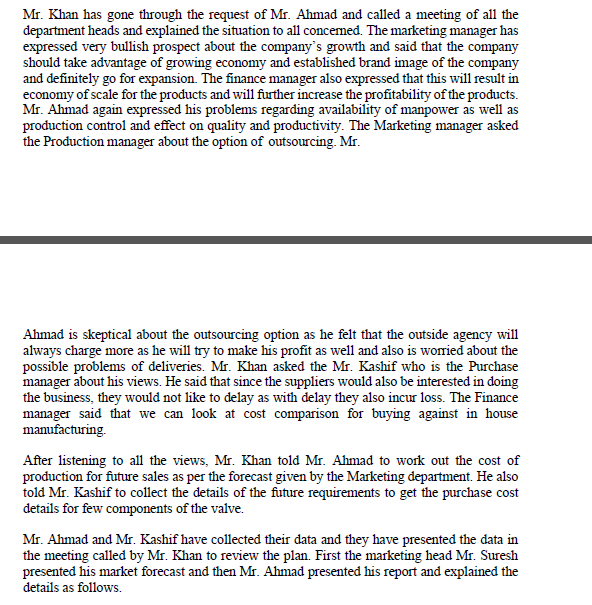
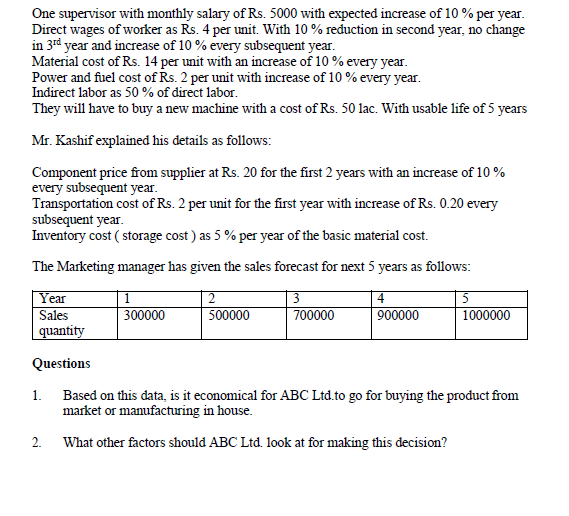
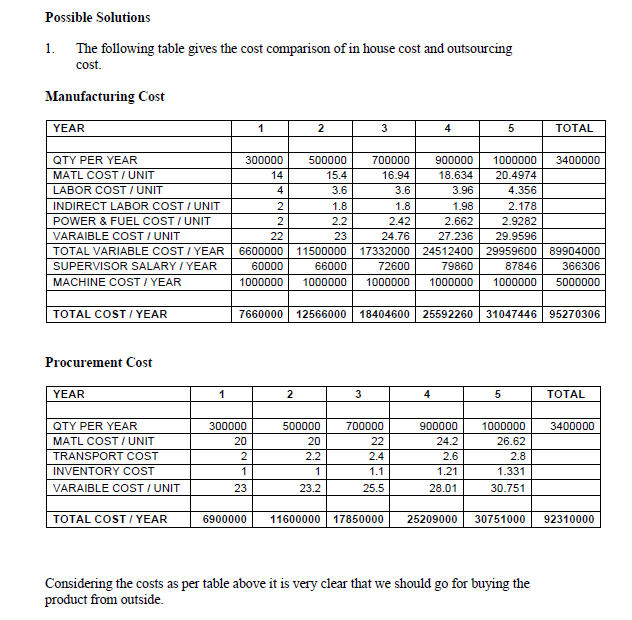
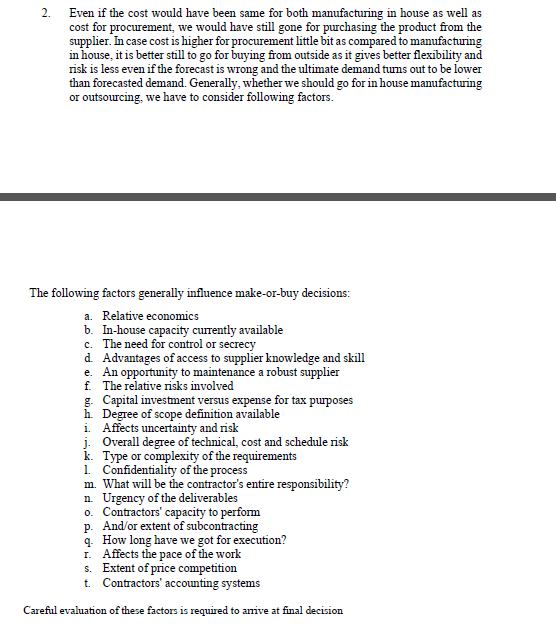
Mr. Khan has gone through the request of Mr. Ahmad and called a meeting of all the department heads and explained the situation to all concerned. The marketing manager has expressed very bullish prospect about the company's growth and said that the company should take advantage of growing economy and established brand image of the company and definitely go for expansion. The finance manager also expressed that this will result in economy of scale for the products and will further increase the profitability of the products. Mr. Ahmad again expressed his problems regarding availability of manpower as well as production control and effect on quality and productivity. The Marketing manager asked the Production manager about the option of outsourcing Mr. Ahmad is skeptical about the outsourcing option as he felt that the outside agency will always charge more as he will try to make his profit as well and also is worried about the possible problems of deliveries. Mr. Khan asked the Mr. Kashif who is the Purchase manager about his views. He said that since the suppliers would also be interested in doing the business, they would not like to delay as with delay they also incur loss. The Finance manager said that we can look at cost comparison for buying against in house manufacturing After listening to all the views, Mr. Khan told Mr. Ahmad to work out the cost of production for future sales as per the forecast given by the Marketing department. He also told Mr. Kashif to collect the details of the future requirements to get the purchase cost details for few components of the valve. Mr. Ahmad and Mr. Kashif have collected their data and they have presented the data in the meeting called by Mr. Khan to review the plan. First the marketing head Mr. Suresh presented his market forecast and then Mr. Ahmad presented his report and explained the details as follows. One supervisor with monthly salary of Rs. 5000 with expected increase of 10% per year. Direct wages of worker as Rs. 4 per unit. With 10 % reduction in second year, no change in 3rd year and increase of 10% every subsequent year. Material cost of Rs. 14 per unit with an increase of 10% every year. Power and fiel cost of Rs. 2 per unit with increase of 10% every year. Indirect labor as 50 % of direct labor. They will have to buy a new machine with a cost of Rs. 50 lac. With usable life of 5 years Mr. Kashif explained his details as follows: Component price from supplier at Rs. 20 for the first 2 years with an increase of 10% every subsequent year. Transportation cost of Rs. 2 per unit for the first year with increase of Rs. 0.20 every subsequent year. Inventory cost ( storage cost ) as 5 % per year of the basic material cost. The Marketing manager has given the sales forecast for next 5 years as follows: Year Sales quantity 1 300000 2 500000 3 700000 4 900000 5 1000000 Questions 1. Based on this data, is it economical for ABC Ltd.to go for buying the product from market or manufacturing in house. 2. What other factors should ABC Ltd. look at for making this decision? Possible Solutions 1. The following table gives the cost comparison of in house cost and outsourcing cost. Manufacturing Cost YEAR 1 2 3 4 5 TOTAL 3400000 300000 14 4 QTY PER YEAR MATL COST / UNIT LABOR COST / UNIT INDIRECT LABOR COST / UNIT POWER & FUEL COST / UNIT VARAIBLE COST / UNIT TOTAL VARIABLE COST / YEAR SUPERVISOR SALARY / YEAR MACHINE COST / YEAR 2 2 22 6600000 60000 1000000 500000 15.4 3.6 1.8 2.2 23 11500000 66000 1000000 700000 900000 16.94 18.634 3.6 3.96 1.8 1.98 2.42 2.662 24.76 27.236 17332000 24512400 72600 79860 1000000 1000000 1000000 20.4974 4.356 2.178 2.9282 29.9596 29959600 87846 1000000 89904000 366306 5000000 TOTAL COST / YEAR 7660000 12566000 18404600 25592260 31047446 95270306 Procurement Cost YEAR 1 2 3 4 5 TOTAL 3400000 QTY PER YEAR MATL COST / UNIT TRANSPORT COST INVENTORY COST VARAIBLE COST / UNIT 300000 20 2 500000 20 2.2 1 700000 22 2.4 1.1 900000 24.2 2.6 1.21 28.01 1000000 26.62 2.8 1.331 30.751 1 23 23.2 25.5 TOTAL COST / YEAR 6900000 11600000 17850000 25209000 30751000 92310000 Considering the costs as per table above it is very clear that we should go for buying the product from outside. 2. Even if the cost would have been same for both manufacturing in house as well as cost for procurement, we would have still gone for purchasing the product from the supplier. In case cost is higher for procurement little bit as compared to manufacturing in house it is better still to go for buying from outside as it gives better flexibility and risk is less even if the forecast is wrong and the ultimate demand tums out to be lower than forecasted demand. Generally, whether we should go for in house manufacturing or outsourcing, we have to consider following factors, The following factors generally influence make-or-buy decisions: a. Relative economics b. In-house capacity currently available c. The need for control or secrecy d Advantages of access to supplier knowledge and skill e. An opportunity to maintenance a robust supplier f The relative risks involved & Capital investment versus expense for tax puposes h Degree of scope definition available i. Affects uncertainty and risk j. Overall degree of technical, cost and schedule risk k Type or complexity of the requirements 1 Confidentiality of the process m. What will be the contractor's entire responsibility? n. Urgency of the deliverables o. Contractors' capacity to perform p. And/or extent of subcontracting 9. How long have we got for execution? 1. Affects the pace of the work 5. Extent of price competition t. Contractors' accounting systems Careful evaluation of these factors is required to arrive at final decision









 Study Help