







Question: Case Study - Part One: Defining Operations Projects Global Green Books Publishing is a successful printing and publishing company in its third year. It has
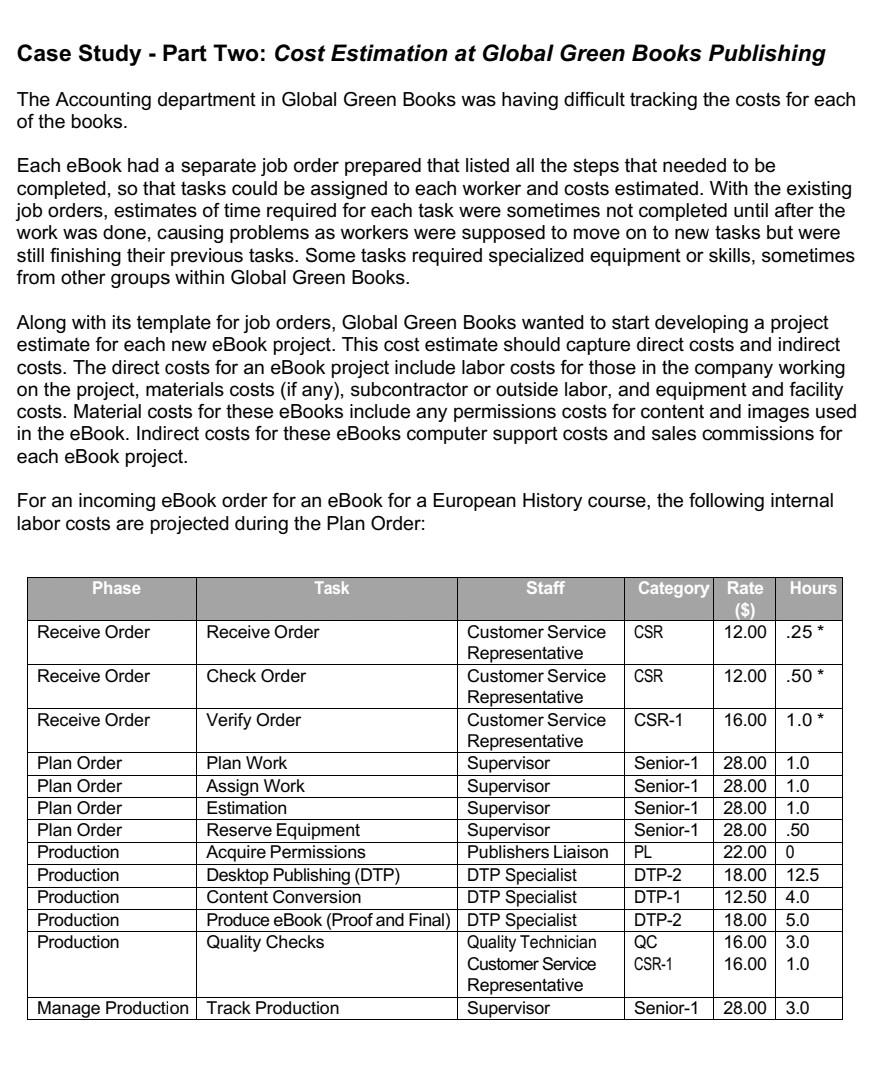
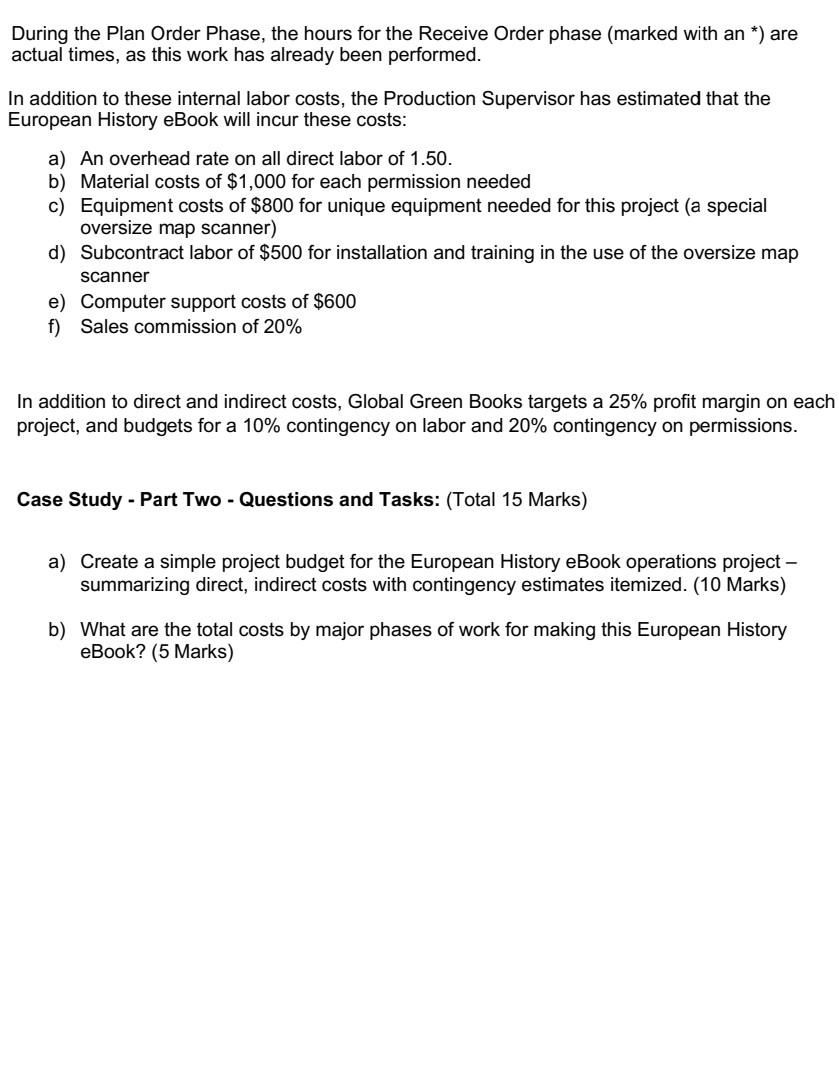
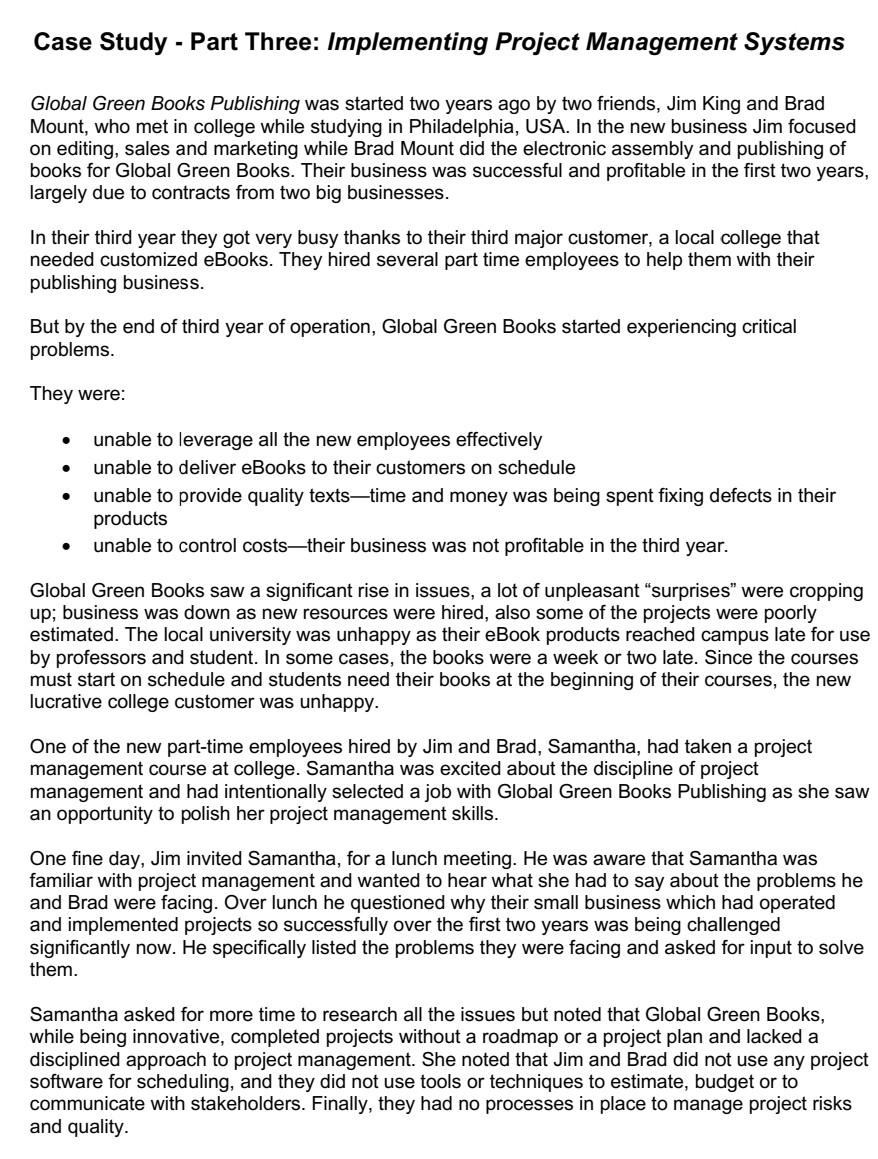
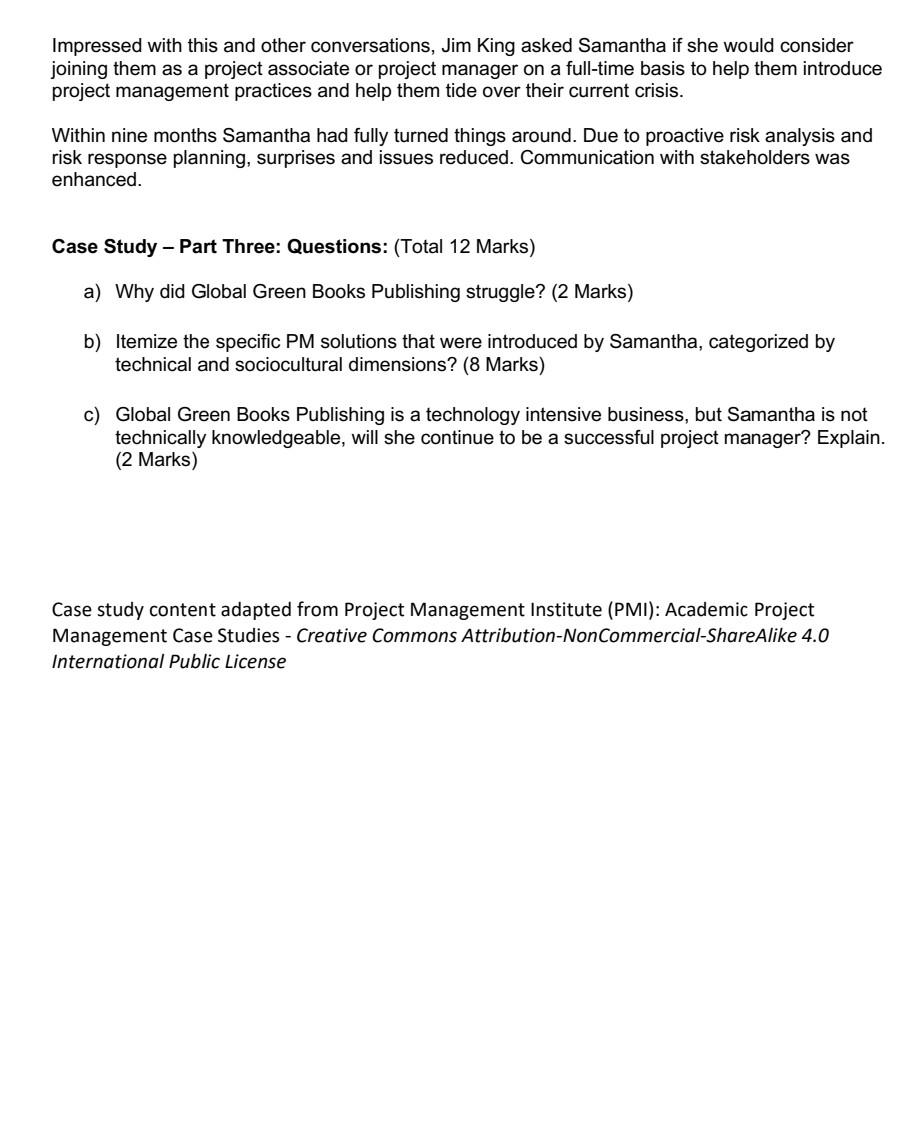
Case Study - Part One: Defining Operations Projects Global Green Books Publishing is a successful printing and publishing company in its third year. It has survived the bringing on a large new customer and all the challenges of new work that this customer needed in a very short time. Much of this work for the college is customized eBooks. As the first term progressed with Global Green Books making customized eBooks for this college, there were a number of issues that affected the quality of the eBooks produced and caused a great deal of rework for the company. The local university was unhappy as their eBook products sometimes reached campus late for use by professors and student. In some cases, the books were a week or two late. The management of Global Green Books was also challenged by these projects. The college expected them delivered on-time and at a low cost, and the company was not always doing that. Accounting was having difficult tracking the costs for each of the books, and the shift supervisor were often having problems knowing what tasks needed to be completed and assigning the right employees to each task. Some of the problems stemmed from the new part time employees. Since many of these workers had flexible schedules, it wasn't always clear which tasks they were supposed to be working on when they came into work. Each book being produced was indeed a book; but that was all they had in common. Each book had different production steps, different contents and reprint approvals required, and different layouts and cover designs. Some were just collections of articles to reprint once approvals were received, and others required extensive desktop publishing. Each eBook was a complex process, but was going to be made just once, as these eBooks were all customized for each professor and course each semester. Each eBook had to be produced on time and had to be made to match just exactly what the professors requested. Understanding what each eBook needed had to be clearly documented and understood before starting production. Global Green Books had been told by the college how many different printing jobs the college would need, but they weren't all arriving at once, and orders were quite unpredictable in arriving from the professors at the college. Some professors needed rush orders for their classes. Some orders arrived as projected, but some came later than anticipated. When Global Green Books finally got all their orders, some of these jobs were much larger than they had thought they would be. Each eBook needed to have a separate job order prepared that listed all the steps that needed to be completed, so that tasks could be assigned to each worker. These job orders were also becoming a problem. Not all the steps needed were getting listed in each order. Often the estimates of time for each task were not completed until after the work was done, causing problems as workers were supposed to move on to new tasks but were still finishing their previous tasks. Some tasks required specialized equipment or skills, sometimes from other groups within Global Green Books. Not all of the new student hires were trained for all of the printing and binding equipment used to print and assemble to books. Global Green Books wanted to start developing a template for job orders. This template should list all of the possible tasks that should be performed in producing an eBook for the college. These tasks could be broken down into the different phases of the work. In the Receive Order phase, the order should be received by Global Green Books from the professor or the college, it should be checked and verified, and a job order started. In checking and verifying each order, the customer representative should make sure that they have the requester's name, email and phone number; the date needed, and a full list of all of the contents. They should also verify that they have received all of the materials that were supposed to be included with that order and have fully identified all of the items that they need to request permissions for. Any problems found in checking and verifying should be resolved by contacting the professor. In the Plan Order phase, all of the desktop publishing work is planned, estimated and assigned to production staff. Also, all of the production effort to collate and produce the eBook are identified, estimated and scheduled, and assigned to production staff. Specific equipment resource needs are identified, and equipment is reserved on the schedule to support the planned production effort. In the Production Phase, permissions are acquired, desktop publishing tasks (if needed) are performed, content is converted, and the proof of the eBook is produced. A quality assistant will check the eBook against the job order and customer order to make sure it is ready for production, and once approved by quality, each of the requested eBook formats are created. A second quality check makes sure that each requested format is ready to release to the college. In a Manage Production Phase, happening in parallel with the Production Phase, a supervisor will track progress, work assignments, and costs for each eBook. Any problems will be resolved quickly in an attempt to not have any rework or delays in releasing the eBooks to the college. Each eBook will be planned using the standard job template as a basis for developing a unique plan for that eBook project. Case Study - Part One - Questions and Tasks: (Total 20 Marks) a) Who are the stakeholders in these eBook projects? How are they involved in or affected by an eBook project? (5 Marks) b) Create a Work Breakdown Structure for an eBook project. (5 Marks) c) Create a Gantt chart for the European History eBook showing the major operations project phases, and dependencies. (10 Marks) Case Study - Part Two: Cost Estimation at Global Green Books Publishing The Accounting department in Global Green Books was having difficult tracking the costs for each of the books. Each eBook had a separate job order prepared that listed all the steps that needed to be completed, so that tasks could be assigned to each worker and costs estimated. With the existing job orders, estimates of time required for each task were sometimes not completed until after the work was done, causing problems as workers were supposed to move on to new tasks but were still finishing their previous tasks. Some tasks required specialized equipment or skills, sometimes from other groups within Global Green Books. Along with its template for job orders, Global Green Books wanted to start developing a project estimate for each new eBook project. This cost estimate should capture direct costs and indirect costs. The direct costs for an eBook project include labor costs for those in the company working on the project, materials costs (if any), subcontractor or outside labor, and equipment and facility costs. Material costs for these eBooks include any permissions costs for content and images used in the eBook. Indirect costs for these eBooks computer support costs and sales commissions for each eBook project. For an incoming eBook order for an eBook for a European History course, the following internal labor costs are projected during the Plan Order: During the Plan Order Phase, the hours for the Receive Order phase (marked with an *) are actual times, as this work has already been performed. In addition to these internal labor costs, the Production Supervisor has estimated that the European History eBook will incur these costs: a) An overhead rate on all direct labor of 1.50. b) Material costs of $1,000 for each permission needed c) Equipment costs of $800 for unique equipment needed for this project (a special oversize map scanner) d) Subcontract labor of $500 for installation and training in the use of the oversize map scanner e) Computer support costs of $600 f) Sales commission of 20% In addition to direct and indirect costs, Global Green Books targets a 25\% profit margin on each project, and budgets for a 10% contingency on labor and 20% contingency on permissions. Case Study - Part Two - Questions and Tasks: (Total 15 Marks) a) Create a simple project budget for the European History eBook operations project summarizing direct, indirect costs with contingency estimates itemized. (10 Marks) b) What are the total costs by major phases of work for making this European History eBook? (5 Marks) Case Study - Part Three: Implementing Project Management Systems Global Green Books Publishing was started two years ago by two friends, Jim King and Brad Mount, who met in college while studying in Philadelphia, USA. In the new business Jim focused on editing, sales and marketing while Brad Mount did the electronic assembly and publishing of books for Global Green Books. Their business was successful and profitable in the first two years, largely due to contracts from two big businesses. In their third year they got very busy thanks to their third major customer, a local college that needed customized eBooks. They hired several part time employees to help them with their publishing business. But by the end of third year of operation, Global Green Books started experiencing critical problems. They were: - unable to leverage all the new employees effectively - unable to deliver eBooks to their customers on schedule - unable to provide quality texts-time and money was being spent fixing defects in their products - unable to control costs-their business was not profitable in the third year. Global Green Books saw a significant rise in issues, a lot of unpleasant "surprises" were cropping up; business was down as new resources were hired, also some of the projects were poorly estimated. The local university was unhappy as their eBook products reached campus late for use by professors and student. In some cases, the books were a week or two late. Since the courses must start on schedule and students need their books at the beginning of their courses, the new lucrative college customer was unhappy. One of the new part-time employees hired by Jim and Brad, Samantha, had taken a project management course at college. Samantha was excited about the discipline of project management and had intentionally selected a job with Global Green Books Publishing as she saw an opportunity to polish her project management skills. One fine day, Jim invited Samantha, for a lunch meeting. He was aware that Samantha was familiar with project management and wanted to hear what she had to say about the problems he and Brad were facing. Over lunch he questioned why their small business which had operated and implemented projects so successfully over the first two years was being challenged significantly now. He specifically listed the problems they were facing and asked for input to solve them. Samantha asked for more time to research all the issues but noted that Global Green Books, while being innovative, completed projects without a roadmap or a project plan and lacked a disciplined approach to project management. She noted that Jim and Brad did not use any project software for scheduling, and they did not use tools or techniques to estimate, budget or to communicate with stakeholders. Finally, they had no processes in place to manage project risks and quality. Impressed with this and other conversations, Jim King asked Samantha if she would consider joining them as a project associate or project manager on a full-time basis to help them introduce project management practices and help them tide over their current crisis. Within nine months Samantha had fully turned things around. Due to proactive risk analysis and risk response planning, surprises and issues reduced. Communication with stakeholders was enhanced. Case Study - Part Three: Questions: (Total 12 Marks) a) Why did Global Green Books Publishing struggle? (2 Marks) b) Itemize the specific PM solutions that were introduced by Samantha, categorized by technical and sociocultural dimensions? (8 Marks) c) Global Green Books Publishing is a technology intensive business, but Samantha is not technically knowledgeable, will she continue to be a successful project manager? Explain. (2 Marks) Case study content adapted from Project Management Institute (PMI): Academic Project Management Case Studies - Creative Commons Attribution-NonCommercial-ShareAlike 4.0 International Public License
Step by Step Solution
There are 3 Steps involved in it
1 Expert Approved Answer
Step: 1 Unlock

Question Has Been Solved by an Expert!
Get step-by-step solutions from verified subject matter experts
Step: 2 Unlock
Step: 3 Unlock
 Study Help