







Question: case study Please read the closing case BETHESDA MINING at the end of chapter 8 page and submit your analysis to your professor at the
case study
Please read the closing case BETHESDA MINING at the end of chapter 8 page and submit your analysis to your professor at the end of this session.
Answers must be well thought-out and in discussion format. Short one-liner answers are not sufficient.
- Answer the five questions at the end of the Case Synopsis and Purpose
- Repeat each question ahead of your answer
- Use headings to separate the response to each question
- Make sure you answer each question
- Follow APA style
- Check grammar, spelling, sentence structure, etc.
I strongly suggest you use a good proofreader for each written submission.
answer
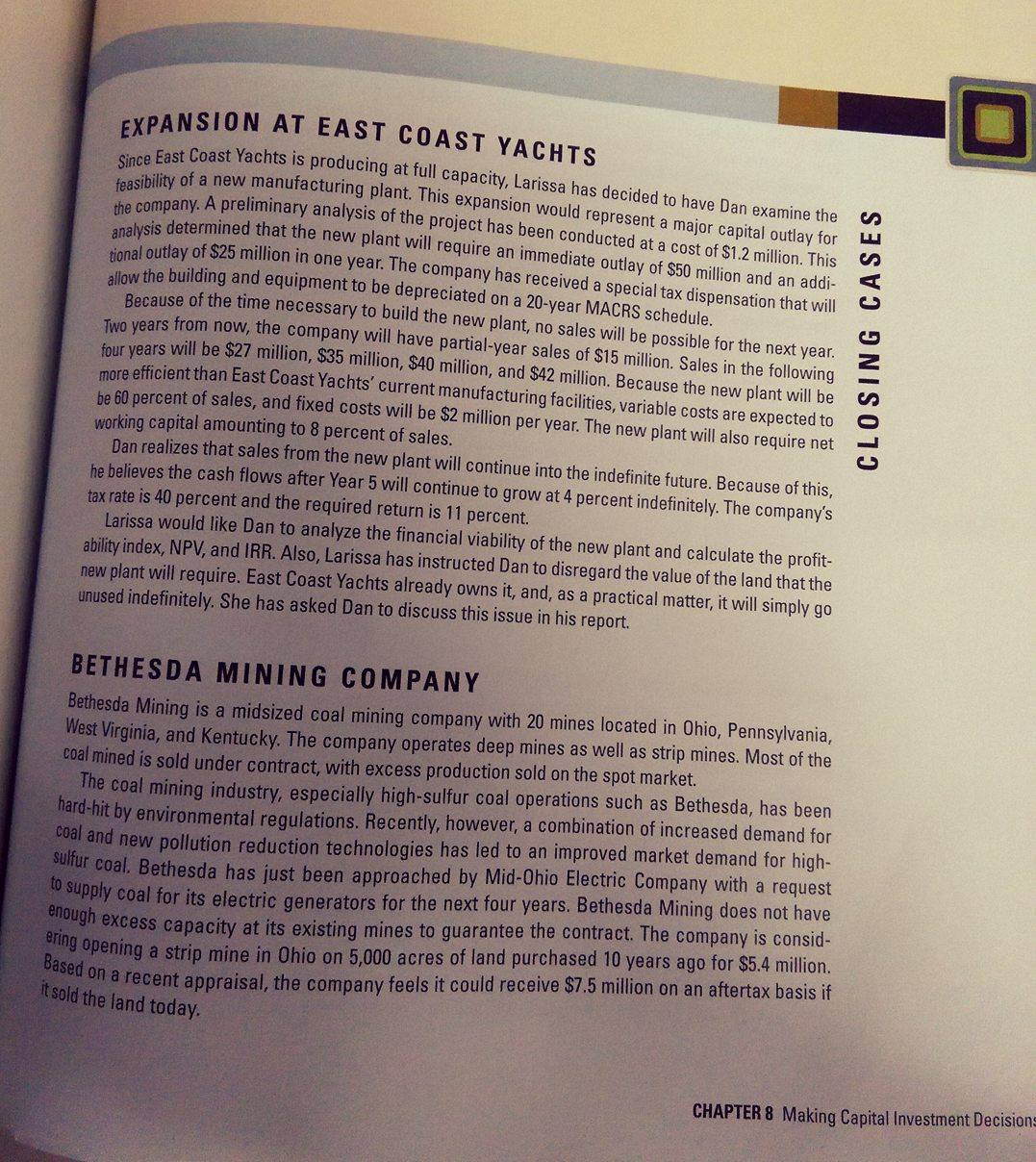
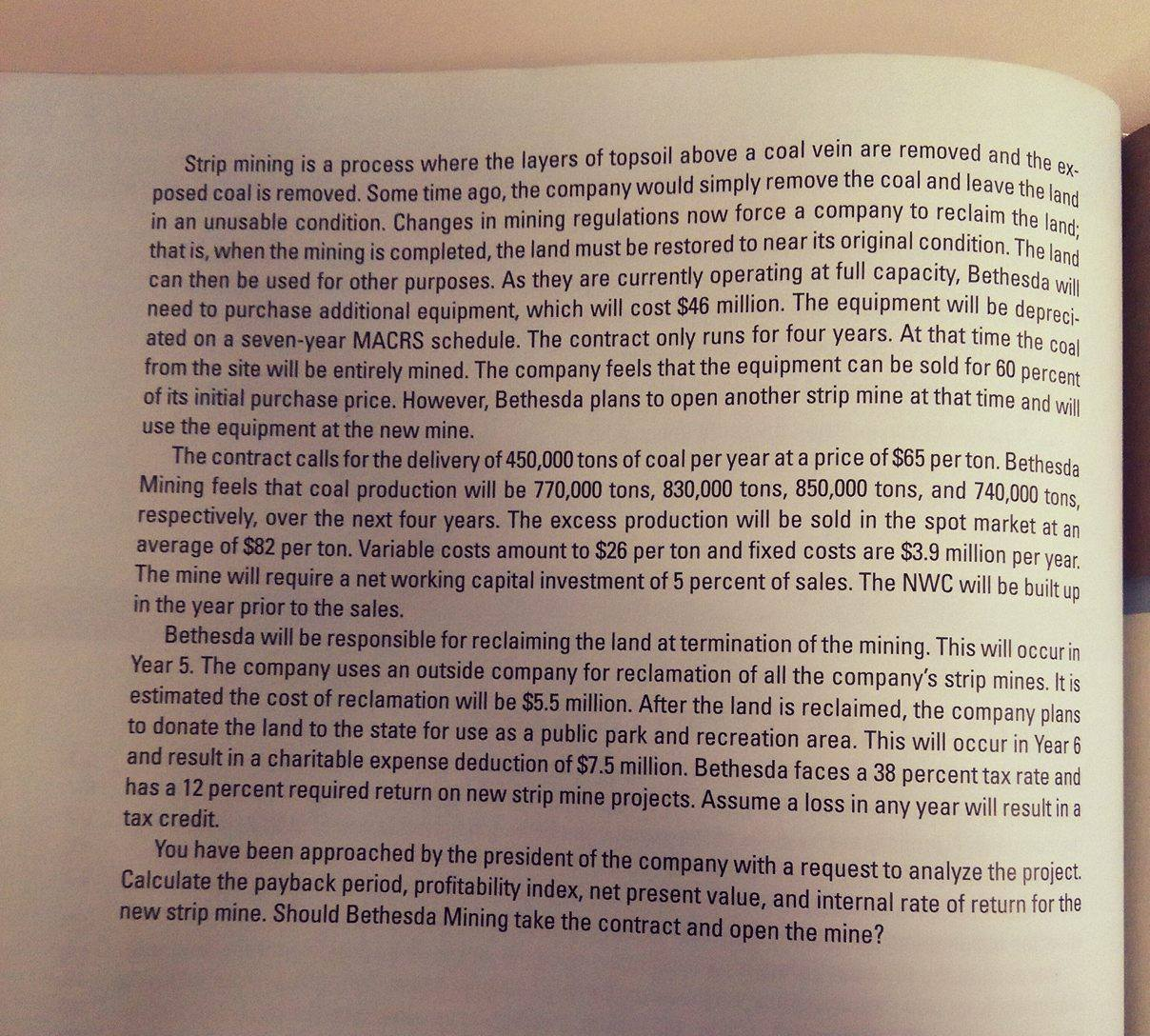
To analyze case study #2, you must calculate the incremental cash flows generated by the project. Since net working capital is built up ahead of sales, the initial cash flow depends in part on working capital. First calculate sales revenue. Each year, the firm will sell 450,000 tons under contract, and the rest on the spot market. The total sales revenue is the price per ton times 450,000 tons, plus the market sales times the spot market price.
I will do year one for you:
For example;
Year 1:
contract $29,250,000
spot 26,240,000
total $55,490,000
initial net working capital = .5 9$55,490,000) = $2,774,500
so the cash flow today is:
equipment -$46,000,000
land $-7,500,000
NWC $-2774,500
total - $56,274,500
So for year one;
OCF is:
sales $55,490,000
var costs 20,020,000
fixed costs 3,900,000
Depreciation 6,573,400
EBT $24,996,600
tax 9,498,708
net income $15,497,892
+ depreciation 6,573,400
OCF = $22,071,292
You will have to calculate OCF cash flows for years 2 - 6.
Year 5 and 6 have fixed costs, (no revenues or variable costs). Year 5 and 6 will still have EBT (which is negative) then tax write-off, providing a net negative net income and negative OCF for these last two years. For example for year 6, the case states that there is a $7,500,000 fixed costs (deduction value).
Year 1
beg NWC $2,774,500
end NWC 3,020,500
NWC CF = - $246,000
You must also calculate salvage value
So, the net cash flows each year, including operating cash flow =
time 0 -$56,274,500
year 1 21,825,292
you need to calculate net cash flows for years 2 - 6
Then solve for payback, P.I., IRR, and NPV
continue ??
EXPANSION AT EAST COAST YACHTS Since feasibility of a n the compain analysis dete East Coast Yachts is producing at full capacity, Larissa has decided to have Dan examine the f a new manufacturing plant. This expansion would represent a major capital outlay for en ny. A preliminary analysis of the project has been conducted at a cost of S1.2 million. This r s determined that the new plant will require an immediate outlay of $50 million and an addi- outlay of $25 million in one year. The company has received a special tax dispensation that will he building and equipment to be depreciated on a 20-year MACRS schedule Because of cause of the time necessary to build the new plant, no sales will be possible for the next year. ars from now, the company will have partial-year sales of $15 million. Sales in the following rs will be $27 million, $35 million, $40 million, and $42 million. Because the new plant will be z yea ient than East Coast Yachts' current manufacturing facilities, variable costs are expected to O u re effic 60 percent of sales, and fixed costs will be $2 million per year. The new plant will also require net be ing capital amounting to 8 percent of sales realizes that sales from the new plant will continue into the indefinite future. Because of this ieves the cash flows after Year 5 will continue to grow at 4 percent indefinitely. The company's e beli tax rate is 40 percent and the required return is 11 percent. Larissa would like Dan to analyze the financial viability of the new plant and calculate the profit ity index, NPV, and IRR. Also, Larissa has instructed Dan to disregard the value of the land that the new plant will require. East Coast Yachts already owns it, and, as a practical matter, it will simply go unused indefinitely. She has asked Dan to discuss this issue in his report. BETHESDA MINING COMPANY Bethesda Mining is a midsized coal mining company with 20 mines located in Ohio, Pennsylvania, West Virginia, and Kentucky. The company operates deep mines as well as strip mines. Most of the coal mined is sold under contract, with excess production sold on the spot market The coal mining industry, especially high-sulfur coal operations such as Bethesda, has been hard-hit by environmental regulations. Recently, however, a combination of increased demand for coal and new pollution reduction technologies has led to an improved market demand for high- d by Mid-0hio Electric Company with a request tors for the next four years. Bethesda Mining does not have cess capacity at its existing mines to guarantee the contract. The company is consid- a strip mine in Ohio on 5,000 acres of land purchased 10 years ago for $5.4 million sulfur coal. to suppl enough excess capa Bethesda has just been approache ly coal for its electric genera n a recent appraisal, the company feels it could receive $7.5 million on an aftertax basis if t sold the land today CHAPTER 8 Making Capital Investment Decisions
Step by Step Solution
There are 3 Steps involved in it

Get step-by-step solutions from verified subject matter experts
 Study Help