Question: CASE STUDY: Please read the following case study about LEGO, the global toy company, and answer ALL of the questions that come after. Dana At
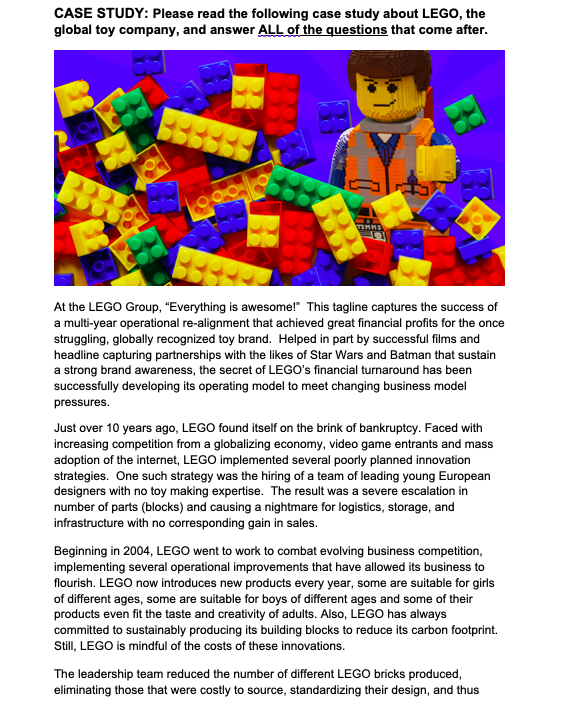
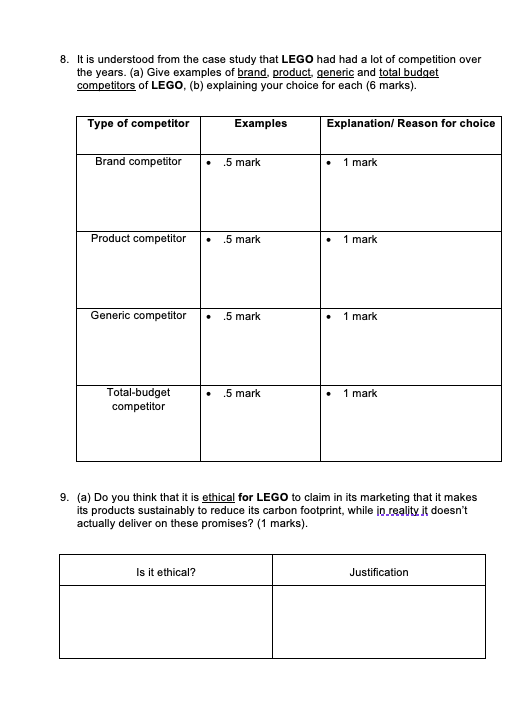
CASE STUDY: Please read the following case study about LEGO, the global toy company, and answer ALL of the questions that come after. Dana At the LEGO Group, "Everything is awesome!" This tagline captures the success of a multi-year operational re-alignment that achieved great financial profits for the once struggling, globally recognized toy brand. Helped in part by successful films and headline capturing partnerships with the likes of Star Wars and Batman that sustain a strong brand awareness, the secret of LEGO's financial turnaround has been successfully developing its operating model to meet changing business model pressures. Just over 10 years ago, LEGO found itself on the brink of bankruptcy. Faced with increasing competition from a globalizing economy, video game entrants and mass adoption of the internet, LEGO implemented several poorly planned innovation strategies. One such strategy was the hiring of a team of leading young European designers with no toy making expertise. The result was a severe escalation in number of parts (blocks) and causing a nightmare for logistics, storage, and infrastructure with no corresponding gain in sales. Beginning in 2004, LEGO went to work to combat evolving business competition, implementing several operational improvements that have allowed its business to flourish. LEGO now introduces new products every year, some are suitable for girls of different ages, some are suitable for boys of different ages and some of their products even fit the taste and creativity of adults. Also, LEGO has always committed to sustainably producing its building blocks to reduce its carbon footprint. Still, LEGO is mindful of the costs of these innovations. The leadership team reduced the number of different LEGO bricks produced, eliminating those that were costly to source, standardizing their design, and thus increasing the team's ability to react more quickly to consumer trends. Additionally, LEGO strategically chooses to work with a narrower set of suppliers to stabilize its already relatively high toy prices compared to other toy brands. LEGO's business model had historically been guided by two principles: capacity for innovation and commitment to quality. As described above, LEGO's current operating model is set up to create unique competitive advantages that have been critical in enabling LEGO to turn around its financial performance. Yet despite LEGO's remarkable turnaround, constant evaluation of operating and business model efficiencies is required. LEGO recently announced that it had failed to foresee a jump in demand in Europe and, as a result, may not be able to meet all orders around Christmas time. Until existing factories are expanded and new factories are built, the company must focus on improving its customer demand forecasting capabilities. Under the current operating model, the company's sales team meets monthly to adjust order estimates for the coming month based on sales in the prior month - a system that could require analytical improvement. However, as proven by its commitment to adjust operating tactics to meet business model goals, LEGO will likely address this flaw so that everything remains awesome" for the company in 2021 and beyond. 8. It is understood from the case study that LEGO had had a lot of competition over the years. (a) Give examples of brand, product generic and total budget competitors of LEGO, (b) explaining your choice for each (6 marks). Type of competitor Examples Explanation/ Reason for choice Brand competitor .5 mark 1 mark Product competitor .5 mark . 1 mark Generic competitor .5 mark 1 mark .5 mark 1 mark Total-budget competitor 9. (a) Do you think that it is ethical for LEGO to claim in its marketing that it makes its products sustainably to reduce its carbon footprint, while jo seality it doesn't actually deliver on these promises? (1 marks). Is it ethical? Justification









 Study Help