Question: Case Study: PwC please dont copy , write it with your own words Describe management issues such as diversity, attitudes and job satisfaction, personality, and
Case Study: PwC
please dont copy , write it with your own words
Describe management issues such as diversity, attitudes and job satisfaction, personality, and values in organizational behavior. (CLO2).
Assignment 1
Reference Source:
Textbook:-
Colquitt, J. A., LePine, J. A., & Wesson, M. J. (2019). Organizational behaviour: Improving performance and commitment in the workplace (6th ed). Burr Ridge, IL: McGraw-Hill Irwin.
Case Study: -
Case: PwC
Please read the case PwC from Chapter 3 Organizational Commitment Page: - 83 given in your textbook Organizational behaviour: Improving performance and commitment in the workplace (6th ed). by Colquitt, J. A., LePine, J. A., & Wesson, M. J. (2019) and Answer the following Questions:
Assignment Question(s):
1. Compare the findings described above for Millennials to your own views on Millennial characteristics. What surprises you about the findings? What doesn't surprise you? (1.25 Marks ) (Min words 150-200)
2. If you think about the three types of commitmentaffective, continuance, and normativewhich do you think is most changed among Millennials (or twenty-somethings)? In what way? (1.25 Marks ) (Min words 150-200)
3. Consider all the initiatives and programs PwC uses to inspire employee loyalty. Do most of those seek to move the needle on affective commitment, continuance commitment, or normative commitment? (1.25 Marks ) (Min words 200)
Part:-2
Discussion question: - Please read Chapter 3 organizational commitment Carefully and then give your answers on the basis of your understanding.
4. Which type of organizational commitment (affective, continuance, or normative) do you think is most important to the majority of employees? Which do you think is most important to you? (1.25 Marks ) (Min words 200-300)
Important Note: - Support your submission with course material concepts, principles, and theories from the textbook and at least two scholarly, peer-reviewed journal articles.
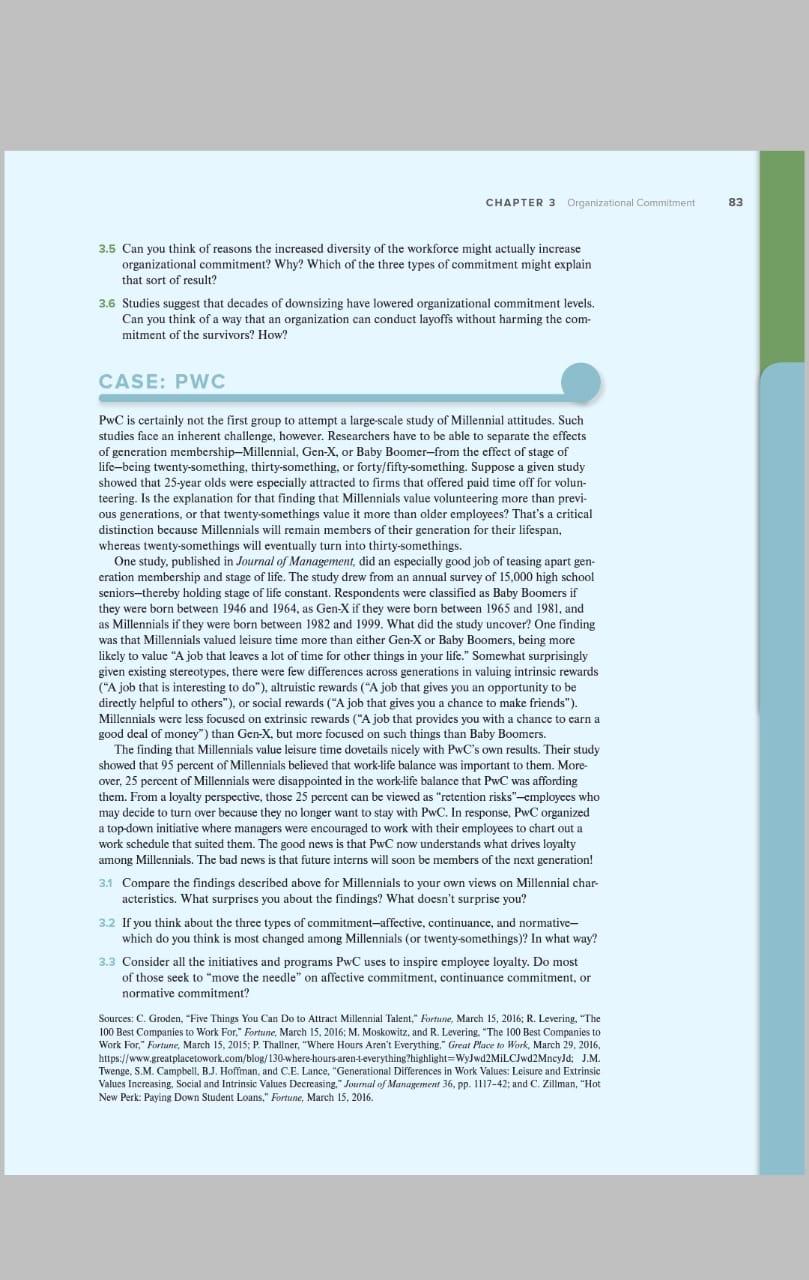
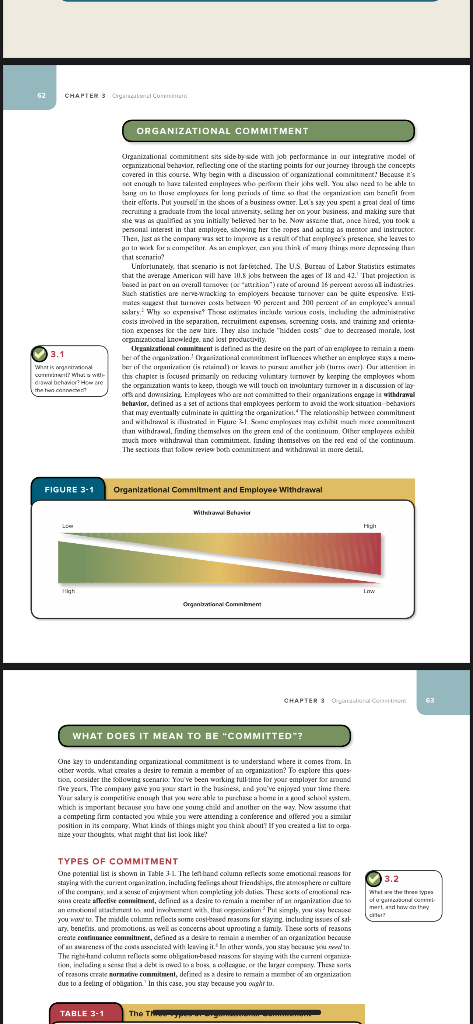
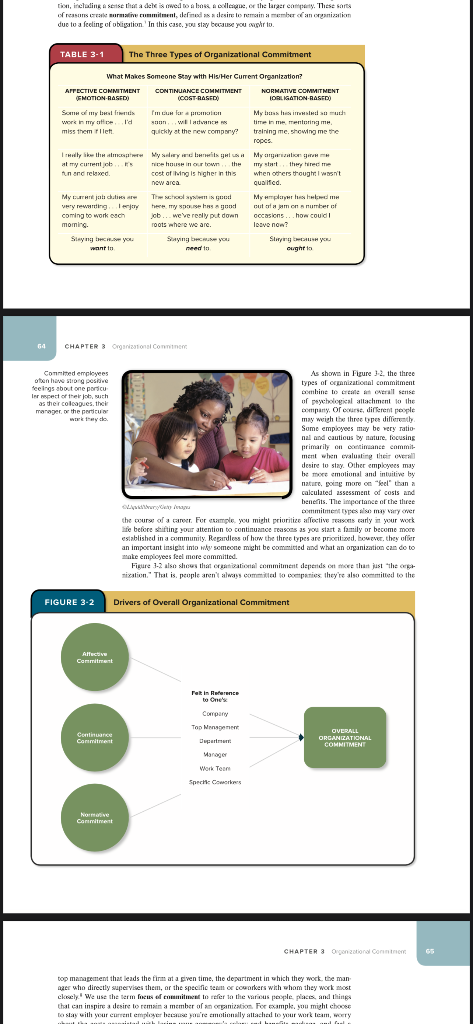
CHAPTER 3 Organizational Commitment 83 3.5 Can you think of reasons the increased diversity of the workforce might actually increase organizational commitment? Why? Which of the three types of commitment might explain that sort of result? 3.6 Studies suggest that decades of downsizing have lowered organizational commitment levels. Can you think of a way that an organization can conduct layoffs without harming the com- mitment of the survivors? How? CASE: PWC e explanation for PwC is certainly not the first group to attempt a large-scale study of Millennial attitudes. Such studies face an inherent challenge, however. Researchers have to be able to separate the effects of generation membership-Millennial, Gen-X, or Baby Boomer-from the effect of stage of lifc-being twenty-something, thirty-something, or forty/fifty-something. Suppose a given study showed that year rolds were especially attracted to firms that offered paid time off for volun- teering Is the for that t finding that Millennials value volunteering more than previ- ous generations, or that or that twenty-somethings value it more than older employees? That's a critical distinction because Millennials will remain members of their generation for their lifespan, hereas twenty-somethings will eventually turn into ratione mury published in Journal of Management, did an especially good job of teasing apart gen- One study, published in Journal of Many turn into thirty-somethings. membership and stage of life. The study drew from an annual survey of 15,000 high school seniors-thereby holding stage of life constant. Respondents werc classified as Baby Boomers if they were born between 1946 and 1964, as Gen-X if they were born between 1965 and 1981, and een as Millennials if they were born between 1982 and 1999. What did the study uncover? One finding 10 sed was that Millennials valued leisure time more than either Gen-X or Baby Boomers, being more likely to value "A job that leaves a lot of time for other things in your life." Somewhat surprisingly . given existing stereotypes, there were few differences across generations in valuing intrinsic rewards ("A job that is interesting to do"), altruistic rewards ("A job that gives you an opportunity to be directly helpful to others"), or social rewards ("A job that gives you a chance to make friends"). Millennials were less focused on extrinsic rewards ("A job that provides you with a chance to carn a good deal of money) than Gen-X, but more focused on such things than Baby Boomers. The finding that Millennials value leisure time dovetails nicely with PwC's own results. Their study that 95 percent of Millennials believed that work-life balance was important to them. More over, 25 percent of Millennials were disappointed in the work-life balance that PwC was affording them. From a loyalty perspective, those 25 percent can be viewed as "retention risks"-employees who may decide to turn over because they no longer want to stay with PwC. In response, PwC organized a top down initiative where manngers were encouraged to work with their employees to chart out a work schedule that suited them. The good news is that PwC now understands what drives loyalty among Millennials. The bad news is that future interns will soon be members of the next generation! 3.1 Compare the findings described above for Millennials to your own views on Millennial char- acteristics. What surprises you about the findings? What doesn't surprise you? 3.2 If you think about the three types of commitment-affective, continuance, and normative- which do you think is most changed among Millennials (or twenty-somethings)? In what way? 3.3 Consider all the initiatives and programs PwC uses to inspire employee loyalty. Do most of those seek to "move the needle" on affective commitment, continuance commitment, or normative commitment? showed Sources: C. Giroden. "Five Things You Can Do to Attract Millennial Talent. Fortune March 15, 2016; R. Levering, "The 100 Best Companies to Work For." Fortune, March 15, 2016; M. Moskowitz, and R. Levering. "The 100 Best Companies to Work For," Fortune, March 15, 2015: P. Thaliner, "Where Hours Aren't Everything." Great Place to Work, March 29, 2016, https://www.greatplacetowork.com/blog/130-where-hours-aren-t-everything?highlight=WyJwd2MILC]wd2Mncy]d: J.M. Twenge, S.M. Campbell, B.J. Hoffmanand CE. Lance, "Generational Differences in Work Values: Leisure and Extrinsic Values Increasing, Social and Intrinsic Values Decreasing." Journal of Management 36, pp. 1117-42; and C. Zillman, "Hot New Perk: Paying Down Student Loans," Fortune, March 15, 2016, 62 CHAPTER 3 Oynal Com ORGANIZATIONAL COMMITMENT Organizational commitment sits side by side with job performance in our integrative model or Opinizational behavior, reflecting one of the starting points for our journey through the concepts covered in this course. Why begin with a discussion of organizational committen! Because it's not enough to have talented employees who perform their jobs well. You also need to be able to hann an los huse emples for long periods of time so that the critim can benefit from their efforts. Put yourself in the shoes of a business owner. Let's say you spend a great deal of time Tecrutega graduate from the local university, selling her on your business, and making sure that she was a qualified as you initially believed her to be. Now assume that once hired, you took a personal interest in that employee, showing her the ropes and acting as mentor and instructor Theil, just as the company was set to impress result of that employee's presence, she leaves to a la wek kar a competine. As an employer, can you think of anything more depressing tham that senario? Unfortunately, that scenario is not far feiched. The U.S. Bureau of Labor Statistics estimates that the werage American will have 20. jobs between the ages of 18 and 42. The projection based in paxt on an overall canove Otrkios) cate of around 16 percent com a indestries. Such statistics are terve wrocking to employers because turnover can be quite expensive. Esti ales sugest that turnerasts betweet percent and 200 percent of an employee's sel xabary. Why so expensive? The estimates include various custs, including the administrative cosis involved in the separation, recruitment expenses, screening costs, and training and orientu tion expenses for the new hire. They also include "hidden costs due to decreased morale, lost Opinzabal knowledge and lost productivity, Organizational commitment is detined as the desire on the part of an employee to remain a mem- Der of the organization. Catalitinerces whether an employee says a mem Iber of the sirganization is relaina) u kaves to pursue anherja (turtes wer). Duraliente in this chapter is focused primarily un reducing vulintary turnuver by keeping the employees whom the opunzation wants to keep, though we will touch on imoluntary turnover in a discussion of lay of and downsizine. Employees who are not committed to their arganizations engage is withdrawal behavior, defined as a set of actions that employees perform to avoid the work situation behaviors that may eventually culminate in quitting the arganization. The relationship between commitment and withdrawal is illustrata in Figure 3. Setemes may exhibit much more commitment than withdrawal. finding themselves on the green end of the continuum. Other employees exhibit much more withdrawal tan commitment. finding themselves on the red end od the continuum. The sections that follow review both commitment and withdrawal in more detail. V) 3.1 Wii wyni TWI will dwal bewowe that FIGURE 3-1 Organizational Commitment and Employee Withdrawal Withdrawal Behavior Hy High Low Organibalem CHAPTER 3 Onion Con 63 WHAT DOES IT MEAN TO BE "COMMITTED"? One key to understanding oranizational commitment is to understand where it comes trom. In other words, what creates a desire to remain a member of an organization? To explore this ques tion, consider the following scenario You've been working full time for your employer for around five years. The company have you ever start in the lines, and you've enjoyed your time there Your salary is competitive enough that you were able to perchase a home in a good school system, which is important because you have young child and another on the way. Now assume that a competing firm contacted you while you were attending a conference and offered you a similar position in its company. What kinds of things might you think about? If you created a list to on mize your thoughts, wat might that list look like! 3.2 What is the three types eluyareREIH' ! The Andhawn they TYPES OF COMMITMENT One potential list is shown in Table 3.1. The len hand column reflects some emocional reasons for staying with the current anization, including feelingsbar friendships the mosphere or culture of the company and a sof enjoyment when completing job cili These els afemxional or sans create affective comment, defined as a desire to remain a member of organization due to an emlachment to anilicement with this gration Put simple, you say be you want. The middle column reflecis some cust-based reasons for staying including issues of sal- ary, benetits, and promotions, as well as concerns about uprooting a family. These sorts of reasons create continanee comitment, defined as a desire to remember of an organization because of an awareness of the contenciated with kaving it. In her words, you stay ease youred to The right hand column relacis some obligation-basa nossoms for staying with the current tim, including a sense that dele is twed to a boss selgus, or the larger company. These wants of reasons weale normative commitment, defined as a desire to remain a member of an organization due to a feeling of obupation. In this case, you stay because you up to TABLE 3-1 The Ti. To, including a sense that a dele is wed to an allege, or the larger cay. These sarts frases cruri rummitment, derned a desire to remain a member of an organization due to a feeling of obligation. In this case you stay because you sugrio. TABLE 3-1 The Three Types of Organizational Commitment What Makes someone Stay with His/Her Current Organization? AFFECTIVE COMMITMENT CONTINUANCE COMMITMENT NORMATIVE COMMITMENT FMOTION BASED COST-RASED) ( ORLIGATION BASED Sammy I'm los aromaten My toe besimdruth work in my tipe I'd son with time me mentoring me miss them llett quickly at the new compory? ? training me, showing me the roocs Iridly like the act My siya yule Mycongruation at my current job nice house in our own the Tyt, the time me nere relased cost of Ming is higher in this when others though I WIE now arca qualifcd My Butjat chats Twingo My employed very rewanting lej here my phone bution number of coming to work each Job ... we've really put down cocasions... how could! moming. roots where we are. Icove non? Stay ng you Soying you Sharing wantin need in ought to 64 CHAPTER 3 Organizational Continens Cand employees often have strong feelings about one pericu Iar spect of their job, with asther colleagues, their manager or the partium work they do As shown in Figure 2. the three types of organizational commitment combine to create a cerall sense of paychological attachment to the company of us, different people may weigh the three typee differently Some employees may be very ratio nal and cautious by nature focusing primarily on inance commit. ment when evaluating the one desire to stay Other employees may be more emotional and intuitive by mature, poing more on "feel than a calculated assessment of costs and benefits. The importance of the three mitment types may vary cwer the wurse of a camer. For example, you might prioritize allective reasons early in your work lite before shifting your attention to continuance reasons as you start a family or become more established in a community. Regardless of how the three types are prioritized. bowever, they offer an important insight into why someone might be committed and what an organization can do to make employers feel more committed Figure 1-3 also shows that organizational commitment deperds on ice that just there nization. That is people aren't always come to companies they're also committed to the FIGURE 3-2 Drivers of Overall Organizational Commitment Allective Commitment Tein Reference to One's Continuance Commitment OVERALL ORGANZATIONAL COMMITMENT Company Top Management Departur Manager Work Terre Specii: Coches Normative Commitment CHAPTER 3 Don Conne top management that leads the firm at a given time, the department in which they work, the man Azer who directly supervises them, or the specific tea or coworkers with whom they work most ckoly We use the term foes of commitment to refer to the various people places, and things that can inspire a desire to remain a member of nanization. For example, you might choose to stay with your current employer because you're emotionally allached to your work team, wery









 Study Help