case study:
queations
1. From the perspective of a patient, how would you feel about being diagnosed by a doctor who could be hun- dreds or thousands of miles away from you? What kind of expectations or concerns would you have about that kind of experience?
2. What other professions, aside from health care and ed- ucation, could benefit from application of some of the technologies discussed in the case? How would they derive business value from these projects? Develop two proposals.
3. The deployment of IT in the health professions is still very much in its infancy. What other uses of technology could potentially improve the quality of health care? Brainstorm several alternatives.
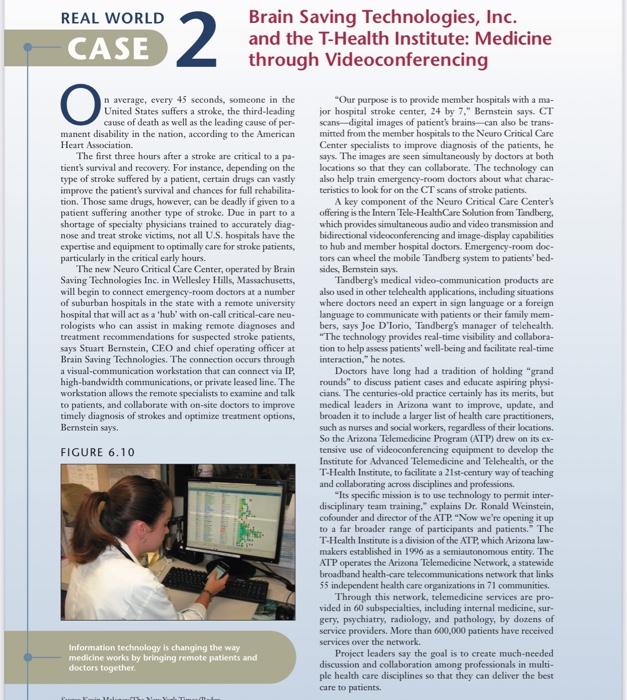
REAL WORLD CASE 2 Brain Saving Technologies, Inc. and the T-Health Institute: Medicine through Videoconferencing O n average, every 45 seconds, someone in the United States suffers a stroke, the third-leading cause of death as well as the leading cause of per- manent disability in the nation, according to the American Heart Association The first three hours after a stroke are critical to a pa- tient's survival and recovery. For instance, depending on the type of stroke suffered by a patient, certain drugs can vastly improve the patient's survival and chances for full rehabilita- tion. Those same drugs, however, can be deadly if given to a patient suffering another type of stroke. Due in part to a shortage of specialty physicians trained to accurately diag- nose and treat stroke victims, not all U.S. hospitals have the expertise and equipment to optimally care for stroke patients, particularly in the critical early hours. The new Neuro Critical Care Center, operated by Brain Saving Technologies Inc. in Wellesley Hills, Massachusetts, will begin to connect emergency-room doctors at a number of suburban hospitals in the state with a remote university hospital that will act as a 'hub' with on-call critical-care neu- rologists who can assist in making remote diagnoses and treatment recommendations for suspected stroke patients, says Stuart Bernstein, CEO and chief operating officer at Brain Saving Technologies. The connection occurs through a visual communication workstation that can connect via IP. high-bandwidth communications, or private leased line. The workstation allows the remote specialists to examine and talk to patients, and collaborate with on-site doctors to improve timely diagnosis of strokes and optimize treatment options, Bernstein says. FIGURE 6.10 *Our purpose is to provide member hospitals with a ma- jor hospital stroke center, 24 by 7." Bernstein says. CT scans digital images of patient's brains can also be trans- mitted from the member hospitals to the Neuro Critical Care Center specialists to improve diagnosis of the patients, he says. The images are seen simultaneously by doctors at both locations so that they can collaborate. The technology can also help train emergency-room doctors about what charac- teristics to look for on the CT scans of stroke patients. A key component of the Neuro Critical Care Center's offering is the Intern Tele-Health Care Solution from Tandberg, which provides simultaneous audio and video transmission and bidirectional videoconferencing and image-display capabilities to hub and member hospital doctors Emergency-room doc- tors can wheel the mobile Tandberg system to patients' bed- sides, Bemstein says. Tandberg's medical video communication products are also used in other telehealth applications, including situations where doctors need an expert in sign language or a foreign language to communicate with patients or their family mem- bers, says Joe D'Iorio, Tandberg's manager of telehealth. "The technology provides real-time visibility and collabora- tion to help assess patients' well-being and facilitate real-time interaction," he notes Doctors have long had a tradition of holding "grand round" to discuss patient cases and educate aspiring physi- cians. The centuries-old practice certainly has its merits, but medical leaders in Arizona want to improve, update, and broaden it to include a larger list of health care practitioners, such as nurses and social workers, regardless of their locations. So the Arizona Telemedicine Program (ATP) drew on its ex- tensive use of videoconferencing equipment to develop the Institute for Advanced Telemedicine and Telehealth, or the T-Health Institute, to facilitate a 21st century way of teaching and collaborating across disciplines and professions "Its specific mission is to use technology to permit inter- disciplinary team training, explains Dr. Ronald Weinstein, cofounder and director of the ATP. "Now we're opening it up to a far broader range of participants and patients. The T-Health Institute is a division of the ATP, which Arizona law makers established in 1996 as a semiautonomous entity. The ATP operates the Arizona Telemedicine Network, a statewide broadband health-care telecommunications network that links 55 independent health care organizations in 71 communities. Through this network, telemedicine services are pro- vided in 60 subspecialties, including internal medicine, sur gery, psychiatry, radiology, and pathology, by dozens of service providers. More than 600.000 patients have received services over the network Project leaders say the goal is to create much-needed discussion and collaboration among professionals in multi- ple health care disciplines so that they can deliver the best care to patients. Information technology is changing the way medicine works by bringing remote patients and doctors together MT Chapter 6 / Tilications and Network 237 "It's the effort to be inclusive, Weinstein says. Medi- eine is quite closed and quite limited, but we're counting on Telecommunications to bridge some of those communication gap. The institute in esentially a teleconferencing hub that enables students, professors, and working professionals to participate in live meetings. Its technology also allows them to switch nearly instantly between different discussion groups easily as they could if they were meeting in person and mercy switching chairs. Gail Barker has noticed that participants who don't speak up during in-person meetings often become much more active in discussions held via videoconferencing. Per haps it's because they feel less intimidated when they're not physically surrounded by others or because the videoconfer encing screen provides a buffer against criticism, says Barker, who is director of the T-Health Institute and a teacher at the University of Arizona College of Public Health When used poorly, videoconferencing can be stiff and dull, just a talking head beaming out across cyberspace without any chance to engage the audience. But Barker and others are finding that when the technology is used in a thoughtful and deliberate manner, it has some advantages over real-life sessions because of its ability to draw more por ticipants into the fray "It's literally a new method of teaching medical students It's a novel approach," says Jim Mauger, director of engi neering at Audio Video Resources Inc., a Phoenix-based company hired to design and install the videoconferencing equipment for the T-Health Institute The T-Health Institute uses a Tandberg 1500 videocon ferencing system, and its video wall has 12 50-inch Toshiba PSO3DL DLP Datawall RPU Video Cabes. The video wall itself is controlled by a Jupiter Fusion 960 Display Wall Processor wtiliving dual Intel Xeon processors. The Fusion 960 allows the wall to display fully movable and scalable im ages from multiple PC, video, and network suces. Although Weinstein was able to articulate this vision of Interprofessional interaction--that is, he could clearly lay out the user requirements-implementing the technology to support it brought challenges, IT worken say Mauger says creating a videoconferencing system that linked multiple sites in one side wall wasn't the challenging part. The real challenge was developing the technology that allows facilitators to move participants into separate virtual groups and then seamlessly with them around. "The biggest challenges to making this work were the audio isolation among the separate conference participants as well as fast dynamics of switching video and moving per ticipants to meetings," he explains. He says his team also en- countered other challenges ones that affect more typical IT projects, such as badget constraints, the need to get staff ers in different cities to collaborate, and the task of translar ing user requirements into actionable items. "Its necessary to have someone there on-site who understands all the com plex parts of the project," he says. "Someone who is not just meeting with people every now and then, but someone who works with them on a daily basis. Barker, who teaches in the College of Public Health at the University of Arizona and is a user of the system, led trial-run training session at the T-Health amphitheater She met with 13 people, including a clinical pharmacist, two family nurse practitioners, a senior business developer, twe program coordinators, a diabetes program case manager and an A/V telemedicine specialist. For that event, Barker says the biggest benefit was the time swed by having the facility in place, without the T Health Institute, me per ticipants would have had to make a four-hour rotund trip to attend in person Now the system is opening up to others in Arizona's health care and medical education communities. T-Health Institute officials say they see this as the fint step towand a health care system that truly teaches its practitioners to work together across professional disciplines so that they can de tiver the best, most efficient care posible We think." Weinstein says, "that this is the only way you're going to create coordinated health care." Serial and Recore Read More und Mary KATT CASE STUDY QUESTIONS 1. From the perspective of a patient, how would you feel about being diagnosed by a doctor who could be hun- deeds of thousands of miles away from you! What kind of expectations or concerns would you have about that kind of experience! 2. What other professions, aside from health care and od ucation, could benefit from application of some of the technologies discussed in the case? How would they derive business value from these projects? Develop two proposals 3. The deployment of IT in the health professions is still very much in its infancy. What other use of technology could potentially improve the quality of health care? Brainstorm several alternatives REAL WORLD ACTIVITIES 1. Technology enhances the ability of educational insti- nutes to reach students across geographic boundaries One recent development in this area is YouTube EDU Go online to check out the site and prepare a report sumrining its objectives, the kind of content available there, and how it could be used to support traditional modes of education delivery, such as lectures 2. If widely adopted, these technologies could conceivably lead to a concentration of specialists in a small number of "hubinstitutions, essentially creating a two-tier health care system. Do you believe this would lead to an increase or decrease in the availability of these probes wonal for patients? What coold be the positive and negative consequences of this development Break into small groups with your own testo di these issues