







Question: . case study question 1. What is the tech billionaires view of philanthropy? 2. Describe the tech CEOs relationship with government and politicians, as shown
. 
case study question
1. What is the tech billionaires view of philanthropy?
2. Describe the tech CEOs relationship with government and politicians, as shown in this case study.?
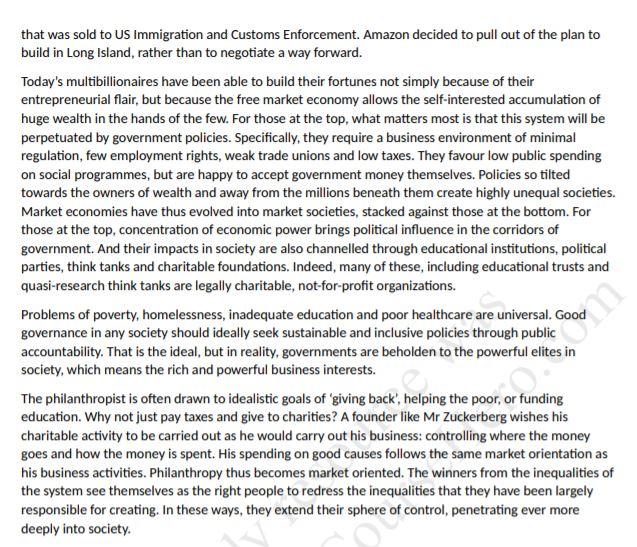
that was sold to US Immigration and Customs Enforcement. Amazon decided to pull out of the plan to build in Long Island, rather than to negotiate a way forward. Today's multibillionaires have been able to build their fortunes not simply because of their entrepreneurial flair, but because the free market economy allows the self-interested accumulation of huge wealth in the hands of the few. For those at the top, what matters most is that this system will be perpetuated by government policies. Specifically, they require a business environment of minimal regulation, few employment rights, weak trade unions and low taxes. They favour low public spending on social programmes, but are happy to accept government money themselves. Policies so tilted towards the owners of wealth and away from the millions beneath them create highly unequal societies. Market economies have thus evolved into market societies, stacked against those at the bottom. For those at the top, concentration of economic power brings political influence in the corridors of government. And their impacts in society are also channelled through educational institutions, political parties, think tanks and charitable foundations. Indeed, many of these, including educational trusts and quasi-research think tanks are legally charitable, not-for-profit organizations. Problems of poverty, homelessness, inadequate education and poor healthcare are universal. Good governance in any society should ideally seek sustainable and inclusive policies through public accountability. That is the ideal, but in reality, governments are beholden to the powerful elites in society, which means the rich and powerful business interests. The philanthropist is often drawn to idealistic goals of 'giving back, helping the poor, or funding education. Why not just pay taxes and give to charities? A founder like Mr Zuckerberg wishes his charitable activity to be carried out as he would carry out his business: controlling where the money goes and how the money is spent. His spending on good causes follows the same market orientation as his business activities. Philanthropy thus becomes market oriented. The winners from the inequalities of the system see themselves as the right people to redress the inequalities that they have been largely responsible for creating. In these ways, they extend their sphere of control, penetrating ever more deeply into societyStep by Step Solution
There are 3 Steps involved in it
1 Expert Approved Answer
Step: 1 Unlock

Question Has Been Solved by an Expert!
Get step-by-step solutions from verified subject matter experts
Step: 2 Unlock
Step: 3 Unlock
 Study Help