Question: CASE STUDY Siemens A: exploring the future Gerry Johnson Founded in 1847 Siemens is a multinational electrical engineering company that has developed a wide range
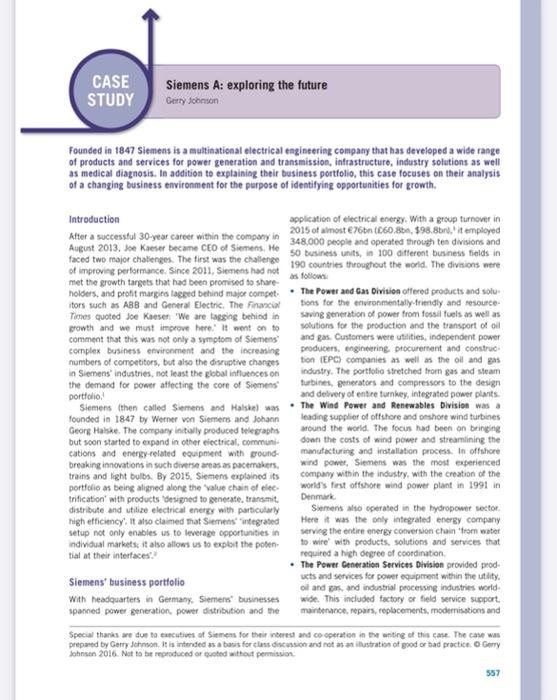
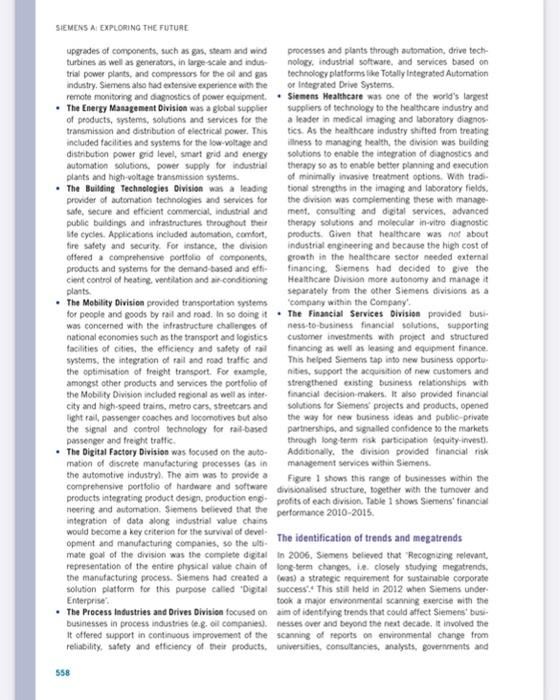
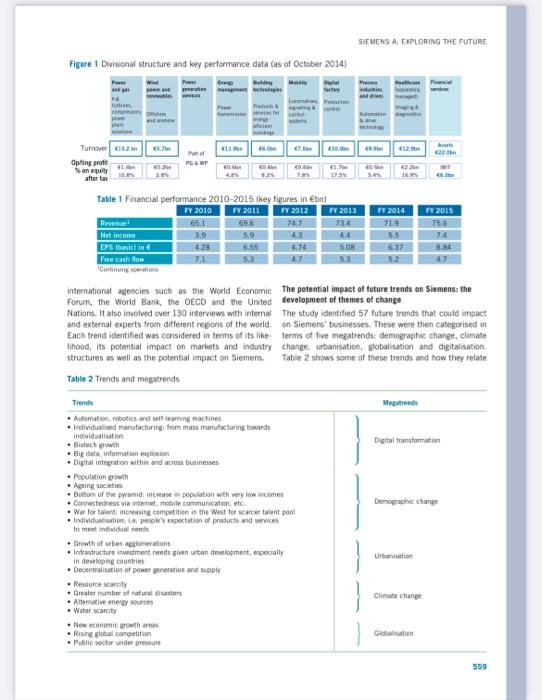
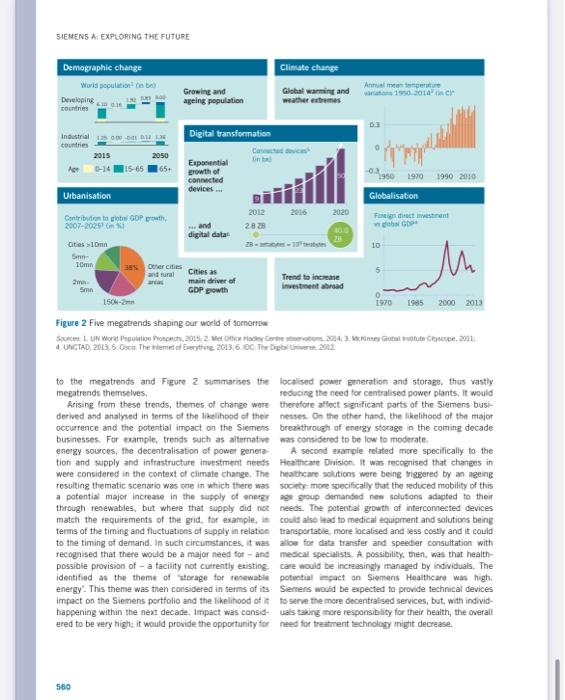
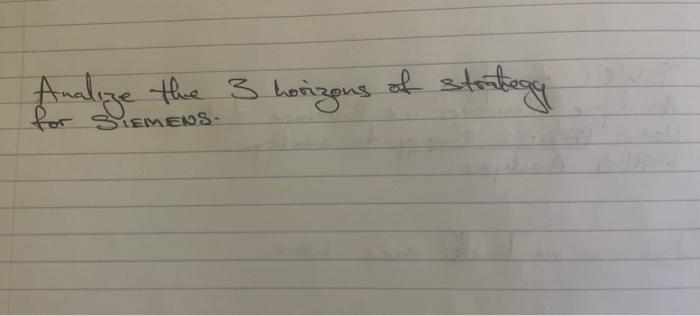
CASE STUDY Siemens A: exploring the future Gerry Johnson Founded in 1847 Siemens is a multinational electrical engineering company that has developed a wide range of products and services for power generation and transmission, infrastructure, industry solutions as well as medical diagnosis. In addition to explaining their business portfolio, this case focuses on their analysis of a changing business environment for the purpose of identifying opportunities for growth. Introduction application of electrical energy, with a group turnover in After a successful 30-year career within the company in 2015 of almost 76 (C60.80 $98.8br.it employed August 2013. Joe Kaeser became CEO of Siemens. He 348,000 people and operated through ten divisions and faced two major challenges. The first was the challenge 50 business units, in 100 different business fields in of improving performance. Since 2011, Siemens had not 190 countries throughout the world. The divisions were as follows met the growth targets that had been promised to share holders, and profit margins tagged behind major compet .. The Power and Gas Division offered products and solu itors such as ABB and General Electric. The Financial tions for the environmentally friendly and resource Times quoted Joe Kaeser 'We are tagging behind in saving generation of power from fossil fuels as well as growth and we must improve here. It went on to solutions for the production and the transport of oil comment that this was not only a symptom of Siemens and gas. Customers were utilities, independent power complex business environment and the increasing producers, engineering procurement and construc numbers of competitors, but also the disruptive changes tion (EPC) companies as well as the oil and gas in Siemens'industries, not least the global influences on industry. The portfolio stretched from gas and steam the demand for power affecting the core of Siemens turbines, generators and compressors to the design portfolio and delivery of entire turnkey, integrated power plants. Siemens (then called Siemens and Halske) was The Wind Power and Renewables Division was a founded in 1847 by Werner von Siemens and Johann leading supplier of offshore and onshore wind turbines Georg Halske. The company initially produced telegraphs around the world. The focus had been on bringing but soon started to expand in other electrical communi. down the costs of wind power and streamining the cations and energy-related equipment with ground- manufacturing and installation process. In offshore breaking innovations in such diverse areas as pacemakers, wind power, Siemens was the most experienced trains and light bulbs. By 2015. Siemens explained its company within the industry, with the creation of the portfolio as being aligned along the value chain of elec world's first offshore wind power plant in 1991 in trification with products designed to generate transmit Denmark distribute and utilize electrical energy with particularly Siemens also operated in the hydropower sector high efficiency. It also claimed that Siemens integrated Here it was the only integrated energy company setup not only enables us to leverage opportunities in serving the entire energy conversion chain from water individual markets it also allows us to exploit the poten to wire with products. solutions and services that tial at their interfaces required a high degree of coordination The Power Generation Services Division provided prod. Siemens' business portfolio uts and services for power equipment within the utility oil and gas and industrial processing industries world with headquarters in Germany, Siemens' businesses wide. This included factory of field service support spanned power generation power distribution and the maintenance, repairs, replacements, modernisations and Special thanks are due to creatives of Siemens for their interest and cooperation in the unting of this case. The case was prepared by Gerry Johnson. It is intended as a basis for class discussion and not alustration of good or bad practice Gerry Johnsen 2016. Not to be reproduced or usted without permission 557 SIEMENS A EXPLORING THE FUTURE upgrades of components, such as gas, steam and wind processes and plants through automation, drive tech turbines as well as generators, in targe-scale and indus nology industrial software, and services based on trial power plants, and compressors for the ol and gas technology platforms like Totally integrated Automation industry, Siemens also had extensive experience with the or integrated Drive Systems remote monitoring and diagnostics of power equipment Siemens Healthcare was one of the world's largest The Energy Management Division was a global supplier suppliers of technology to the healthcare industry and of products, systems, solutions and services for the a leader in medical imaging and laboratory diagnos transmission and distribution of electrical power. This ties. As the healthcare industry shifted from treating included facilities and systems for the low voltage and ness to managing health, the division was building distribution power grid level, smart grid and energy solutions to enable the integration of diagnostics and automation solutions, power supply for industrial therapy so as to enable better planning and execution plants and high-voltage transmission systems. of minimally invasive treatment options. With trade The Building Technologies Division was a leading tional strengths in the imaging and laboratory fields provider of automation technologies and services for the division was complementing these with manage safe, secure and efficient commercial industrial and ment consulting and digital services, advanced public buildings and infrastructures throughout their therapy solutions and molecular in-vitro diagnostic life cycles. Applications included automation, comfort, products. Given that healthcare was not about fire safety and security. For instance, the division industrial engineering and because the high cost of offered a comprehensive portfolio of components growth in the healthcare sector needed external products and systems for the dersand-based and etfi financing, Siemens had decided to give the cient control of heating, ventilation and air-conditioning Healthcare Division more autonomy and manage it plants separately from the other Siemens divisions as a The Mobility Division provided transportation systems company within the Company for people and goods by rail and road. In so doing it . The Financial Services Division provided bus was concerned with the infrastructure challenges of ness-to-business financial solutions, supporting national economies such as the transport and logistics Customer investments with project and structured facilities of cities, the efficiency and safety of financing as well as leasing and equipment finance. systems, the integration of rail and road traffic and This helped Siemens tap into new business opportu the optimisation of freight transport. For example, nities, sopport the acquisition of new customers and amongst other products and services the portfolio of strengthened existing business relationships with the Mobility Division included regional as well as inter financial decision makers. It also provided financial city and high-speed trains, metro cars, streetcars and solutions for Siemens projects and products, opened light rail, passenger coaches and locomotives but also the way for new business ideas and public-private the signal and control technology for rail-based partnerships, and signalled confidence to the markets passenger and freight traffic through long term risk participation equity invest The Digital Factory Division was focused on the auto Additionally, the division provided financial risk mation of discrete manufacturing processes as in management services within Siemens the automotive industry. The aim was to provide a comprehensive portfolio of hardware and software divisionalised structure, together with the turnover and Figure 1 shows this range of businesses within the products integrating product design, production en profits of each division Table 1 shows Siemens financial neering and automation Siemens believed that the performance 2010-2015 integration of data along industrial value chains would become a key criterion for the survival of devel opment and manufacturing companies, so the ul. The identification of trends and megatrends mate goal of the division was the complete digital in 2006, Siemens believed that "Recognizing relevant representation of the entire physical value chain of long-term changes. e. closely studying megatrends, the manufacturing process. Siemens had created as a strategic requirement for sustainable corporate solution platform for this purpose called 'Digital success. This still held in 2012 when Siemens under Enterprise took a major environmental scanning exercise with the The Process Industries and Drives Division focused on aim of identifying trends that could affect Siemens' busi businesses in process industries teg oil companies). nesses over and beyond the next decade. It involved the It offered support in continuous improvement of the scanning of reports on environmental change from reliability, safety and efficiency of their products, universities, consultancies, analysts, governments and 558 SIEMENS A EXPLORING THE FUTURE Figure 1 Divisional structure and key performance data (as of October 2014) Www Detal saina Merwe ww Turnov Opting prote Sony after tan PG . 10. ar CM 3. Table 1 Financial performance 2010-2015 key figures in Ebn) FY 2010 FY 2011 FY 2012 FY 2013 FY 2014 FY 2015 Revenge 65.1 747 734 71.9 Net income 3.0 59 43 44 5.5 7.4 EPS basic in 4.28 6.55 4.74 5.08 854 The cash flow 7.1 1.3 47 53 4.7 Continuing the international agencies such as the World Economic The potential impact of future trends on Siemens: the Forum, the World Bank, the OECD and the United development of themes of change Nations. It also involved over 130 interviews with internat The study identified 57 future trends that could impact and external experts from different regions of the world on Siemens' businesses. These were then categorised in Each trend identified was considered in terms of its like terms of five megatrends: demographic change, climate lihood, its potential impact on markets and industry change urbanisation, globalisation and digitalisation structures as well as the potential impact on Siemens Table 2 shows some of these trends and how they relate Table 2 Trends and megatrends Megatrends Digital transformation Demographic changes Tiends Amation robotics and will leaming machines Individuained manufacturing from man manufacturing towards individualisation Bistech growth Big data non explosion Digital integration within and across businesses Population growth Ageing societies Bit of the pyramid increase in population with very low incomes Connectedness via internet, mobile communication, etc. War for talent increasing competition in the West for scarcer talent pool Individuation.. hole expectation of products and services to meet individual de Growth of what wont Intrastructure investment needs given utan development, especially in developing countries . Decentralisation of power generation and supply Resource scarcity Greater number of naturalis Alternative energy sources Water scarcity New econnic growth areas Rising global competition Public sector under pressure Uration Climate change Global 559 SIEMENS A: EXPLORING THE FUTURE Demographic change Word in die Climate change Global warming and Anime 103014 Growing and ageing population Devin countries 1950 2016 Industrial Digital transformation countries 2015 2050 Coduce Esponential for 0-14 115-65 165 prowth of -03 connected 1970 1990 2010 devices.. Urbanisation Globalisation Contribution to GOP, 2012 2020 Finant 2007-2021 wand 2828 bal digital data Cities som 10 S 10min 5 atural ma main driver of Sm GDP powth Investment abroad 150- 1995 2000 2013 Figure 2 Five megatrends shaping our world of tomorrow Somont 1. UN World Pegni Propech.2015:2 Met Office Centre 243. Goti rett Cocope 2011 4. UNCTAD, 2013 6. Oso The emel of erythir 2013.6.0. The Demo 2012 BS Outer Cities M 1970 to the megatrends and Figure 2 summarises the localised power generation and storage, thus vastly megatrends themselves, reducing the need for centralised power plants, it would Arising from these trends, themes of change were therefore afect significant parts of the Siemens busi- derived and analysed in terms of the likelihood of their nesses. On the other hand, the likelihood of the major occurrence and the potential impact on the Siemens breakthrough of energy storage in the coming decade businesses. For example, trends such as alternative was considered to be low to moderate energy sources, the decentralisation of power genera A second example related more specifically to the tion and supply and infrastructure investment needs Healthcare Division. It was recognised that changes in were considered in the context of climate change. The healthcare solutions were being triggered by an ageing resulting thematic scenario was one in which there was Society more specifically that the reduced mobility of this a potential major increase in the supply of energy age group demanded new solutions adapted to their through renewables, but where that supply did not needs. The potential growth of interconnected devices match the requirements of the grid, for example, it could also lead to medical equipment and solutions being terms of the timing and fluctuations of supply in relation transportabile, more localised and less costly and it could to the timing of demand. In such circumstances, it was all for data transfer and speedier consultation with recognised that there would be a major need for and medical specialists. A possibility, then, was that health possible provision of -a facility not currently existing care would be increasingly managed by individuals. The identified as the theme of storage for renewable potential impact on Siemens Healthcare was high energy. This theme was then considered in terms of its Siemens would be expected to provide technical devices impact on the Siemens portfolio and the likelihood of sto serve the more decentralised services, but with individ- happening within the next decade. Impact was considuals taking more responsibility for their health, the overall ered to be very high: it would provide the opportunity for need for treatment technology might decrease. 560 SIEMENS A DIPLORING THE FUTURE The potential impact of megatrends on Siemens: the case of digital transformation One of the megatrends identified was that of digitalisa tion. Siegtried Russwurm, the Chief Technology Office of Siemens explained its impact Digitalization is) a field that is taking command of virtually every aspect of our daily lives. From connected devices in our private lives to increasingly connected complex systems in the industrial space - we all five in a more and more digitalized world. At Siemens, we are at the forefront of digitalization in our industries. We are leveraging digitalization to combine the physical and the virtual world. The physical world is represented by our huge installed base around the globe-ranging from gas and wind turbines to our trains and our medical imaging equipment. ... We have become a leader in the electrification and automation of power plants and grids, transportation, buildings and produc tion systems For many years now, another dimension has been added to this ... the virtual world... for example... In inte grating product design, production engineering and automaties - including sophisticated simulation and verification capabilities... At present, more than 280,000 devices in our installed worldwide base are connected via a secure communi cation platform through the Internet. They generate huge amounts of condition and performance data, and we apply our... know how to generate specific insights from this data. Ultimately, we use these insights to improve the resilience of electricity prids. optimize energy efficiency in buildings, help surgeons conduct image-guided therapies - or a thousand other things that keep our modern world running So digitalisation is about leveraging digital technologies like data analytics and cloud computing along our entire portfolio to create business opportuni ties in three ways: First... it enhances our electrification and automa tion business.... In Riyadh, for example, we just won a 1.6 billion euro order for a driverless metro system. The trains will employ a large set of sensors, IP communication and advanced automa tion software...(to)... improve throughout by up to 50 per cent and at the same time deliver 15 per cent energy savings.... In India, ... we won two projects to build smart distribution grids across 19 Indian cities. Several thousand smart units now collect sensor data from distribution substations and relay this data to central distribution control centers. There in turn integrate range of IT systems to ensure fast fault elimination and improve grid availability and resilience....The benefits are much more stable grid operations and at the same time up to 50 per cent reduction in losses. . Second... Service is a strong lever for profit and growth at Siemens, and we have a unique advan tage: the ability to leverage all the data from those 280.000 connected devices worldwide to expand our digital service offers. The 99.9 percent on-time track record for Velare trains in Spain or the 5.5 million euros in energy savings for a hotel group are just two examples of how our analytics-driven oper ations and maintenance improve our services, while saving money for our customers . A significant percentage of our gas turbine customers have long-term contracts We remotely monitor their machines and collect opera- tions data. We now combine this data with our know-how of the underlying physics to build very accurate deterministic models that predict equip. ment and component wear and tear under different operating conditions. For example, we can predict the condition and service need of a turbine blade for a particular turbine operating 20.000 hours at peak load vs. one operating in volatile load cycles.... . Using our analytics-based models, we can also optimize our spare parts ventory and our service technicians scheduling by predicting replacement needs. In addition additive manufacturing helps us to provide selected spare parts with unprecedented speed Third ... is our ability to optimally leverage our leading integrated portfolio of vertical software... For example, one of our customers, a leading global machine tool vendor, offers its customers in addition to a real machine a virtual machine - a fully fune tional digital twin. Together we have developed a software solution that allows its customers to simulate and optimize the production of highly complex parts using actual machine data prior to production. This highly precise simulation reflects the real time behaviour of the machine with a devia tion of less than 1 per cent and saves customers up to 80 per cent of set up time without keeping the real machine sway from productive work. This in turn translates into shorter time-to-market and tower costs. 561 SIEMENS A EXPLORING THE FUTURE The result of the environmental scanning confirmed Notes and teles that major changes were likely to happen globally. For 1. Bryant Sebasties to come il sostenes Funcis, 6 November 2014 CEO Joe Kaeser that meant that the next decade would Won Simons sal verw, 2014 Siemens.com provide major opportunities to further develop the 3-08-1.3. company. St, important questions remained. Were The Siemens Megatrend Report, October 2006, Siemens.com these indeed the trends that Siemens' strategy needed to These are extracts from Distalisation Strategy, a presentation made on 9 December 2014 in art by Professor Dr Stied uswurm, be built on and what were the implications for Siemens Chief Technology Omer and a member of the Managed and its businesses? Siemens AG 562 Analize the 3 horizons 3 of strategy









 Study Help