Question: Case Study: Sneaker 2013 Background: It was 6:35 PM on Friday as Michelle held her head in her hands and sought to regain focus. Her
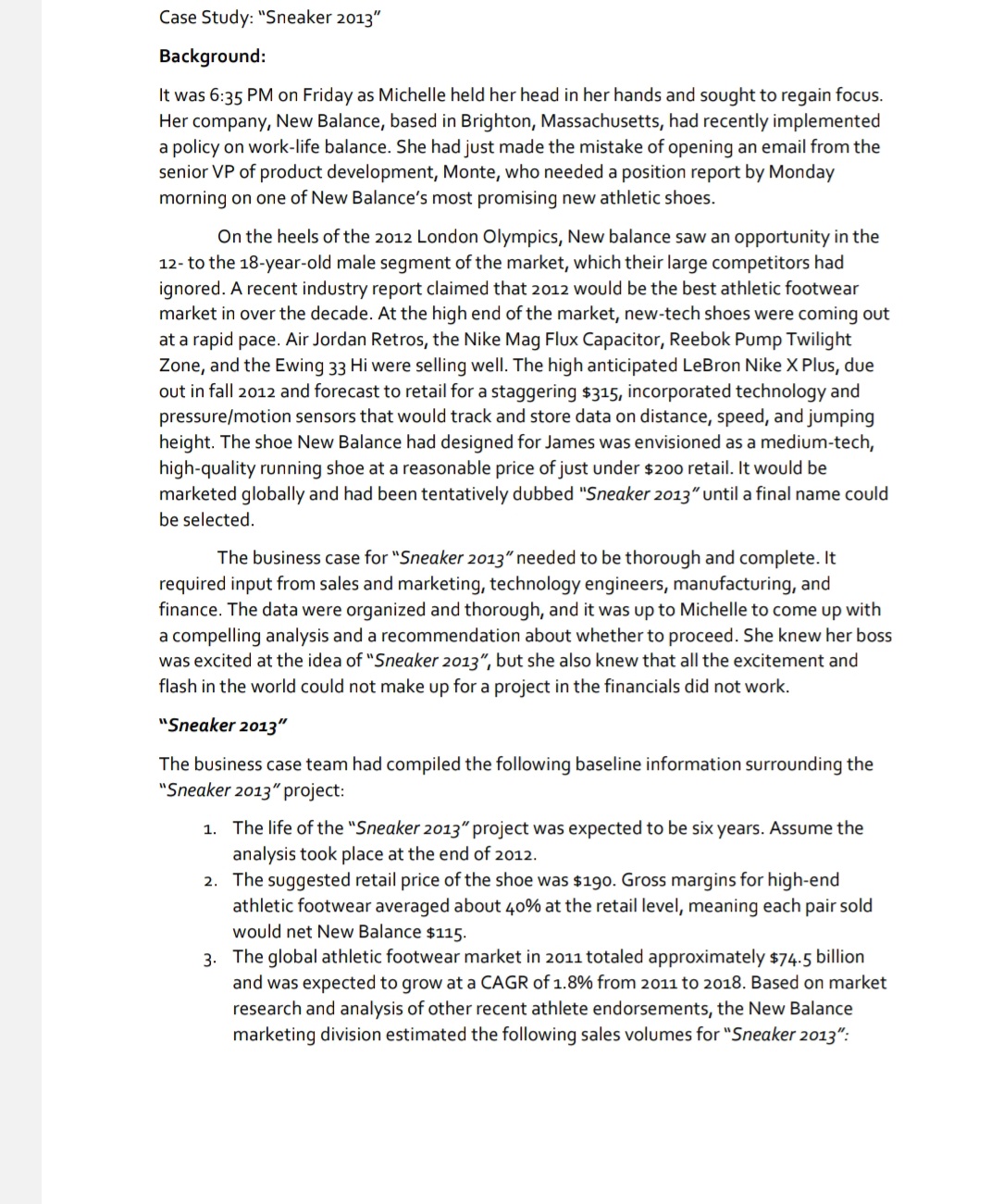
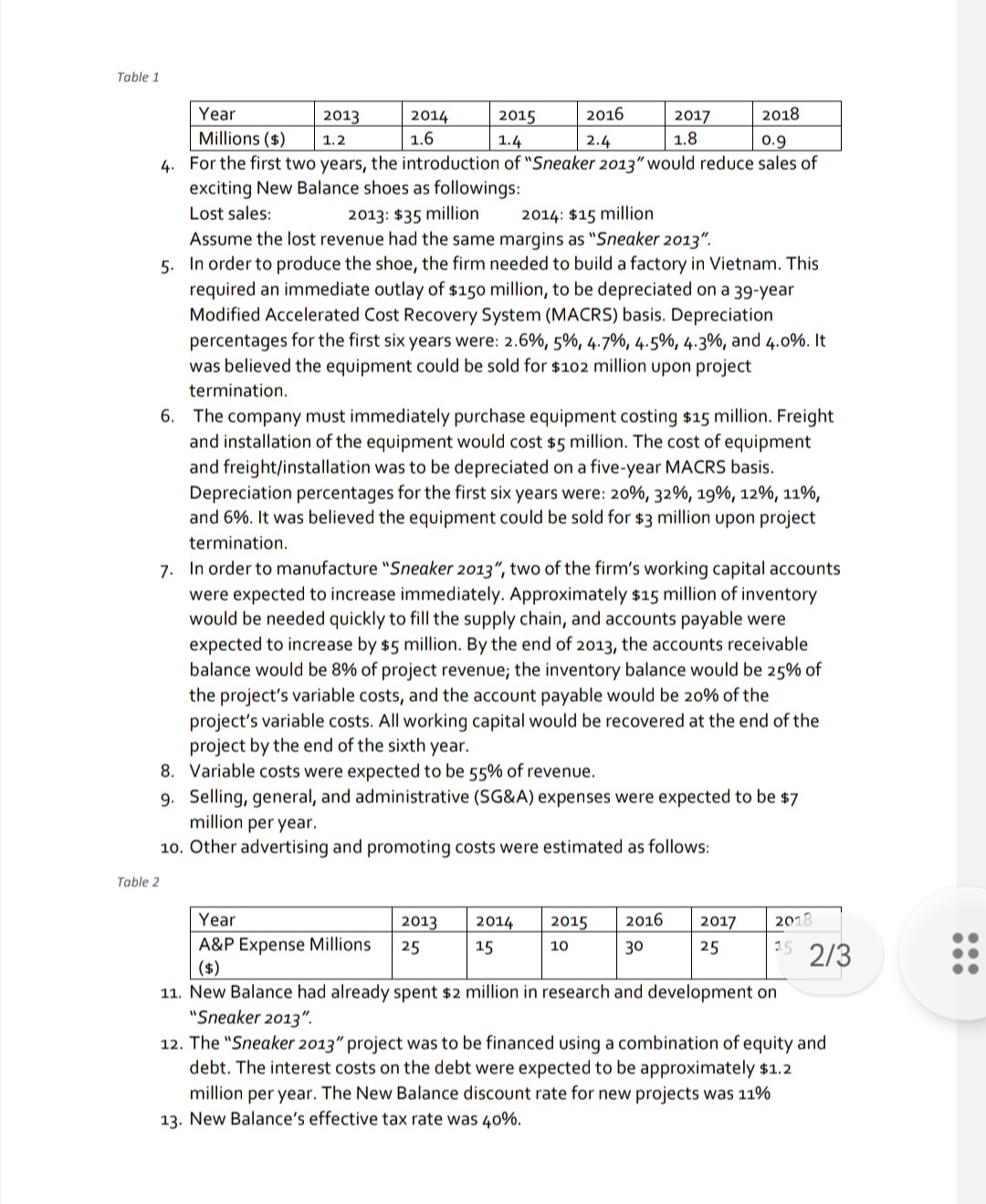
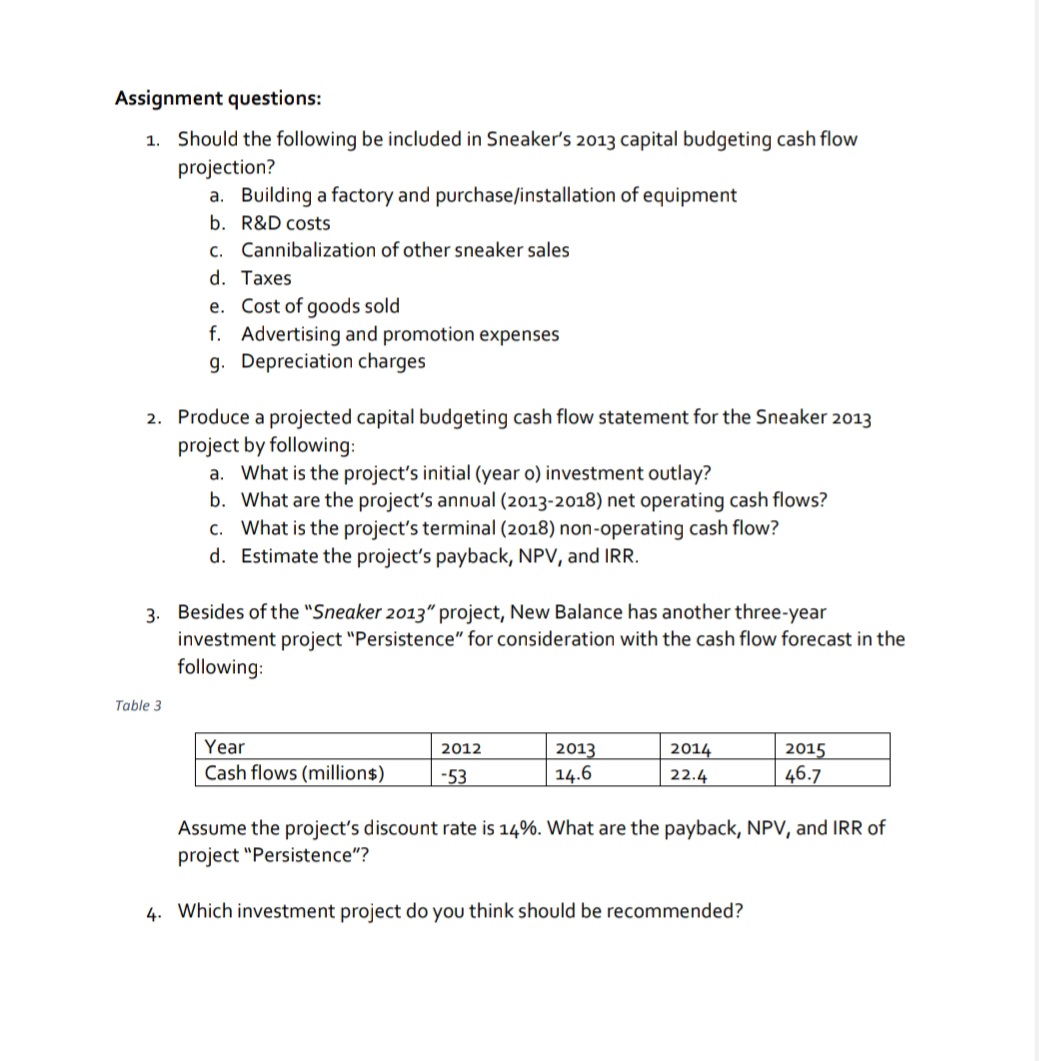
Case Study: \"Sneaker 2013" Background: It was 6:35 PM on Friday as Michelle held her head in her hands and sought to regain focus. Her company, New Balance, based in Brighton, Massachusetts, had recently implemented a policy on work-life balance. She hadjust made the mistake of opening an email from the senior VP of product development, Monte, who needed a position report by Monday morning on one of New Balance's most promising new athletic shoes. On the heels ofthe 2012 London Olympics, New balance saw an opportunity in the 12- t0 the 18-year-old male segment ofthe market, which their large competitors had ignored. A recent industry report claimed that 2012 would be the best athletic footwear market in over the decade. At the high end ofthe market, new-tech shoes were coming out at a rapid pace. Air Jordan Retros, the Nike Mag Flux Capacitor, Reebok Pump Twilight Zone, and the Ewing 33 Hi were selling well. The high anticipated LeBron Nike X Plus, due out in fall 2012 and forecast to retail for a staggering $315, incorporated technology and pressu refmotion sensors that would track and store data on distance, speed, and jumping height. The shoe New Balance had designed forJames was envisioned as a medium-tech, high-quality running shoe at a reasonable price ofjust under 5200 retail. It would be marketed globally and had been tentatively dubbed \"Sneaker 2013\" until a final name could be selected. The business case for \"Sneaker 2013\" needed to be thorough and complete- It required input from sales and marketing, technology engineers, manufacturing, and finance. The data were organized and thorough, and it was up to Michelle to come up with a compelling analysis and a recommendation about whetherto proceed. She knew her boss was excited at the idea of \"Sneaker 2013", but she also knew that all the excitement and flash in the world could not make up for a project in the nancials did not work. \"Sneaker 2013\" The business case team had compiled the following baseline information surrounding the \"Sneaker 2013\" project: 1. The life of the \"Sneaker 2013\" project was expected to be six years. Assume the analysis took place at the end of 2012. 2. The suggested retail price of the shoe was 5190. Gross margins for high-end athletic footwear averaged about 1.0% at the retail level, meaning each pair sold would net New Balance $115. 3. The global athletic Footwear market in 2011 totaled approximately $74.5 billion and was expected to grow at a CAGR of 1.8% from 2011 to 2018. Based on market research and analysis of other recent athlete endorsements, the New Balance marketing division estimated the following sales volumes for \"Sneaker 2013'": Table 1 Year 2013 2014 2015 2016 2017 2018 Millions ($) 1.2 1.6 1.4 2.4 1.8 0.9 4. For the first two years, the introduction of "Sneaker 2013" would reduce sales of exciting New Balance shoes as followings: Lost sales: 2013: $35 million 2014: $15 million Assume the lost revenue had the same margins as "Sneaker 2013". 5. In order to produce the shoe, the firm needed to build a factory in Vietnam. This required an immediate outlay of $150 million, to be depreciated on a 39-year Modified Accelerated Cost Recovery System (MACRS) basis. Depreciation percentages for the first six years were: 2.6%, 5%, 4.7%, 4.5%, 4.3%, and 4.0%. It was believed the equipment could be sold for $102 million upon project termination 6. The company must immediately purchase equipment costing $15 million. Freight and installation of the equipment would cost $5 million. The cost of equipment and freight/installation was to be depreciated on a five-year MACRS basis. Depreciation percentages for the first six years were: 20%, 32%, 19%, 12%, 11%, and 6%. It was believed the equipment could be sold for $3 million upon project termination. 7. In order to manufacture "Sneaker 2013", two of the firm's working capital accounts were expected to increase immediately. Approximately $15 million of inventory would be needed quickly to fill the supply chain, and accounts payable were expected to increase by $5 million. By the end of 2013, the accounts receivable balance would be 8% of project revenue; the inventory balance would be 25% of the project's variable costs, and the account payable would be 20% of the project's variable costs. All working capital would be recovered at the end of the project by the end of the sixth year. 8. Variable costs were expected to be 55% of revenue. 9. Selling, general, and administrative (SG&A) expenses were expected to be $7 million per year. 10. Other advertising and promoting costs were estimated as follows: Table 2 Year 2013 2014 2015 2016 2017 2018 A&P Expense Millions 25 15 10 30 25 ($ ) 25 2/3 11. New Balance had already spent $2 million in research and development on "Sneaker 2013". 12. The "Sneaker 2013" project was to be financed using a combination of equity and debt. The interest costs on the debt were expected to be approximately $1.2 million per year. The New Balance discount rate for new projects was 11% 13. New Balance's effective tax rate was 40%.Assignment questions: 1. Should the following be included in Sneaker's 2013 capital budgeting cash flow projection? a. Building a factory and purchase/installation of equipment b. R&D costs c. Cannibalization of other sneaker sales d. Taxes e. Cost of goods sold f. Advertising and promotion expenses g. Depreciation charges 2. Produce a projected capital budgeting cash flow statement for the Sneaker 2013 project by following: a. What is the project's initial (year o) investment outlay? b. What are the project's annual (2013-2018) net operating cash flows? c. What is the project's terminal (2018) non-operating cash flow? d. Estimate the project's payback, NPV, and IRR. 3. Besides of the "Sneaker 2013" project, New Balance has another three-year investment project "Persistence" for consideration with the cash flow forecast in the following: Table 3 Year 2012 2013 2014 2015 Cash flows (millions) -53 14.6 22.4 46.7 Assume the project's discount rate is 14%. What are the payback, NPV, and IRR of project "Persistence"? Which investment project do you think should be recommended
Step by Step Solution
There are 3 Steps involved in it
1 Expert Approved Answer
Step: 1 Unlock
Question Has Been Solved by an Expert!
Get step-by-step solutions from verified subject matter experts
Step: 2 Unlock
Step: 3 Unlock
Students Have Also Explored These Related Finance Questions!









 Study Help