







Question: Case Study $$ The Jackson's Mortgage $$ Case Description Paul and Leslie Jackson are buying a new house. They have saved for several years to

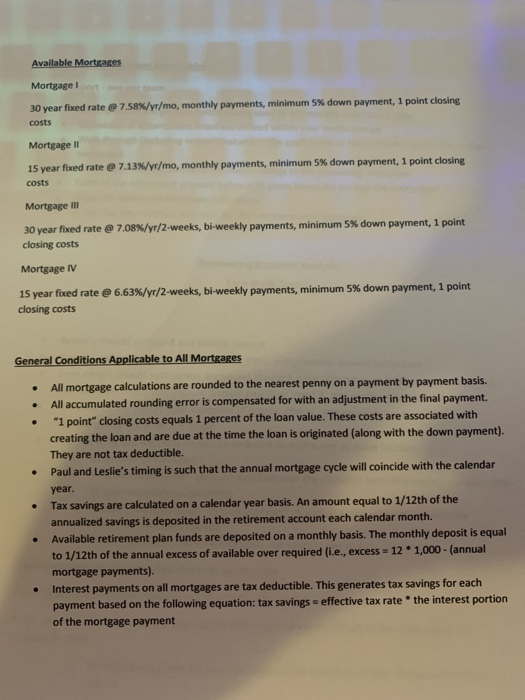
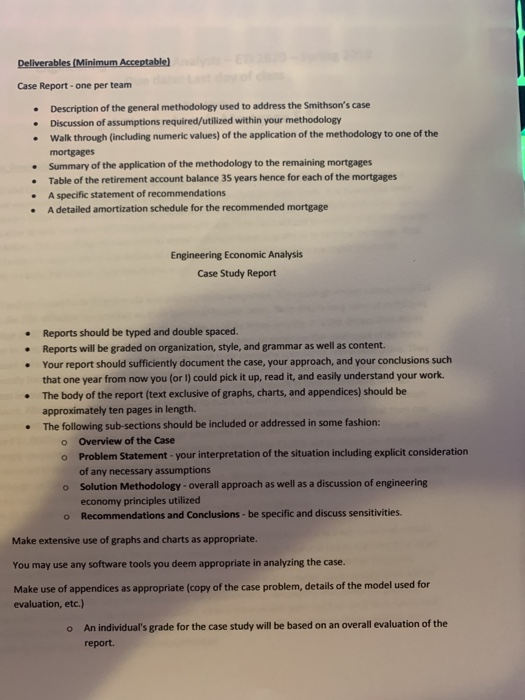
Case Study $$ The Jackson's Mortgage $$ Case Description Paul and Leslie Jackson are buying a new house. They have saved for several years to accumulate a down payment and have now found a house that is just perfect for their needs. It is a beautiful three bedroom Tudor house in a quiet neighborhood in the suburbs. With the help of their real estate agent and after several rounds of offering and counter-offering, they have agreed on a price of $103,000 with the sellers. The only thing that remains to make their new home a reality is to select a mortgage. Paul and Leslie are unsure about the details of making this type of decision and have come to you for guidance because of your expertise in this area. Paul and Leslie are both 30 years old and professionally employed. They earn generous salaries and fall into the 28% effective tax bracket on their personal income taxes. They dream long term of retiring at the age of 65 so they can travel the country to take in all its scenic beauty. It is this dream that drives them to determine a mortgage arrangement that allows them to generate the maximum retirement account balance that they can create to supplement their company sponsored retirement plans. They currently have accumulated $10,000 to use for the down payment and closing costs on their house. Any excess amount not used in this way could be used as an initial deposit in their retirement savings account. Alternatively, any excess could be used to make a down payment in excess of the minimunm requirement. After studying their budget and spending patterns they have determined that they can afford $1,000/month to cover both mortgage payments and personal retirement savings. They are strongly committed to their retirement travel plans, so any of the $1,000 not spent on the mortgage will be invested in the retirement savings account. In addition, any tax savings generated through the mortgage will be deposited in the retirement account. Although they anticipate salary increases over the years until they retire, the impact of inflation and changes in lifestyle will offset these to the extent that the $1,000 per month can be considered constant over the next 35 years. They have selected a retirement savings vehicle which involves investment in a tax sheltered mutual fund which pays an average of 9% per year compounded monthly. Paul and Leslie, with the help of an investment banker, have studied the history of this fund and are comfortable that the 9%/yr/mo average return over their 35 year retirement savings horizon is reasonable. Undoubtedly their will be ups and downs but the long term average of 9% appears to be reasonable and stable for planning purposes. Since this is a tax sheltered account, all investments will grow tax free until their retirement. Paul and Leslie have identified four potential mortgage options. They will make their selection from among these four based on your recommendation. Mortgage I down payment, i point closing 30 year fixed rate @ 7.58%)yr/mo, monthly payments, minimum 5% costs Mortgage II 15 year fixed rate @ 7.13%/w/mo, monthly payments, minimum 5% down payment, 1 point closing costs Mortgage IIl 30 year fixed rate @ 7.08%)yr /2-weeks, bi-weekly payments, minimum 5% down payment, 1 point closing costs Mortgage IV 15 year fixed rate @ 6.63%) yr/2-weeks, bi-weekly payments, minimum 5% down payment. 1 point closing costs General Conditions Applicable to All Mortgages All mortgage calculations are rounded to the nearest penny on a payment by payment basis. All accumulated rounding error is compensated for with an adjustment in the final payment. . "1 point" closing costs equals 1 percent of the loan value. These costs are associated with creating the loan and are due at the time the loan is originated (along with the down payment). They are not tax deductible. Paul and Leslie's timing is such that the annual mortgage cycle will coincide with the calendar year. . Tax savings are calculated on a calendar year basis. An amount equal to 1/12th of the annualized savings is deposited in the retirement account each calendar month. Available retirement plan funds are deposited on a monthly basis. The monthly deposit is equal to 1/12th of the annual excess of available over required (i.e, excess 12 1,000-(annual mortgage payments). Interest payments on all mortgages are tax deductible. This generates tax savings for each payment based on the following equation: tax savings effective tax rate the interest portion of the mortgage payment Case Report- one per team .Description of the general methodology used to address the Smithson's case .Discussion of assumptions required/utilized within your methodology Walk through (including numeric values) of the application of the methodology to one of the mortgages . Summary of the application of the methodology to the remaining mortgages . Table of the retirement account balance 35 years hence for each of the mortgages .A specific statement of recommendations A detailed amortization schedule for the recommended mortgage Engineering Economic Analysis Case Study Report Reports should be typed and double spaced Reports will be graded on organization, style, and grammar as well as content. . . .Your report should sufficiently document the case, your approach, and your conclusions such that one year from now you (or 1) could pick it up, read it, and easily understand your work. The body of the report (text exclusive of graphs, charts, and appendices) should be approximately ten pages in length. . The following sub-sections should be included or addressed in some fashion: Overview of the Case Problem Statement -your interpretation of the situation including explicit consideration of any necessary assumptions Solution Methodology-overall approach as well as a discussion of engineering economy principles utilized Recommendations and Conclusions- be specific and discuss sensitivities. o o o o Make extensive use of graphs and charts as appropriate You may use any software tools you deem appropriate in analyzing the case. Make use of appendices as appropriate (copy of the case problem, details of the model used for evaluation, etc.) An individual's grade for the case study will be based on an overall evaluation of the report. o Case Study $$ The Jackson's Mortgage $$ Case Description Paul and Leslie Jackson are buying a new house. They have saved for several years to accumulate a down payment and have now found a house that is just perfect for their needs. It is a beautiful three bedroom Tudor house in a quiet neighborhood in the suburbs. With the help of their real estate agent and after several rounds of offering and counter-offering, they have agreed on a price of $103,000 with the sellers. The only thing that remains to make their new home a reality is to select a mortgage. Paul and Leslie are unsure about the details of making this type of decision and have come to you for guidance because of your expertise in this area. Paul and Leslie are both 30 years old and professionally employed. They earn generous salaries and fall into the 28% effective tax bracket on their personal income taxes. They dream long term of retiring at the age of 65 so they can travel the country to take in all its scenic beauty. It is this dream that drives them to determine a mortgage arrangement that allows them to generate the maximum retirement account balance that they can create to supplement their company sponsored retirement plans. They currently have accumulated $10,000 to use for the down payment and closing costs on their house. Any excess amount not used in this way could be used as an initial deposit in their retirement savings account. Alternatively, any excess could be used to make a down payment in excess of the minimunm requirement. After studying their budget and spending patterns they have determined that they can afford $1,000/month to cover both mortgage payments and personal retirement savings. They are strongly committed to their retirement travel plans, so any of the $1,000 not spent on the mortgage will be invested in the retirement savings account. In addition, any tax savings generated through the mortgage will be deposited in the retirement account. Although they anticipate salary increases over the years until they retire, the impact of inflation and changes in lifestyle will offset these to the extent that the $1,000 per month can be considered constant over the next 35 years. They have selected a retirement savings vehicle which involves investment in a tax sheltered mutual fund which pays an average of 9% per year compounded monthly. Paul and Leslie, with the help of an investment banker, have studied the history of this fund and are comfortable that the 9%/yr/mo average return over their 35 year retirement savings horizon is reasonable. Undoubtedly their will be ups and downs but the long term average of 9% appears to be reasonable and stable for planning purposes. Since this is a tax sheltered account, all investments will grow tax free until their retirement. Paul and Leslie have identified four potential mortgage options. They will make their selection from among these four based on your recommendation. Mortgage I down payment, i point closing 30 year fixed rate @ 7.58%)yr/mo, monthly payments, minimum 5% costs Mortgage II 15 year fixed rate @ 7.13%/w/mo, monthly payments, minimum 5% down payment, 1 point closing costs Mortgage IIl 30 year fixed rate @ 7.08%)yr /2-weeks, bi-weekly payments, minimum 5% down payment, 1 point closing costs Mortgage IV 15 year fixed rate @ 6.63%) yr/2-weeks, bi-weekly payments, minimum 5% down payment. 1 point closing costs General Conditions Applicable to All Mortgages All mortgage calculations are rounded to the nearest penny on a payment by payment basis. All accumulated rounding error is compensated for with an adjustment in the final payment. . "1 point" closing costs equals 1 percent of the loan value. These costs are associated with creating the loan and are due at the time the loan is originated (along with the down payment). They are not tax deductible. Paul and Leslie's timing is such that the annual mortgage cycle will coincide with the calendar year. . Tax savings are calculated on a calendar year basis. An amount equal to 1/12th of the annualized savings is deposited in the retirement account each calendar month. Available retirement plan funds are deposited on a monthly basis. The monthly deposit is equal to 1/12th of the annual excess of available over required (i.e, excess 12 1,000-(annual mortgage payments). Interest payments on all mortgages are tax deductible. This generates tax savings for each payment based on the following equation: tax savings effective tax rate the interest portion of the mortgage payment Case Report- one per team .Description of the general methodology used to address the Smithson's case .Discussion of assumptions required/utilized within your methodology Walk through (including numeric values) of the application of the methodology to one of the mortgages . Summary of the application of the methodology to the remaining mortgages . Table of the retirement account balance 35 years hence for each of the mortgages .A specific statement of recommendations A detailed amortization schedule for the recommended mortgage Engineering Economic Analysis Case Study Report Reports should be typed and double spaced Reports will be graded on organization, style, and grammar as well as content. . . .Your report should sufficiently document the case, your approach, and your conclusions such that one year from now you (or 1) could pick it up, read it, and easily understand your work. The body of the report (text exclusive of graphs, charts, and appendices) should be approximately ten pages in length. . The following sub-sections should be included or addressed in some fashion: Overview of the Case Problem Statement -your interpretation of the situation including explicit consideration of any necessary assumptions Solution Methodology-overall approach as well as a discussion of engineering economy principles utilized Recommendations and Conclusions- be specific and discuss sensitivities. o o o o Make extensive use of graphs and charts as appropriate You may use any software tools you deem appropriate in analyzing the case. Make use of appendices as appropriate (copy of the case problem, details of the model used for evaluation, etc.) An individual's grade for the case study will be based on an overall evaluation of the report. o
Step by Step Solution
There are 3 Steps involved in it

Get step-by-step solutions from verified subject matter experts
 Study Help